Nederlands
Hopping Hopcopter robot gets a flexible foot for sand, ice and rocks
Researchers at the University of Toronto gave the hopping drone Hopcopter a flexible foot pad. It now lands and jumps much better on sand, ice and rocks, where the one-legged robot used to sink, slip or fall over.
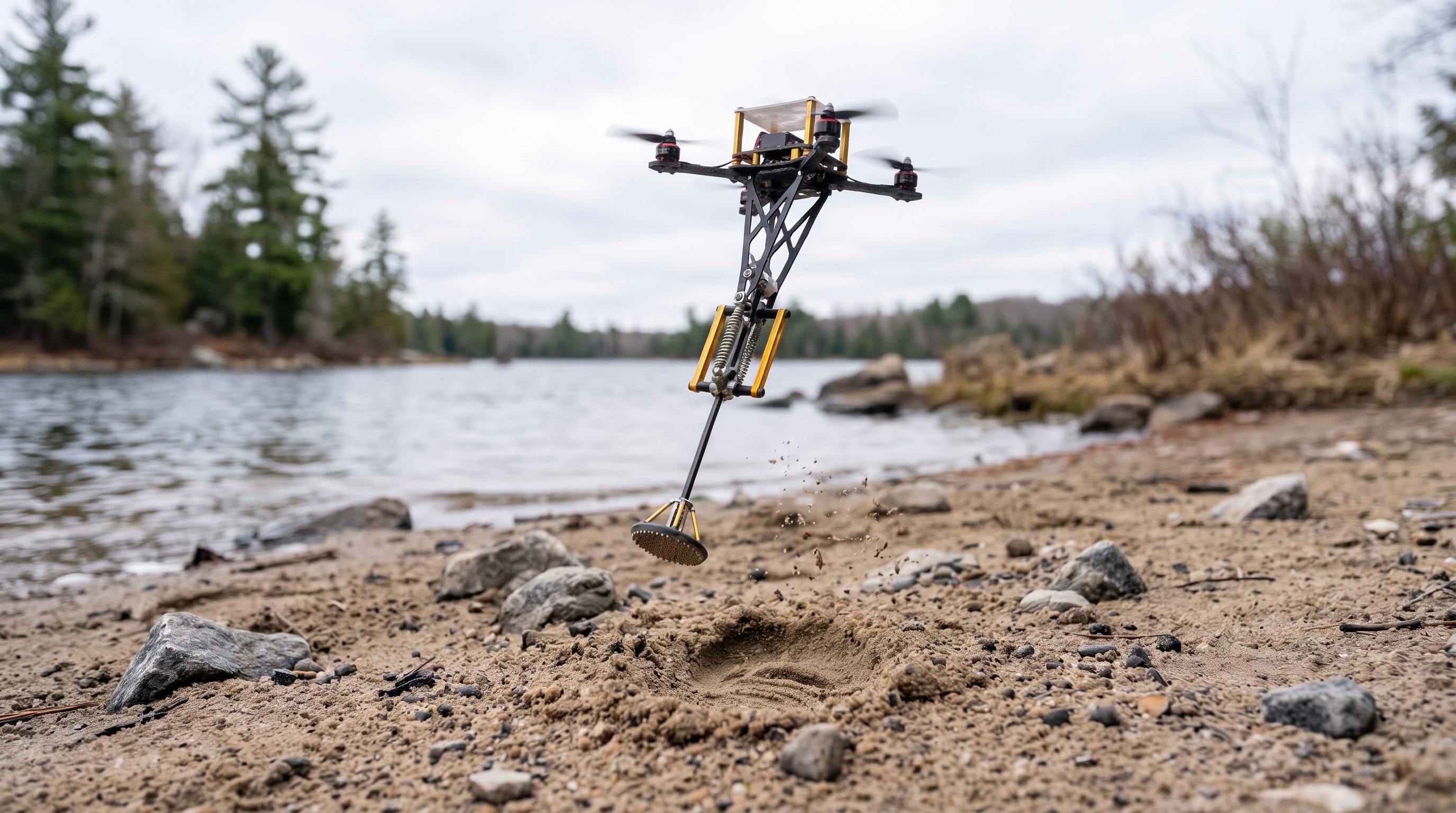
The Hopcopter is a drone with four rotors and one leg with a spring in it. It does not fly all the time, but hops from place to place. This uses much less energy. The first prototype, presented two years ago, could only land well on flat ground such as concrete or fine gravel. On sand the leg sank in, on ice it slipped, and on a slope the robot often tipped over.
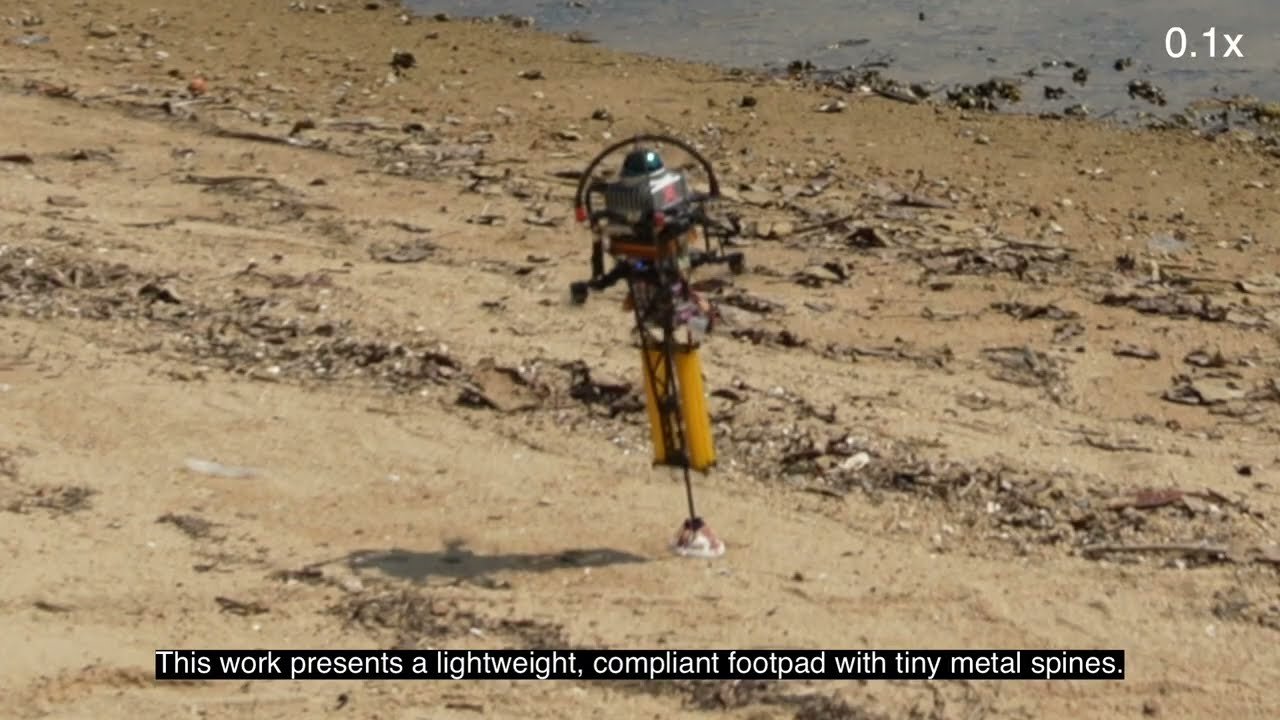
Playing loads YouTube, which may set cookies. More information
How the new foot works
The team of Professor Pakpong Chirarattananon at the University of Toronto therefore developed a flexible foot pad, together with a doctoral student from City University of Hong Kong. According to New Atlas, the Hopcopter itself was developed earlier by researchers at City University of Hong Kong and the Hong Kong University of Science and Technology.
The new foot has four parts:
- A wider surface. This spreads the weight of the drone over a larger area of ground, just as a snowshoe stops you sinking into snow.
- A ball joint. This lets the foot tilt in any direction and land flat on a sloping surface.
- Elastic bands that pull the foot back into the right position after each landing.
- Short pins on the underside for grip on slippery surfaces, like the crampons of ice climbers.
According to the researchers, this reduces the error when pushing off for a new jump by up to 66 per cent and makes the robot up to 64 per cent more efficient. The differences in performance between surfaces become 84 per cent smaller. On ice, sand and rocks, the robot therefore hops almost as well as on flat ground. The research has been published in the journal Advanced Intelligent Systems.
Hopping like a bird
The idea comes from birds. They are not in the air all the time, but flutter from place to place, rest in between and sometimes hop along the ground. This saves energy. The Hopcopter does something similar: during a jump it falls freely and the rotors run only briefly. According to the makers, it uses about a tenth of the energy of a drone of the same size, and it can carry more weight than an ordinary drone.
Chirarattananon explains why such a middle way is useful. Drones are cheap and can fly over any terrain, but because they must be light, they carry little cargo and do not travel far. Robots with wheels or legs can carry much more and travel further, but they are much more expensive and cannot always cross rough terrain.
What comes next
The team now wants to teach the Hopcopter to navigate on its own. Some of the makers are working through the company HopTo Tech on a version for sale, the Hop-1, with AI components to avoid obstacles. It is not yet on sale. The researchers mention search and rescue after natural disasters, inspection of pipelines and remote mines, and perhaps even Mars, where the air is too thin for most drones.
What does this mean for the road to the singularity?
Robots that do work in the real world must be able to cross messy terrain: sand, ice, stones and slopes. This foot shows that a clever mechanical part can already help a lot there, without extra computing power. At the same time, the hopping approach solves a known problem of drones: they cannot stay in the air for long. If the team also teaches the robot to navigate on its own, an energy-efficient helper for hard-to-reach places comes a lot closer.
What is the technological singularity? Read the explanation →