Nederlands
Blood cells from an 80-year-old become young brain stem cells in the lab
Researchers in Bonn have directly converted blood cells from an 80-year-old into neural stem cells with a molecular age of under 20. The rejuvenation happened gradually, and that is exactly what makes it a useful model for unravelling how cells become younger.
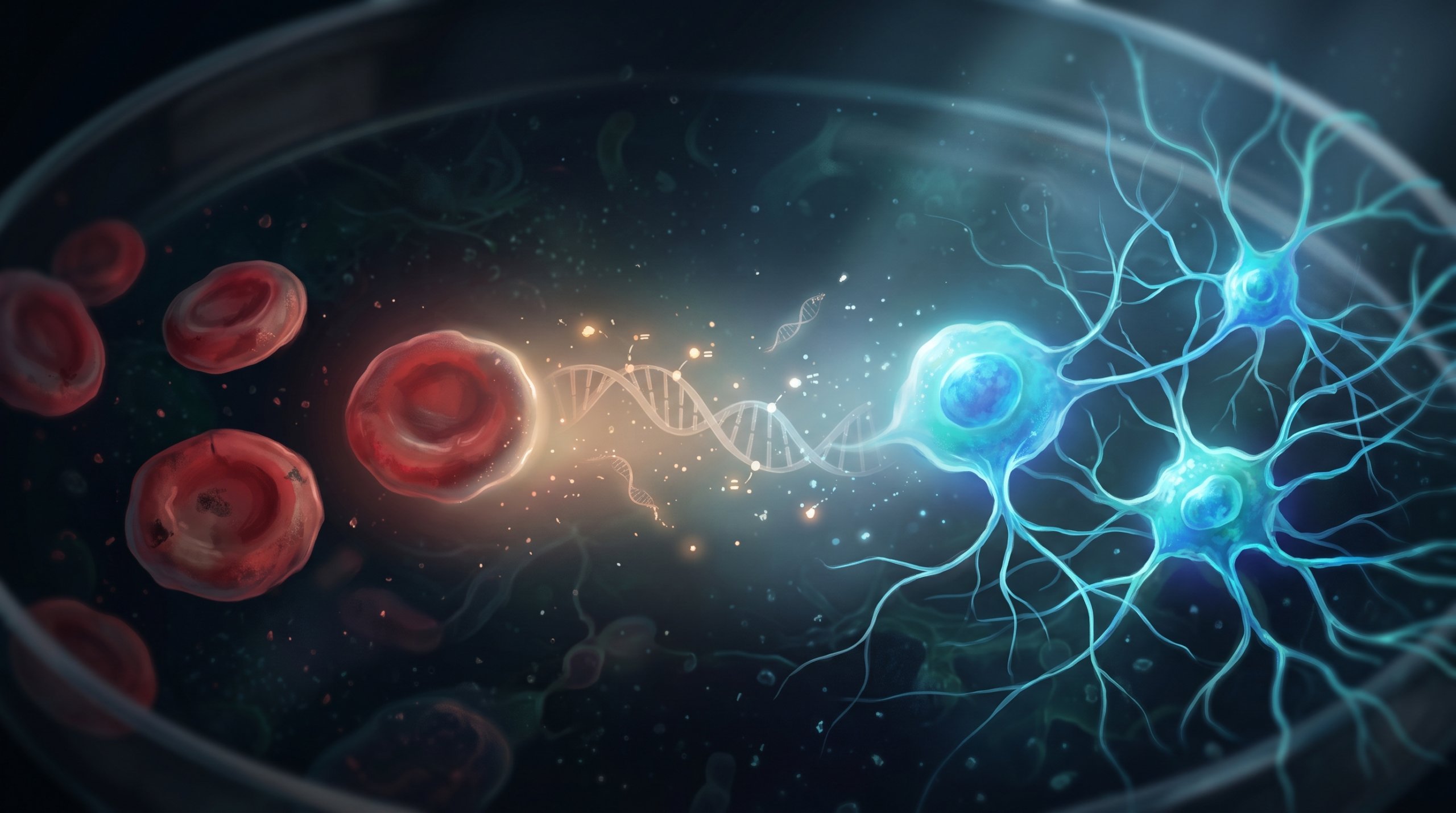
Researchers at the University Hospital Bonn, the University of Bonn and RWTH Aachen University have converted blood cells from an 80-year-old donor into neural stem cells in the laboratory: cells from which nerve cells can grow. What stands out is that the cells not only changed type, but also became younger at the molecular level. Their biological age dropped to less than 20 years. The research was published in the scientific journal Aging Cell.
A shorter route
The researchers, led by neurobiologist Oliver Brüstle, used precursors of red blood cells. Using a cocktail of transcription factors, proteins that determine which genes are switched on and off, they converted these directly into so-called induced neural stem cells.
The usual route is longer. It first turns a body cell into a pluripotent stem cell, a cell that can become any cell type, and only then into a neural stem cell. In that intermediate step, the biological clock is reset almost completely in one go. That is useful if you want young cells, but you cannot see exactly how the resetting happens.
With the direct route in Bonn, the rejuvenation happened gradually instead. According to Brüstle, the researchers were able to follow the process for more than 100 days. In his view, that makes it an ideal experimental model: you can see step by step what changes.
How do you measure the age of a cell?
The researchers used epigenetic clocks. These do not look at the genes themselves, but at chemical markings on the DNA that determine how often genes are read. These markings change in a predictable way as we get older. A biological age can therefore be read from the pattern, and it can differ from the age in years.
According to that measurement, the stem cells from the 80-year-old's blood had become about 60 years younger. Brüstle says that this epigenetic rejuvenation also makes the cells really behave like young cells. His group had already shown that nerve cells made from blood in this way form connections with the existing nerve cells after transplantation into the brains of mice.
Why this is interesting
Age is the most important risk factor for brain diseases such as Alzheimer's. With this model, the researchers want to find out which factors speed up or slow down the rejuvenation, and what happens inside a cell as it becomes younger. Which mechanisms lie behind it is not yet known.
It is still lab work: there is no treatment yet. A younger epigenetic age also does not automatically mean that all properties of a cell are young. How well epigenetic clocks capture true biological age is still a subject of debate in science.
What does this mean for the road to the singularity?
The research touches on one of the big promises of the singularity: that ageing becomes a technical problem that can be solved. That cells can turn back their biological clock was already known. What is new is a way to make that happen slowly and step by step, so that it becomes visible which controls are responsible. Exactly that kind of detailed, measurable data is what AI models need to understand and steer biological processes. It is still a long road from a test tube to a rejuvenation therapy, but it is a road that is being mapped better and better.
What is the technological singularity? Read the explanation →