Nederlands
Deep-sea expedition off Argentina yields 57 new animal species
In a deep underwater canyon off the coast of Argentina, biologists have found 57 animal species that nobody knew, from sea cucumbers to corals. Millions of people watched live as an underwater robot filmed the animals.
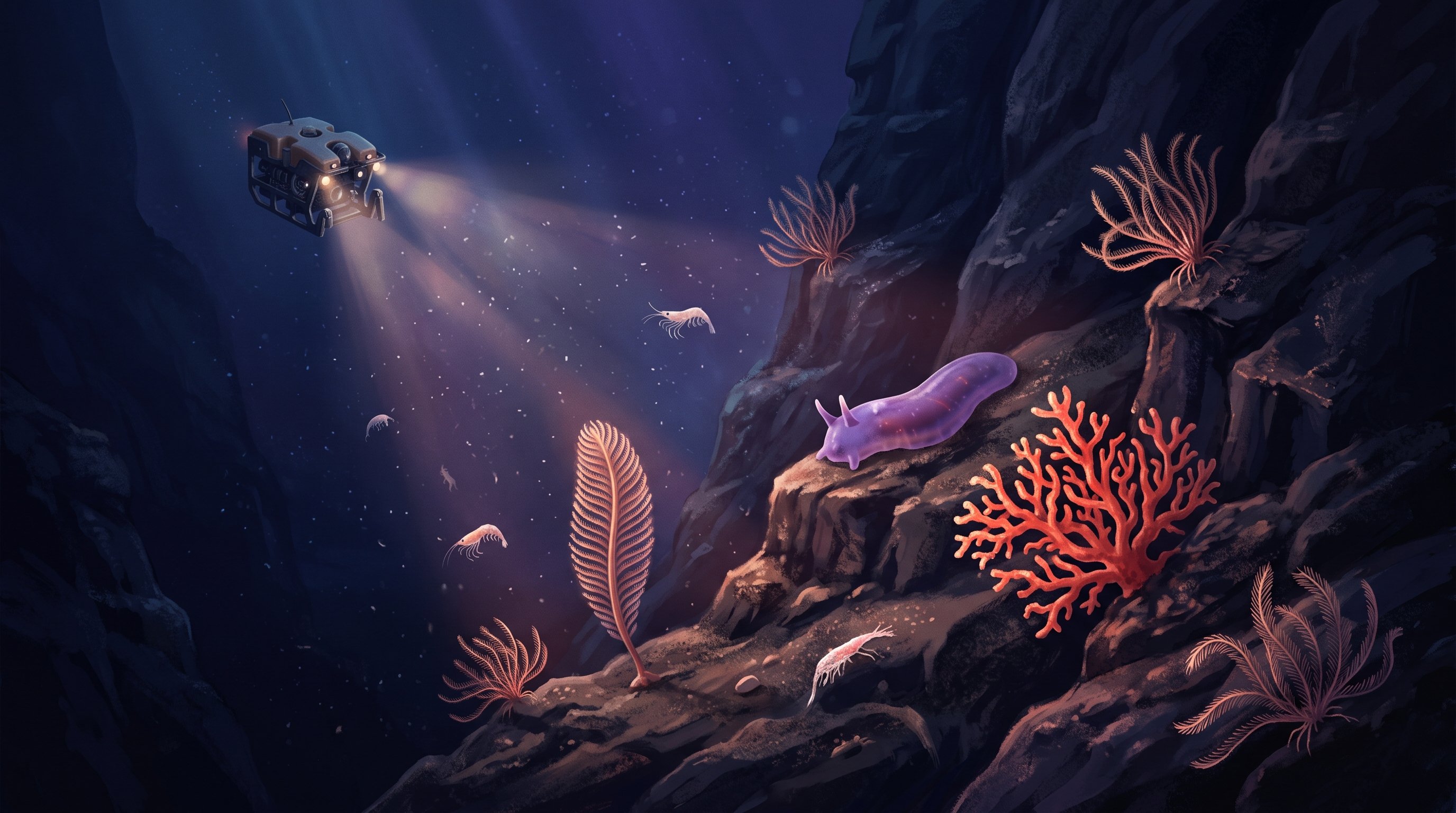
We know more about the surface of the Moon than about the floor of the deep sea. The deeper you go, the less has ever been seen. An international expedition in an underwater canyon off the coast of Argentina now shows how much there is still to discover down there: biologists found 57 animal species that are new to science.
A canyon more than 3.5 kilometres deep
The expedition took place in the summer of 2025 in the Mar del Plata Canyon, one of Argentina's largest underwater canyons. At its deepest point it is more than 3,500 metres deep. Two ocean currents meet there: a warm, salty current from the north and a cold, nutrient-rich current from the south. That makes it one of the most turbulent and richest places in the oceans.
The research vessel Falkor (too) of the American Schmidt Ocean Institute lowered an unmanned underwater robot, which explored the seabed with cameras and grabbing arms. The images were streamed live on the internet. According to the institute, more than four million people watched. A plump orange starfish became especially famous, because it looked like Patrick from the cartoon SpongeBob. That starfish itself, by the way, is not a new species.
57 new species in two weeks
The real discoveries came later, in the lab. In July 2026, twenty specialists in naming species from Latin America and Europe spent two weeks together in Buenos Aires. They examined the animals brought back and established that 57 species were still unknown. Five of them are so different that they get a new genus of their own, a group of closely related species.
The new species are:
- 22 echinoderms: sea cucumbers and sea lilies, relatives of the starfish;
- 20 copepods: tiny crustaceans;
- 14 corals and sea pens;
- 1 so-called tusk shell, a mollusc with a shell shaped like a tusk.
A striking sea cucumber was nicknamed "Loki", after the little horns on its head. A bright purple sea cucumber and a red-orange coral were also found. The copepods were truly special: the researchers examined only about a tenth of the samples, and every copepod they looked at turned out to be new.
What happens now
The data have been recorded in NOVA, an open online collection of newly discovered marine animals from the Ocean Census project. The animals will get a permanent home in the natural history museum in Buenos Aires. For a few corals, genetic research will follow, because they may even belong to a new family. After that, the species will be officially described. In early 2027 a new expedition will go to another underwater canyon.
Ocean Census is a worldwide project that aims to map as much life in the oceans as possible. Its scientific director, Michelle Taylor, says the deep sea is one of the least understood habitats on Earth.
What does this mean for the road to the singularity?
This discovery shows two things. Robots and live cameras make the deep sea accessible to researchers and to millions of viewers at home. And there is still an enormous amount of life down there that we do not know.
Naming species is still largely done by hand, by a small group of specialists. That is exactly the kind of work AI can speed up a lot in the coming years. Image recognition can search thousands of underwater images for animals that differ from everything known. AI models that read DNA can help determine how a new animal is related to known species. In this way, a team like this could in future examine not a tenth but all of the samples. And the better we know what lives in the ocean, the better we can protect it.
What is the technological singularity? Read the explanation →