Nederlands
Sailing robot falls from the sky like a maple seed and then sails on by itself
Researchers in Singapore have built a small sailing robot that can be dropped from the air. Its wings spin like a maple seed and so slow its fall. On the water they become sails. The first trials on a reservoir have succeeded; the open sea comes next.
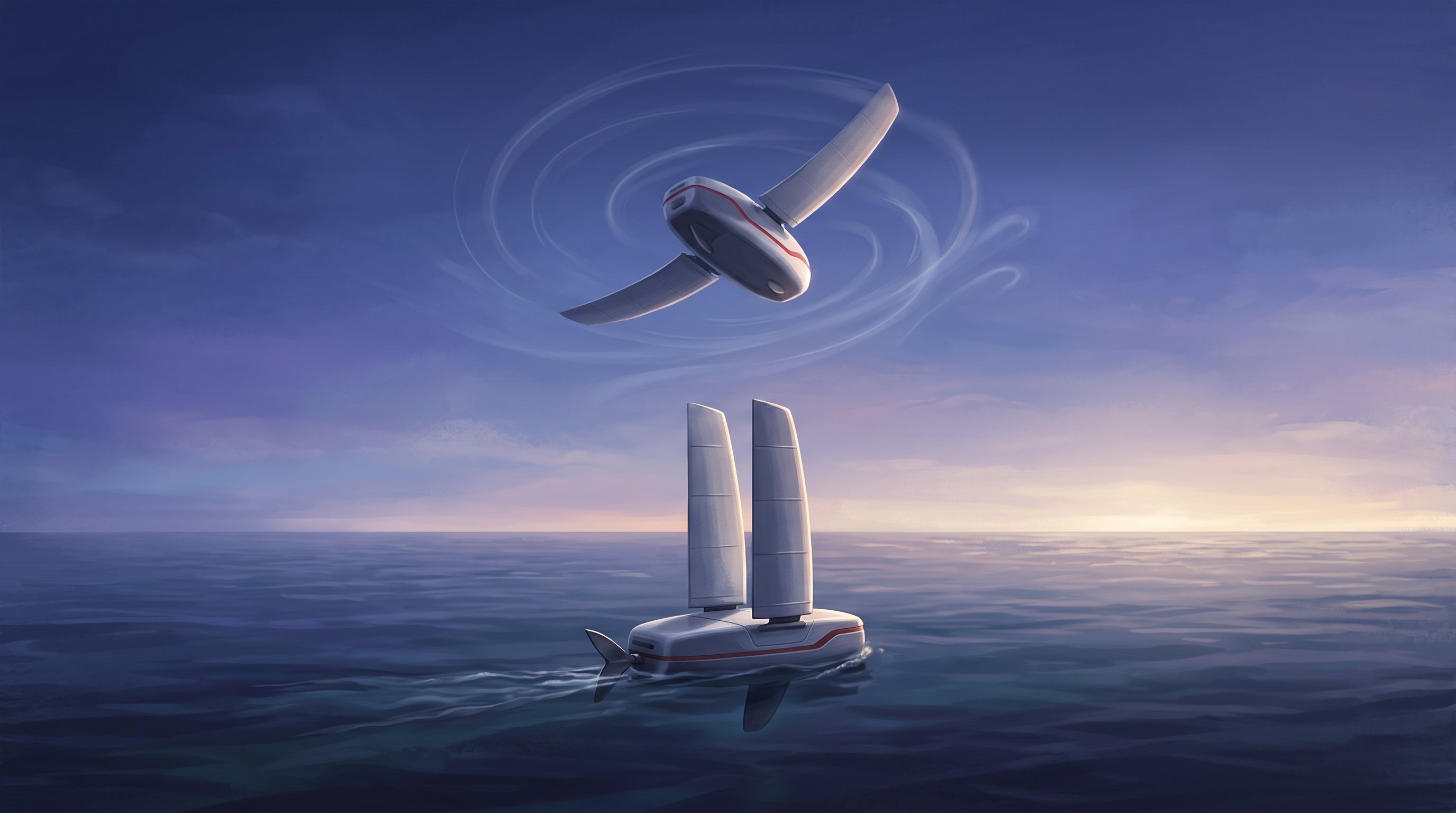
Anyone who wants to know what is happening on the open sea has to get measuring equipment there. That is difficult. Sending a ship takes a lot of time and money, and a drone can only stay in the air for a short time. Researchers at the Singapore University of Technology and Design (SUTD) therefore came up with a robot that combines both worlds. It is dropped from the air, lands gently on the water and then sails on under its own power.
The robot is called ALBATROSS, after the seabird that covers enormous distances across the ocean. The research appeared in the scientific journal Science Robotics.
Falling like a seed
The clever part is in the wings. Think of the seeds of a maple tree, which spin down to the ground like little helicopters. The robot does the same. Its two rigid wings start spinning by themselves when it falls. As a result it falls slowly and steadily, without a parachute and without extra landing gear.
That makes a big difference. According to the researchers, a comparable robot without that spinning would hit the water about 18.5 times as hard. In a test, they dropped a small version from a height of 150 metres. It stayed stable during the fall, landed gently and then turned itself upright. That last step happens without a motor: a heavy keel at the bottom ensures that it always rights itself, like a toy that always springs back upright.
From wing to sail
Once the robot is on the water, the wings get a new job: they become sails. The wind pushes the robot forward. A rudder that looks like a fish tail helps with steering and gives an extra push when there is little wind.
A larger version of the robot sailed independently from point to point for about three hours on a sheltered reservoir in Singapore, guided by GPS. It also sailed in a zigzag against the wind, like an ordinary sailing boat. Along the way, it measured humidity, heat and wind direction. Its top speed was just under 1 kilometre per hour. That is not fast, but for a measuring station that has to stay at sea for a long time, endurance matters more than speed.
Lead researcher Shane Kyi Hla Win says the team designed the robot to use nature instead of fighting it. Falling, righting itself and sailing all happen with the help of gravity and wind.
What it could be used for
The researchers are thinking of many applications: keeping an eye on the environment, climate research, searching for missing people at sea and monitoring sea areas. Such a robot can quickly be dropped at a place where there is no ship yet, and then keep measuring there for a long time.
So far the trials have been done on calm, sheltered water. The next step is the open sea, with strong wind, currents and waves. For that, the robot needs to become sturdier. Professor Foong Shaohui of SUTD says the team now wants to take the design ideas into those tougher conditions. Later versions could also carry more measuring equipment, such as underwater sensors and sonar, and bigger batteries.
What does this mean for the road to the singularity?
Robots are getting better and better at making clever use of their surroundings. This sailing robot shows how far you can get by learning from nature: a maple seed and a fish tail together produce a device that can land without a motor and sail without fuel. Such energy-efficient, independent robots are important for a future in which machines can work for long periods in remote places without human help. If the trials on the open sea succeed, swarms of these small sailors could show us much more of the oceans, which are still largely unknown territory.
What is the technological singularity? Read the explanation →