Nederlands
Doudna and Charpentier turn a bacterial defence system into programmable gene scissors
In Science, Jennifer Doudna and Emmanuelle Charpentier show that the CRISPR system of bacteria can cut DNA at a chosen spot. This makes changing genes cheaper and faster.
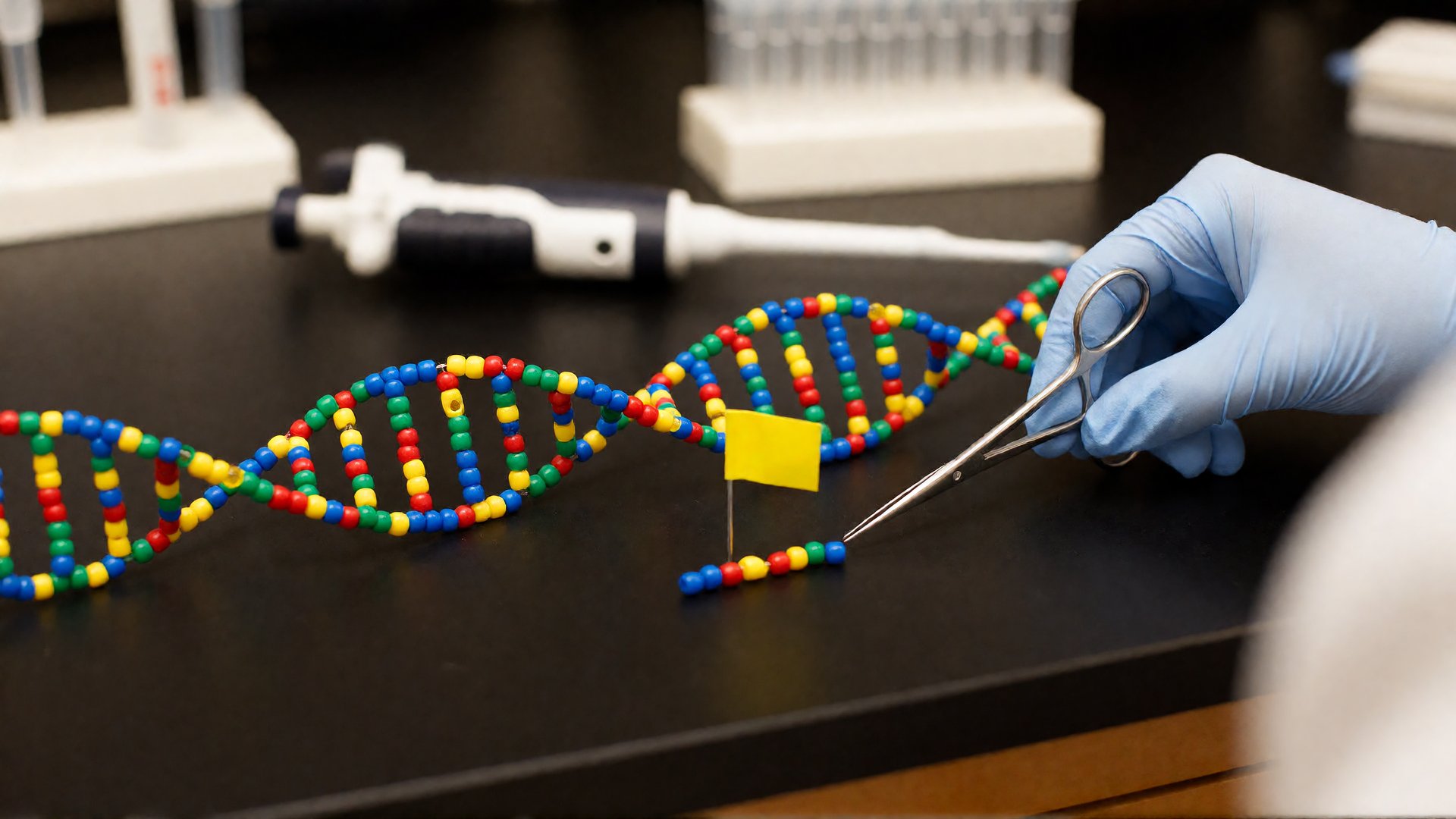
BERKELEY, JUNE 2012 - The journal Science has published a paper by two research groups: that of Jennifer Doudna at the University of California, Berkeley, and that of Emmanuelle Charpentier at Umeå University in Sweden. They show that a bacterial defence system, CRISPR, can be rebuilt into a tool that cuts DNA at a chosen spot. This brings the editing of genes a lot closer.
First: how do bacteria defend themselves?
Bacteria are attacked by viruses. These inject their own DNA into the bacterium, which then starts working for the virus. Some bacteria have developed a trick. They store pieces of DNA from viruses they have survived before in an archive within their own DNA, the CRISPR region. If the same virus comes back, the bacterium uses those pieces as a description of the intruder.
How do the scissors work?
The system has two parts. The first is Cas9, a protein that can cut DNA. The second is a short strand of RNA, the guide. This strand contains a copy of the stored piece of virus and acts as the search address. Led by the guide, Cas9 moves along the DNA, finds the spot where the letters match the guide, and cuts through both strands of the DNA there. The guide is the search term and Cas9 is the scissors.
In bacteria, the guide consists of two separate pieces of RNA. Doudna and Charpentier show that this pair steers Cas9, and that the two pieces can also be joined into a single RNA strand. Cas9 has two cutting sites, one for each strand of the DNA.
Why this matters so much: the search term can be changed
The key insight is that the system is programmable. Swap the piece of RNA that points to the spot, and Cas9 cuts somewhere else. So it can be aimed at any gene. Earlier tools for cutting DNA, zinc finger nucleases and TALENs, needed a separate protein for every target, which took a lot of work. With CRISPR, making a short RNA strand is enough.
Looking back from 2026
The discovery was quickly taken up by laboratories all over the world. Charpentier and Doudna received the Nobel Prize in Chemistry for it in 2020, as the first two women to share it without a male colleague. In November 2023 the British regulator MHRA approved Casgevy, a gene therapy for sickle cell disease and beta thalassaemia: the first medicine made with CRISPR. The US FDA followed on 8 December 2023. Eleven years after the discovery, gene editing had become a recognised treatment.
It is also an example of how two earlier steps fit together: the human genetic code was read in 2003, and this tool makes it possible to change that code in a targeted way.