Nederlands
Firefighters in Alaska put out forest fires to protect frozen ground and its carbon
In the north of Alaska and Canada, researchers and firefighters are trying to stop forest fires before they thaw the permanently frozen ground. That keeps a lot of carbon in the soil. New satellites and maps should help; how well it works is now being studied.
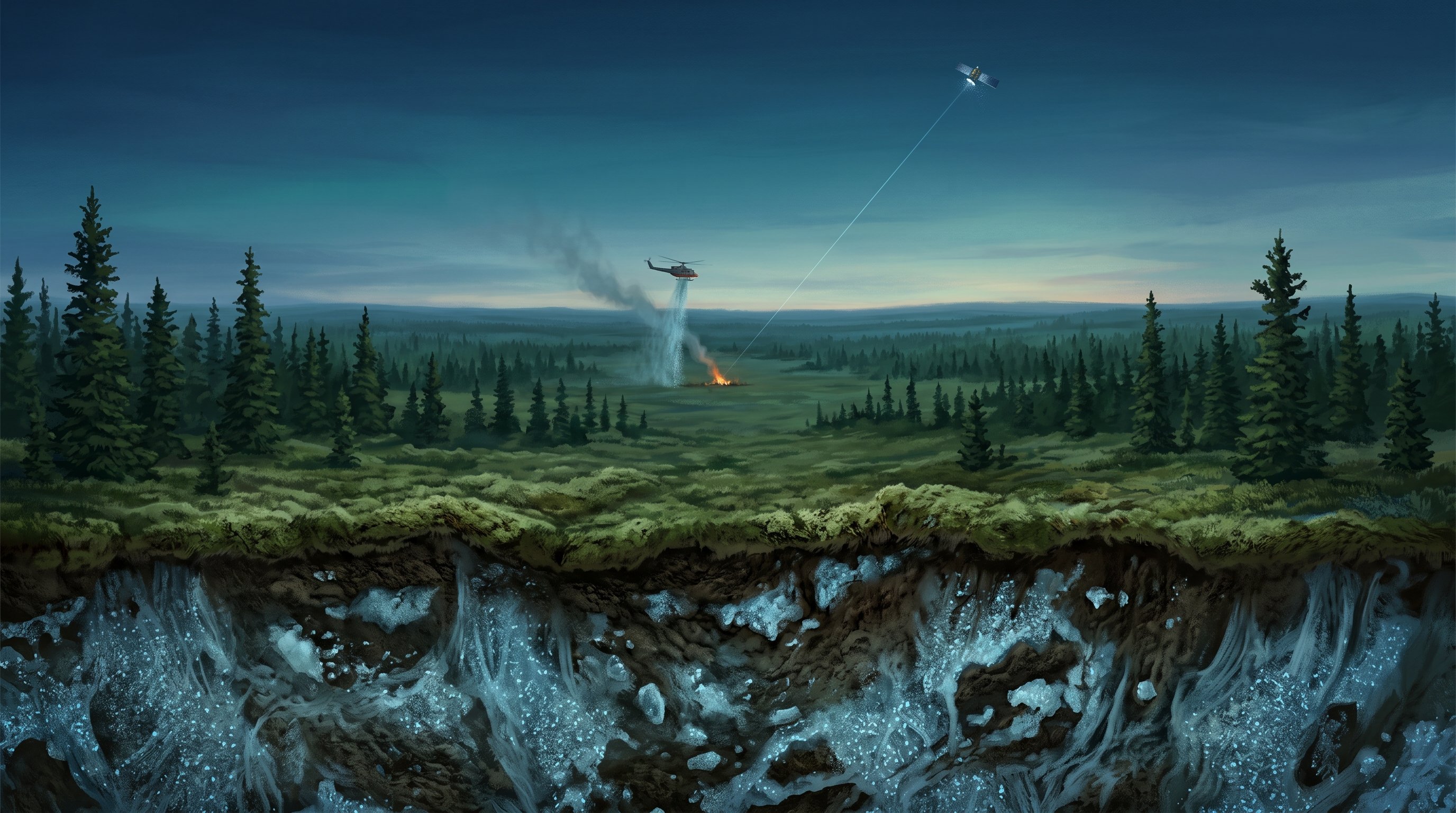
In the far north, an enormous store of carbon lies underground. It sits in permafrost: soil that has been frozen for thousands of years. Permafrost lies under about 15 per cent of the land in the northern hemisphere and holds about twice as much carbon as there is in the air today. As long as the ground stays frozen, that carbon stays neatly stored away, like food in a freezer.
Forest fires open that freezer. A fire burns away the thick layer of moss and dead plant material that insulates the ground. After that the soil thaws more deeply. Old plant remains start to rot and give off greenhouse gases. That makes it warmer, and a warmer climate brings more fires again. Researchers in Alaska and Canada want to break that cycle with a striking tool: more targeted firefighting.
Fires are getting bigger and more frequent
The far north is warming up to four times faster than the average on Earth. Emissions from forest fires in the northern forests have almost tripled since 2001. The Canadian fires of 2023 even released more carbon into the air than all the fossil fuels Canada used that year, research in Nature showed.
How large the effect on the ground is, researchers saw after a fire in 2021 near Fairbanks in Alaska. In places that had not burned, the frozen ground began at a depth of about 30 centimetres. In the burned area that boundary was at least three times as deep.
Fighting fires for the carbon
A trial is running in the Yukon Flats nature reserve in Alaska. An area of about 6,500 square kilometres has been designated there where firefighters put out fires not only to protect people and homes, but also to protect the carbon in the soil. Under that area lies yedoma: very old, ice-rich permafrost from the last ice age that holds a particularly large amount of carbon. If a fire threatens that ground, crews try to put it out, as long as there are enough people and equipment and there is a good chance that the fire will be under control within three days.
The idea comes partly from the Woodwell Climate Research Center, an American climate institute. According to earlier research by Woodwell, fighting fires in Alaska costs about 13 dollars (about 12 euros) per tonne of CO2 that does not reach the air. That is comparable to, or cheaper than, other ways of reducing emissions, such as wind and solar power.
According to MIT Technology Review, Woodwell is now working with the Canadian University of Victoria and the Alaska Venture Fund on a larger programme called North Fire. It also includes trials with small, controlled fires lit by Indigenous communities. Such fires, which original inhabitants have been lighting for thousands of years, remove dry burnable material before a large fire comes. The Council of Athabascan Tribal Governments wants to light such fires near the village of Fort Yukon next spring.
Satellites that spot small fires
The earlier a fire is discovered, the easier it is to put out. That is why satellites are coming that detect fires from space. In July 2026 the first three working FireSat satellites went into space, a project of the Earth Fire Alliance with partners including Google. They can see a fire of 5 by 5 metres, even through smoke and clouds. In the end there should be more than fifty of them. The German company OroraTech already has around twenty such satellites in space, and Canada wants its own system from 2029.
In addition, Woodwell and its partners are making maps of Alaska that show where the risk of fire is highest and where the most carbon is in the ground. That way, firefighters know where putting out a fire achieves the most.
What still has to be shown
Whether this approach really makes a big difference is now being studied. Ecologist Michelle Mack of Northern Arizona University thinks there is still too little evidence that firefighting can substantially limit the fires in the north. A fire that is put out now can also leave behind extra burnable material for a later, bigger fire. The safety of firefighters always comes first. Woodwell researcher Brendan Rogers does see big opportunities: with good management, he says, you can change the outcome of fires. The trials in Alaska and Canada should show that in the coming years.
What does this mean for the road to the singularity?
The great thing about this story is that it uses a familiar tool, firefighting, in a new way: as climate protection. With satellites that see every small fire and maps that show where the carbon is, firefighters can choose more wisely where to go.
This is where AI has a big role to play. An AI model can look at satellite images, weather forecasts, lightning maps and soil data at the same time and indicate within minutes which starting fire poses the greatest danger to the frozen ground. The American environmental organisation EDF is already working on such a tool to rank fires. A language model can also combine knowledge from fields that rarely meet: forestry, soil science, satellite technology and the age-old knowledge of Indigenous peoples about fire. That increases the chance that we keep this enormous store of carbon in the north frozen.
What is the technological singularity? Read the explanation →