Nederlands
Frozen pig kidneys work again after rewarming, one even after more than a year
Researchers at the University of Minnesota stored pig kidneys at −150 °C and then got them working again: they made urine, one even after more than a year in the freezer. There was still some damage. The next step is longer trials in pigs.
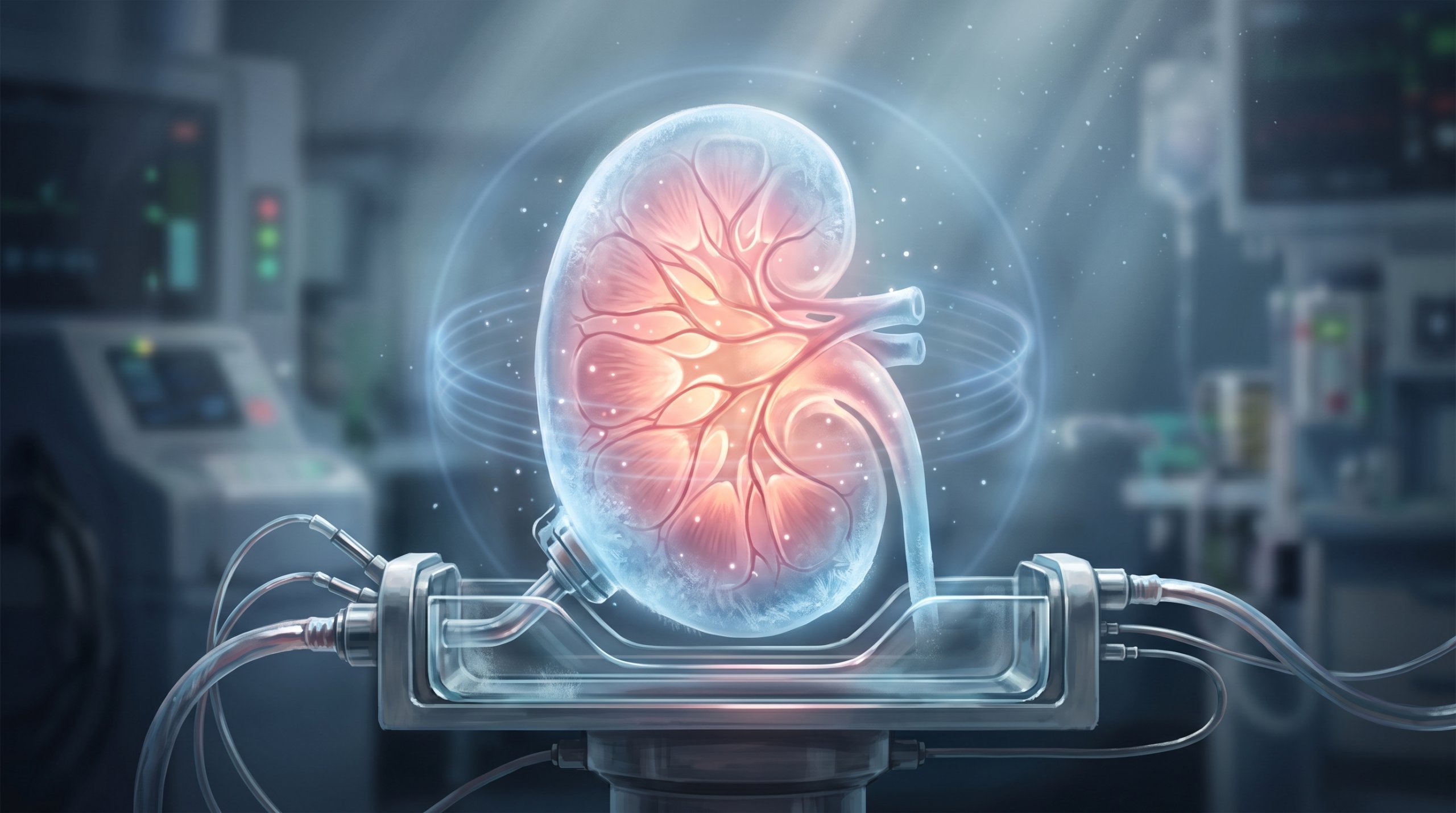
A donor kidney currently has to reach a patient within about a day and a half. Researchers at the University of Minnesota in the United States show that it can be done differently. They cooled pig kidneys to −150 °C, stored them for days up to more than a year and then rewarmed them. The kidneys received blood again, turned pink and started making urine.
According to the researchers, this is the first time an organ of this size has been frozen in this way and then worked again. They put their results online in early October 2026 as a preprint: a research report that is still being reviewed by other scientists. MIT Technology Review reported on it on 15 October.
Why storing organs is so difficult
Ordinary freezing creates ice crystals. They act like sharp splinters that destroy cells. The researchers therefore use a different approach, vitrification. The organ is made so cold so quickly that the water does not freeze into ice, but becomes hard like glass, without crystals. This has been done for years with egg cells and embryos. With a whole organ it is much more difficult.
This requires antifreeze, comparable to the antifreeze in a car. These substances protect against ice, but are toxic to cells in high doses. A second problem is rewarming. A large organ warms up from the outside in. If that happens too slowly or unevenly, ice still forms or cracks appear.
Iron particles as a built-in heater
The team of transplant surgeon Erik Finger and bioengineer John Bischof has a clever solution for the rewarming. First they fill the kidney with an antifreeze mixture over about two hours. Then they pump tiny iron particles through it, thousands of times smaller than a hair. Next they cool the kidney with cold nitrogen vapour. At around −120 °C the organ becomes glass-like. Then they pause briefly, so that the kidney does not crack, and cool it further to −150 °C.
For rewarming, they place the kidney in an alternating magnetic field. The iron particles keep flipping along with that field and give off heat as they do. A bit like the way an induction hob heats a pan, but from the inside and everywhere at once. This way the whole organ warms up quickly and evenly. Afterwards the researchers flush the antifreeze and the iron particles out again.
In 2023 the same group showed that this works with rat kidneys. The kidneys were kept in the freezer for up to 100 days and then kept rats alive for a month. At about 100 grams, a pig kidney is roughly a hundred times as heavy as a rat kidney and is already much closer in size to a human kidney. The antifreeze mixture had to be adapted for this. According to Bischof, that took three years.
The kidneys make urine again
The rewarmed kidneys were tested in two ways. Some were connected to a machine that supplies the organ with blood; others were transplanted into pigs. These were then monitored for two hours. In both cases the blood flow started again and the kidneys made urine within about a minute, around two thirds of the normal amount.
Most kidneys had been stored for days or weeks. A small number lay in the freezer for more than a year. One of those kidneys made urine on the machine straight away and looked better than many others. Finger says the team now dares to say that kidneys can be stored for a year.
Researchers outside the team are enthusiastic too. Cryobiologist Peter Kilbride calls it a major breakthrough that solves half of the problem. Korkut Uygun of Harvard Medical School expects that this will make it truly possible to store organs indefinitely. In 2025 he himself led a trial in which a pig kidney was stored for ten days at −15 °C and also made urine after transplantation. That approach uses much milder cooling and a shorter storage time.
What still needs to happen
The kidneys also suffered damage. According to the researchers, this is mainly caused by the toxic antifreeze. Cryobiologist Greg Fahy, one of the pioneers in this field, considers the restored blood flow very important. He also points out that the trials do not yet show whether such kidneys can keep an animal alive in the longer term.
The team is now working on that. The next step is trials in which pigs are monitored for longer. The researchers are also looking for less toxic antifreeze. Finger points out that organs on a machine often recover and that they can also repair themselves in the body. He also thinks that human kidneys may tolerate the process better than pig kidneys. Trials with human kidneys are already planned.
Why this matters
Around the world, many people are waiting for a donor organ. A human organ currently remains usable for at most 24 to 36 hours. This leaves little time to find the best-matching recipient. With an organ bank, that changes. Finger puts it this way: then the organs wait for the patients, instead of the other way round.
There is then also time to prepare a recipient, so that the body is less likely to reject the kidney. Transplant patients currently take medicines that suppress the immune system for the rest of their lives. Kevin Myer of LifeGift, a Texas organisation that coordinates donor organs, also sees a role in emergencies, such as an overdose or a gunshot wound.
What does this mean for the road to the singularity?
This research shows that the biological clock of a complete organ can almost be stopped. That is a big step in the technical control of living tissue. Such work relies more and more on computers: models that predict how heat and antifreeze spread through an organ help to refine such a process before it is tested in the lab.
As an interpretation: organ banks fit well into a future in which AI helps to match donor and recipient extremely quickly and accurately, and in which organ replacement becomes a normal part of a longer, healthy life. Before that happens, the kidneys first have to show that they keep an animal healthy for a long time. With trials with longer follow-up and human kidneys planned, a real organ bank is coming a big step closer.
What is the technological singularity? Read the explanation →
Sources
- MIT Technology Review
- bioRxiv (preprint, Finger, Bischof e.a., 2026)
- Nature Communications (2023): rattennieren na vitrificatie getransplanteerd
- University of Minnesota (mei 2025): varkensnier na 10 dagen bij −15 °C getransplanteerd
- Nature Communications (2025): vitrificatie en opwarmen op literschaal