Nederlands
Google's quantum chip Willow makes fewer errors as it gets bigger
With the Willow chip, Google achieves error correction below the threshold for the first time: errors get smaller as more qubits are used. This was the biggest obstacle to a useful quantum computer.
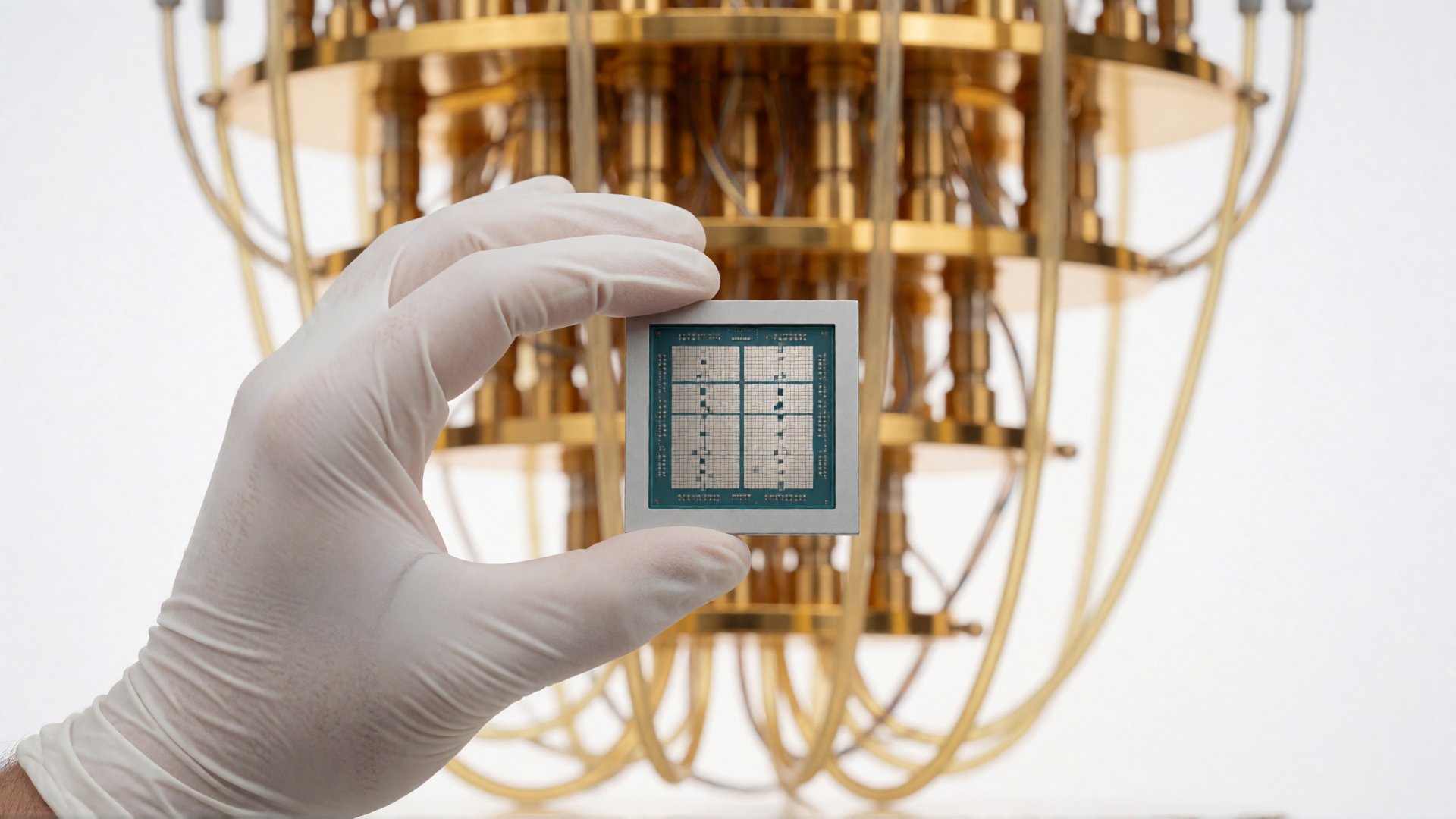
SANTA BARBARA, DECEMBER 2024 - Google has built a quantum chip that clears an obstacle that has stood for years. The chip is called Willow and has 105 qubits. Until now, quantum computers almost always showed the opposite of what you would expect: the more qubits are used, the more errors appear. With Willow the reverse happens, Google writes. The result appears in the journal Nature, and Hartmut Neven, head of Google Quantum AI, presented it on 9 December.
What a qubit is, and why it goes wrong
An ordinary computer calculates with bits, which are either 0 or 1. A quantum computer calculates with qubits. These can also be a mixture of 0 and 1, which makes it possible to tackle certain problems in a completely different way. Such problems are now too big for any ordinary computer.
The problem is that qubits are very sensitive. They exchange information with their surroundings, and in this way an error creeps into a calculation step. A long calculation consists of a great many steps, and a single error can ruin the answer. This has been in the way since 1995, when the mathematician Peter Shor described the first method of error correction.
Fixing errors with more qubits
Error correction works like this. One piece of information is not stored in one qubit, but spread over a small group of qubits. This group can detect and repair errors. Such a group is called a logical qubit. The idea is that a larger group catches errors better.
In practice, a larger group only helps if the individual qubits are good enough. If they are too sloppy, every extra qubit adds more errors than it repairs. Google tried groups of 3 by 3, 5 by 5 and 7 by 7 qubits. With each step, the error became about half as large. The chip is therefore "below the threshold", as it is called: above that threshold the noise wins, below it the correction wins. Google also reports that the corrected qubits last longer than the best individual qubit on the chip, and that the error correction happens in real time, while the calculation is running. The qubits themselves hold their state about five times longer than those of the previous chip.
The test that challenges supercomputers
Google also had the chip run a test task, called random circuits. Willow needed less than five minutes. According to Google, the same task would take Frontier, one of the world's fastest supercomputers, about 10 septillion years (a 1 followed by 25 zeros). That is far longer than the universe has existed. Google acknowledges that the estimate makes generous assumptions for the ordinary computer and that ordinary computers will still improve on this task. The task also has no known use: it only tests whether a quantum computer is faster.
What still has to happen
Google has not yet shown a useful result, meaning a calculation that is out of reach for ordinary computers and also delivers something worthwhile. That is the next goal.
Looking back from 2026
Clearing the threshold was the first requirement. After that, a quantum computer must also be able to perform all kinds of operations, and a few of these need special, prepared states. In October 2026, Google reported that a new way of making those states works on Willow: the errors in them became about 40 times smaller, with a paper in Science.
The importance of Willow is the direction. It was uncertain whether larger quantum computers would become more reliable in practice, and this has now been seen on a real chip. That makes it worthwhile to keep building towards a machine that can handle problems that are too big for any of today's computers.
Sources
In the glossary: Chip, Logical qubit, Quantum computer, Quantum error correction, Qubit