Nederlands
Logical qubit
A logical qubit is one reliable qubit built from many individual qubits. Together they catch each other's errors, so that a quantum computer can compute for longer.
A logical qubit is a group of ordinary qubits (the physical qubits) that work together as one reliable qubit. A qubit is the computing unit of a quantum computer. Individual qubits are very sensitive; a little heat or a vibration is enough to disturb them. A logical qubit is much more robust.
How does it work?
In an ordinary computer you can store a piece of data three times and let the majority decide when in doubt. That does not work with qubits: you cannot copy quantum information, and anyone who looks at a qubit disturbs it.
That is why the information of one logical qubit is spread across a group of physical qubits. Helper qubits keep checking whether their neighbours still agree with each other, without looking at the information itself. A computing program, the decoder, deduces from those checks where an error is and how to repair it. This is called quantum error correction. The more physical qubits make up a logical qubit, the better it can catch errors, provided the individual qubits are good enough.
Why it matters
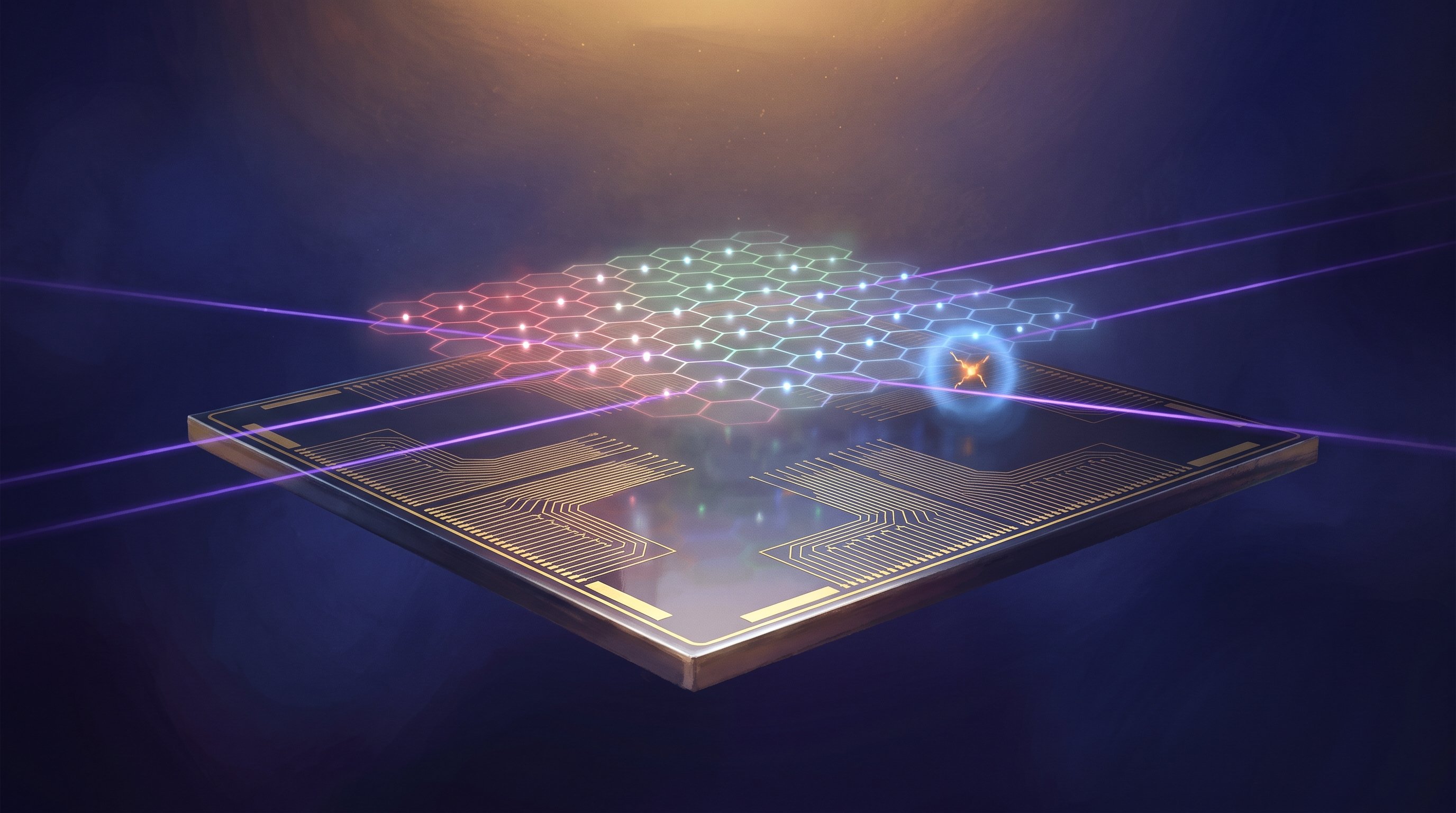
Useful calculations require millions to billions of steps, and then almost nothing may go wrong. Logical qubits are therefore the building blocks of quantum computers that become truly usable. Quantinuum's Helios quantum computer set a new record in error correction: per check round, something went wrong on average only five times in a million, ten times better than the previous record (link). Up to 37 physical qubits together formed one logical qubit, and the errors decreased with each larger version. The next step is to show the same for more complex calculations.
Articles about Logical qubit
-
PSI: AI found proof of a 2008 conjecture on the limits of quantum computers
The US company Physical Superintelligence says its AI system found a proof of the Aaronson-Ambainis conjecture, an open question from 2008 about when quantum computers are much faster. The program Lean has approved the proof; fellow researchers are now checking it.
-
One short measurement beforehand halves a qubit's errors
A team led by the University of Regensburg had a qubit briefly measure which frequency it was on before each series of calculations, then adjusted the controls automatically. Errors fell by about 54 per cent. The next step is more qubits at once.
-
Google demonstrates magic state cultivation on Willow: 40 times fewer errors
Google Quantum AI tested a new way to make magic states on its Willow chip: special states that a quantum computer needs for its hardest operations. The errors in them became about 40 times smaller. The result is published in Science.
-
German company makes a molecule that stores quantum information and can pass it on with light
The German company NVision and researchers from Ulm and Jerusalem describe in Nature a molecule of carbon and hydrogen that stores quantum information and can pass it on with light. Such a building block could later link quantum computers together.
-
IBM links two quantum chips with 80-centimetre cables
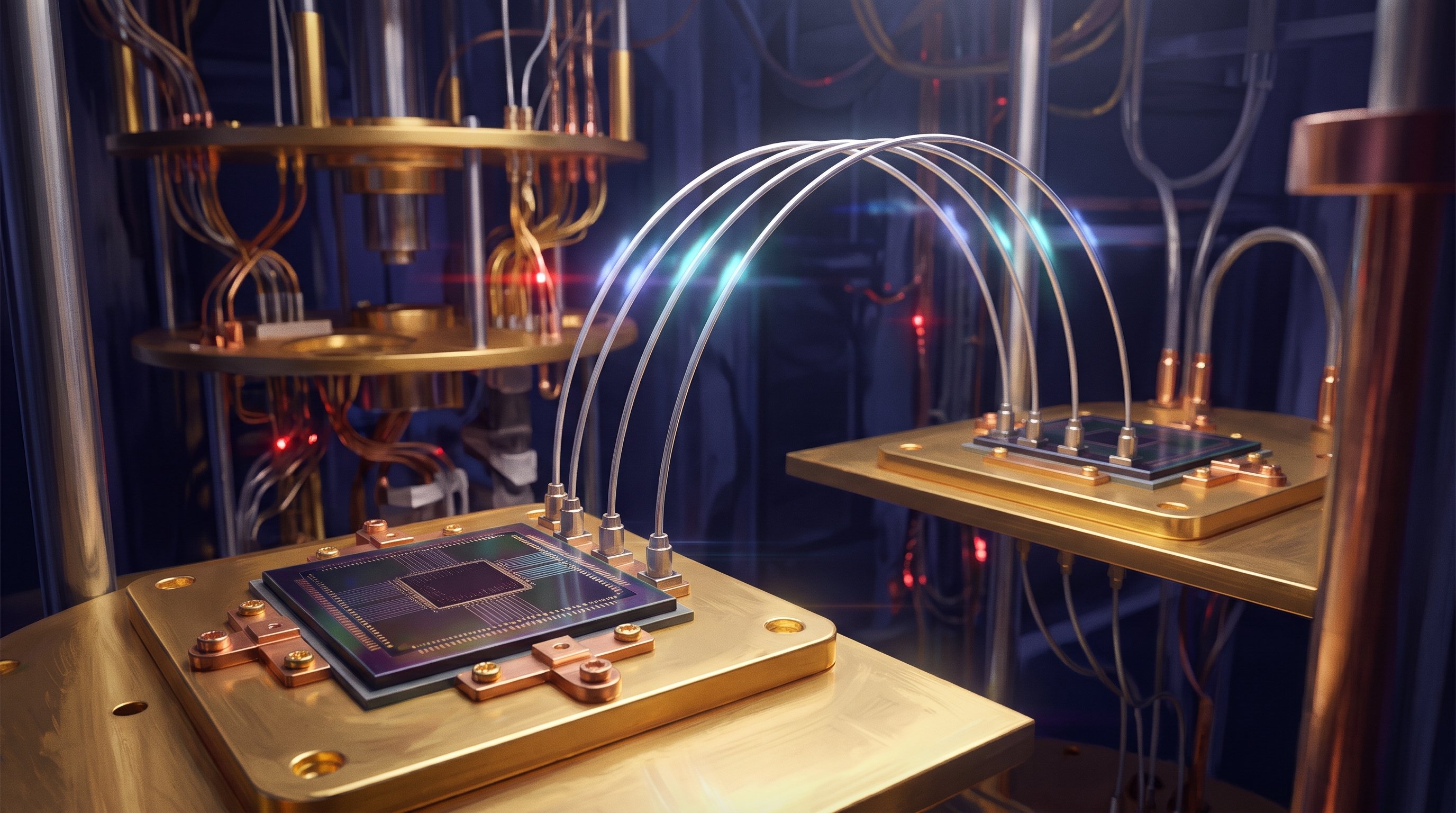
IBM researchers connected two quantum chips of 120 qubits each with four superconducting links of 80 centimetres. The quantum information came across with an average fidelity of 99 per cent. It is a step towards quantum computers built from separate modules.
-
Japanese researchers control five quantum bits in silicon at once, with almost no errors
Researchers at RIKEN in Japan controlled five quantum bits on a silicon chip at the same time, through one shared control line. They found the biggest source of errors and kept accuracy at around 99.9 per cent. That helps to build larger quantum computers.
-
Quantum computer keeps chaos under control on 100 qubits: a step towards fault-tolerant computing
Researchers from Rutgers, IBM and other institutions had a quantum computer check and correct itself thousands of times while it was computing. It is not yet a working fault-tolerant quantum computer, but it is an important building block for one.
-
Quantum computer catches its own errors so well that only 5 in a million remain
Quantinuum's Helios quantum computer set a new record in error correction: on average, something went wrong five times in a million checking rounds. That is ten times better than the previous record. The next step is to show this for more complex calculations too.
-
Nvidia simulates a 104-qubit quantum circuit on a European supercomputer, real errors included
Nvidia and the German research centre Jülich used the JUPITER supercomputer to simulate how a 104-qubit quantum computer makes an important building block, including the errors that real hardware makes. This lets designs be tested before they are built.
-
Stanford builds a grid of more than 600 light traps to link quantum computers made of atoms
Physicists at Stanford built a grid of more than 600 tiny light traps, each of which can catch the light of a single atom. That helps to read out quantum computers made of atoms faster and later to link them together.
-
Oxford keeps a quantum link between atoms in two places alive for more than ten seconds
Physicists at the University of Oxford linked atoms of strontium and calcium in two places into a single quantum state. By passing the link on to calcium, it lasted more than ten seconds instead of milliseconds. A step towards networks of quantum computers.
-
Electron pairs survive after superconductivity is gone
Physicists saw that electrons in a metal keep forming pairs even when it is just too warm for superconductivity. That helps to understand how electricity without losses comes about. The next step is to see whether it also happens inside the material.