Nederlands
Google's quantum chip wins a game more often than any ordinary plan allows
Google researchers had their quantum chip Willow play a game that a plan made in advance can never win every round. The chip won 98.3 per cent of the rounds, against at most 89 per cent with such a plan. The experiments also provide a stricter test for quantum chips.
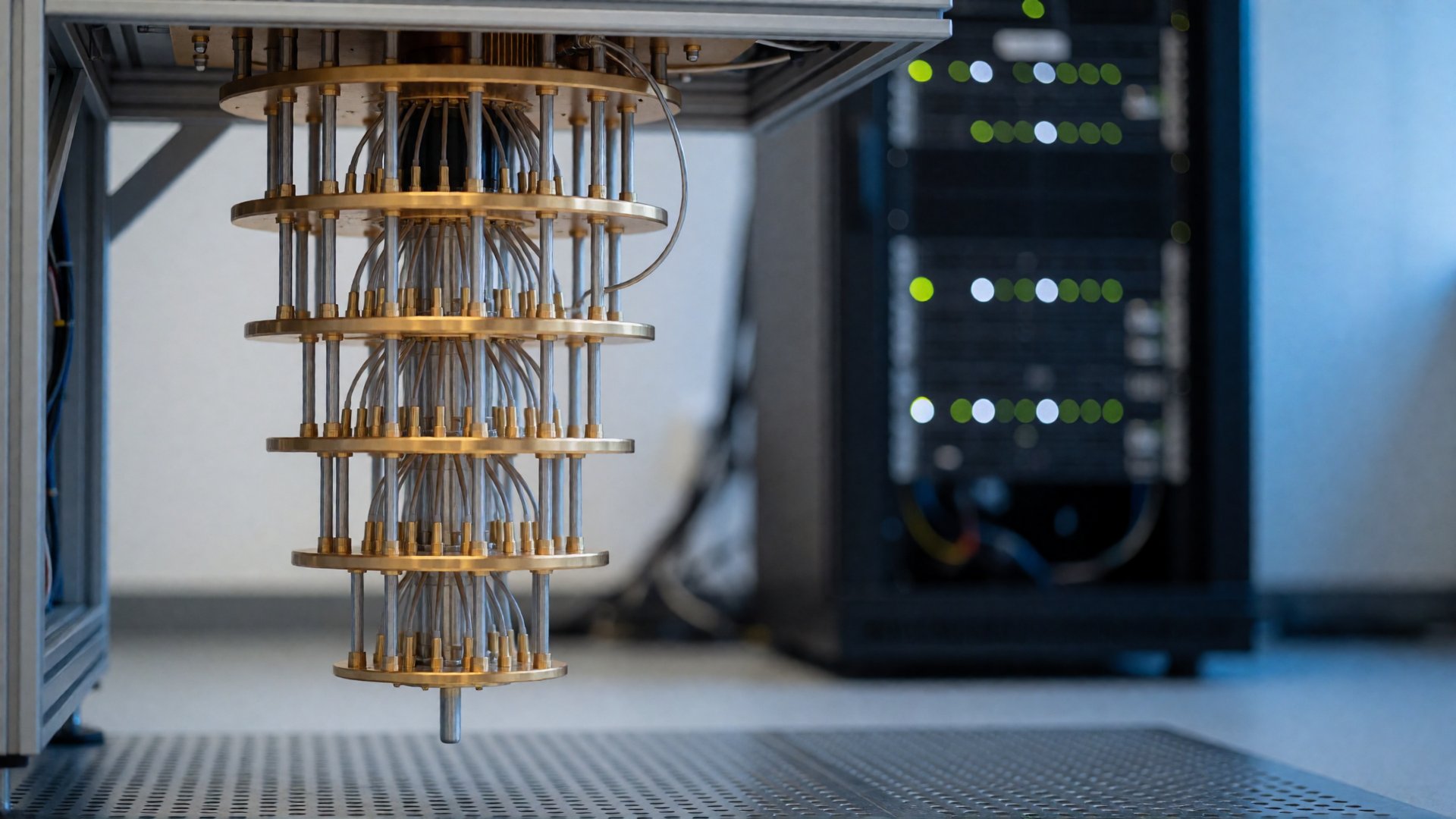
A quantum computer calculates with qubits: building blocks that can be not only 0 or 1, but also a mix of both. Why such a machine can do some tasks much better than an ordinary computer is not yet fully understood. Researchers at Google Quantum AI and academic partners have now tested one of the explanations: a quantum property called contextuality. Their results appeared in the scientific journal Science. The experiments ran on Willow, Google's quantum chip.
A grid that cannot exist
The team started with a puzzle. Fill a grid of three by three squares with pluses and minuses. Every row must have an even number of minuses, so 0 or 2 (zero counts as even). Every column must have an odd number of minuses, so 1 or 3. Filling in one row or column like this is easy, but the whole grid never works. First count all the minuses row by row: three even numbers added together always give an even number, for example 2 + 0 + 2 = 4. Then count the same minuses column by column: three odd numbers added together always give an odd number, for example 1 + 1 + 3 = 5. They are the same minuses, so their number cannot be even and odd at the same time.
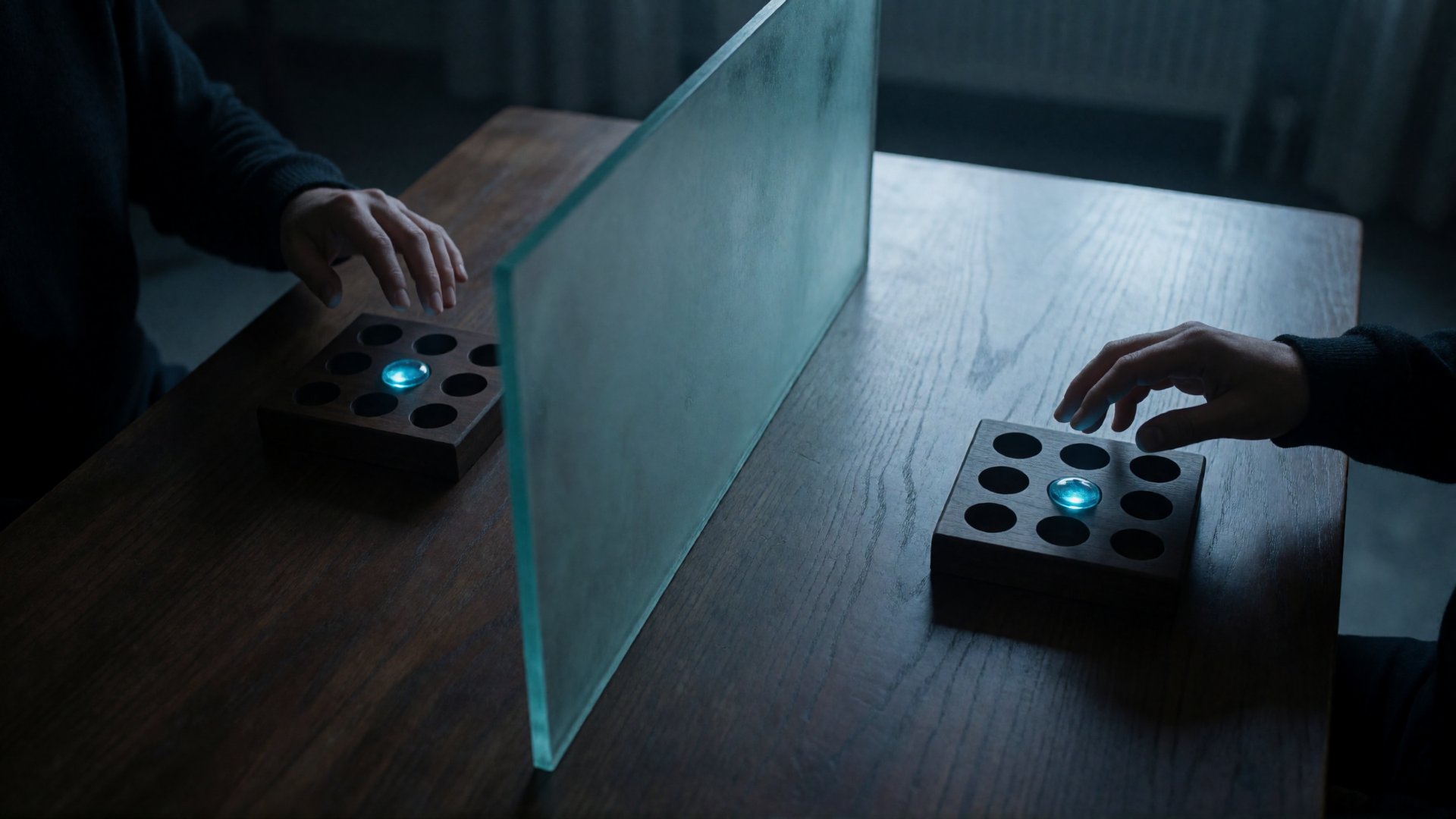
The puzzle has been turned into a game for two players. One player gets a row, the other a column, and they are not allowed to talk to each other. Each fills in their own row or column according to the rules. They win if they put the same sign in the square where the row and the column cross. With a plan agreed in advance, they win at most eight of the nine possible combinations, about 89 per cent.
With a quantum computer, the players can in principle win every round. That is because of contextuality: the outcome of a measurement is not fixed in advance, but depends on which other measurements are made at the same time. So the players do not read their answers from a hidden table. Such a table cannot exist either, because the grid cannot exist. The answers only come about during the measurement. They still match because the players share entangled qubits: qubits whose measurement outcomes are linked to each other, even when they are measured separately.
What Willow showed
On Willow, each player got two qubits, entangled with the other player's two qubits. The team played each of the nine combinations 100,000 times. The qubits won 98.3 per cent of the rounds. They did not win every round because of noise: small disturbances in the chip, which cost about one round in every sixty.
In a second experiment, the researchers measured how strong the effect is. They used a score that can never go above 4 without contextuality and that, according to physics, can be at most 6. Willow reached 5.59.
Then they made the experiments bigger. In a game for many players, each with one qubit, up to 71 qubits took part. More qubits brought more noise, but the chance of winning stayed above that of the best ordinary plan. They also solved a maths puzzle that was proven in 2018 to be solvable by a quantum computer in a fixed, small number of calculation steps, while an ordinary computer cannot solve it in so few steps. For this they used up to 105 qubits, the whole chip. The answer was right in about 60 per cent of the attempts, above the 50 per cent the researchers expect for an ordinary approach.
A stricter test for quantum chips
In these experiments, many qubits have to agree with each other exactly at the same time. That brought to light errors that stay hidden in the usual tests: a fixed, small twist that puts a qubit just off its target. According to Google, such errors largely cancel each other out in the usual tests with random calculation steps.
The researchers therefore propose using contextuality as a yardstick. The ceiling is fixed by physics: a score of 6, or winning every round. The better the chips get, the more clearly the test shows what still goes wrong. That is especially useful for calculations with a fixed structure, such as simulating molecules for chemistry and materials research. According to theory, contextuality is also linked to special states that a quantum computer needs in order to correct its own errors. The same team showed earlier on Willow how it can make those states with around 40 times fewer errors.
What does this mean for the road to the singularity?
Quantum chips are getting bigger and more reliable. With Willow, Google already showed that the errors get smaller as more qubits take part. But extra qubits only help when developers know which errors they bring with them. A test with a fixed ceiling makes that visible. It becomes more valuable as the chips improve, because the gap to the ceiling keeps shrinking and can therefore be measured more and more precisely.
Anyone who announces a better quantum chip in future can put such a score next to it. That makes it harder for other builders to rely only on tests they picked themselves: as soon as one company measures itself against a fixed yardstick, customers and researchers will ask the same of the rest. If developers can then track down and remove the hidden errors more precisely, reliable calculations on molecules and materials come closer. Researchers could then search on the computer for better batteries, substances that make chemical plants use less energy, and new medicines, instead of first having to make every idea in the lab.
What is the technological singularity? Read the explanation →