Nederlands
Hollow-core fibre sends data both ways at once over more than 1,000 kilometres
Chinese researchers sent 64 terabits per second in each direction at the same time over 1,007 kilometres of hollow-core optical fibre. Because the light travels mainly through air instead of glass, the signal arrives sooner. Links like this could help AI data centres work together better.
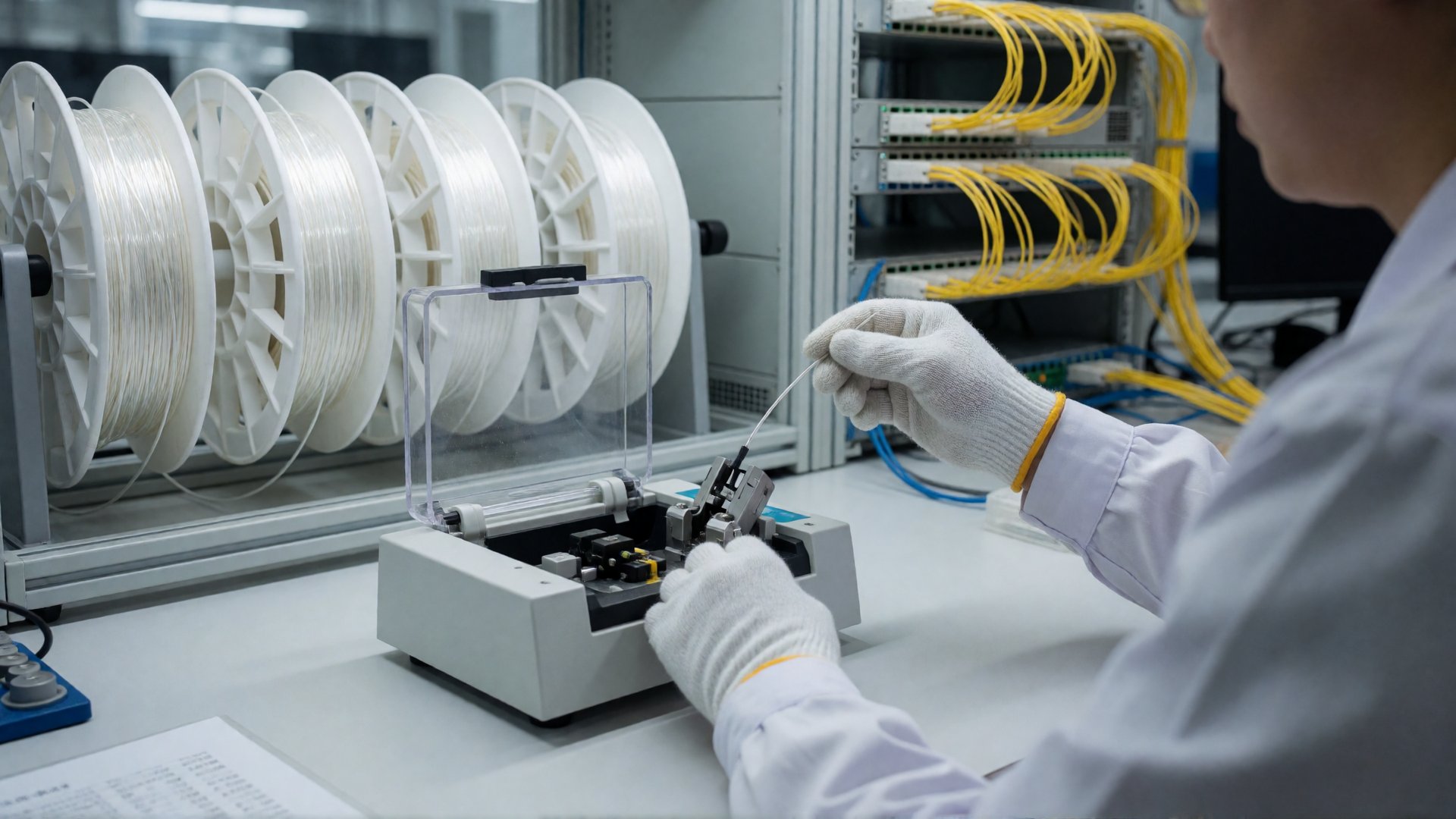
Almost all internet traffic travels long distances as light through optical fibre. Data centres that work together on large AI models are also connected this way. Chinese researchers have now tested a new kind of optical fibre, with a hollow core, over a link of 1,007.48 kilometres. A huge amount of data passed through it in both directions at the same time.
The test was carried out by the research institute of the telecom company China Telecom, the optical fibre maker Yangtze Optical Fibre and Cable, and the network company ZTE. According to the Chinese state broadcaster CCTV, this is the first time that a hollow-core fibre has sent data both ways at once over more than a thousand kilometres.
Light through air instead of glass
In an ordinary optical fibre, the light travels through a thin core of solid glass. Glass slows light down: light moves about a third slower through glass than through air. In hollow-core fibre, the light travels mainly through a channel of air in the middle of the fibre. A fine structure of glass around it keeps the light inside that channel.
As a result, a signal arrives sooner. According to Huo Xiaoli, chief expert for new information and communication technology at China Telecom, the delay becomes 30 per cent smaller. In the test, the signal took 3.43 milliseconds to cover the whole distance.
The link carried 64 terabits per second in each direction, which makes 128 terabits per second over one fibre. According to CCTV, that is enough to send 160 films of 50 gigabytes in 4K quality every second. Sending data both ways over one fibre is difficult, because a small part of the light is reflected back and disturbs the signal travelling the other way. According to the trade journal C114, this interference stayed limited in this test.
Existing equipment, first uses
The researchers used ordinary amplifiers that are already on sale, C114 reports. According to Huo, the test shows that such a fast link works over long distances with existing equipment. According to the report that CCTV draws on, hollow-core fibre doubles the capacity, and the signal goes 60 per cent further than with the best ordinary fibres. The distance is fifty times as long as in earlier tests of this type.
Wang Ruichun, chief scientist at Yangtze Optical Fibre and Cable, says that data centres that train and run AI models together exchange more and more data. In his view, the speed of those links partly decides how efficiently that computing work is done.
Hollow-core fibre is already in use. According to CCTV, a commercial link for the financial sector runs between Shenzhen and Hong Kong, and more than ten commercial and pilot projects are under way in Asia, Europe and elsewhere.
Recently, another Chinese team set a record for real-time processing with an ordinary optical fibre with 24 cores, which carried 3.2 petabits per second. That team chose to put more channels side by side in one fibre. This test instead lets the light travel faster, so there is less waiting time.
What does this mean for the road to the singularity?
Large AI models are increasingly trained in several data centres at once, and those data centres constantly exchange data. Every millisecond of waiting time and every extra terabit counts. This test shows that hollow-core fibre works over more than a thousand kilometres with equipment that already exists. That makes it easier to let computing centres that are far apart work together as one big computer.
What is the technological singularity? Read the explanation →