Nederlands
Robot moth gets a new sense thanks to artificial blood
Researchers from Estonia and Italy had a moth-shaped robot make its own light sensor after it was built, using a kind of artificial blood and UV light. The robot then reacts to UV light by flapping its wings. It is a first test set-up.
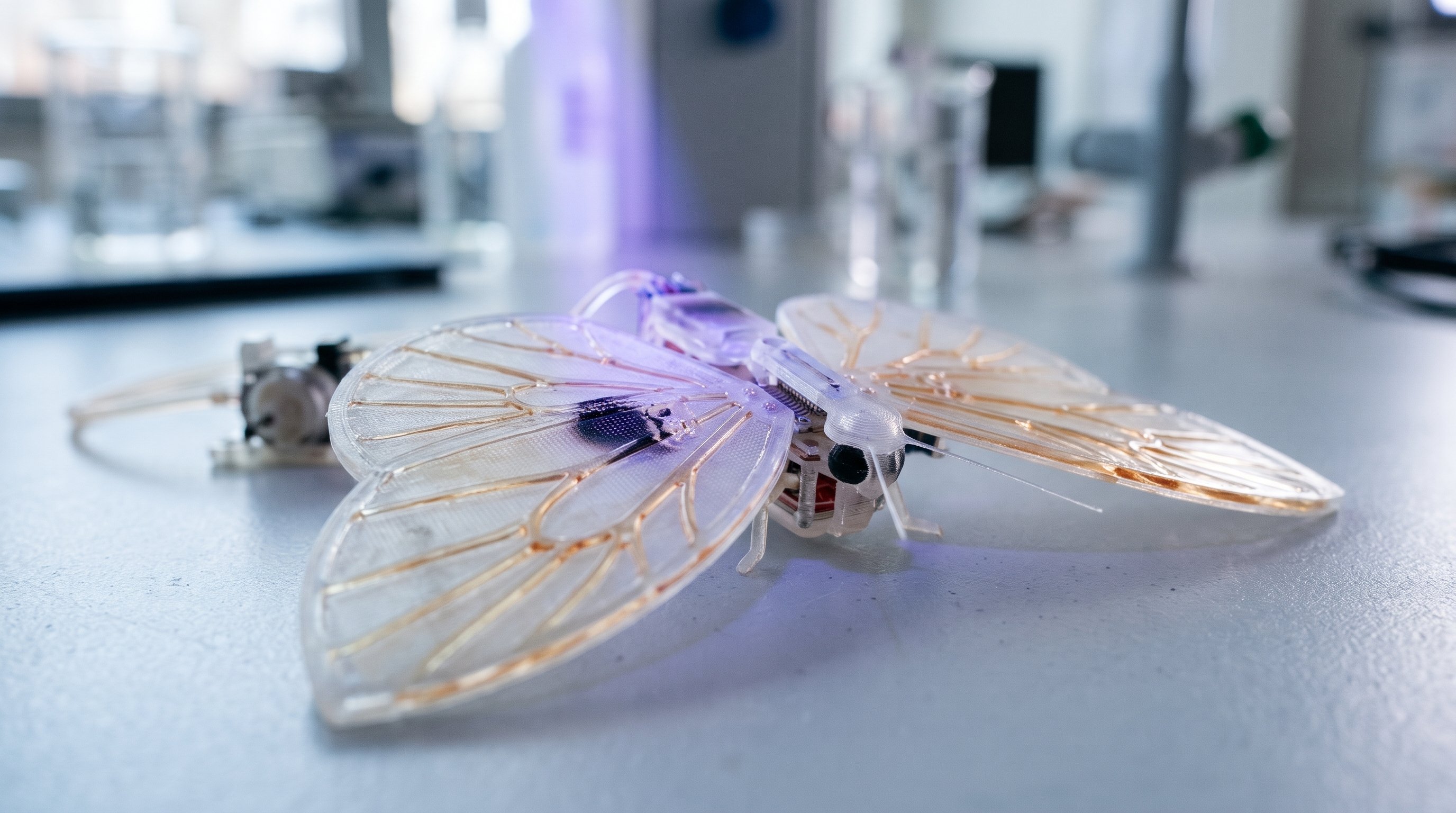
A robot that gets a new sense after it has been built: researchers from the University of Tartu in Estonia and the Italian Institute of Technology have shown that this is possible. They built a moth-shaped robot with an artificial circulatory system. With it, the robot could create a working light sensor at the spot where UV light fell on its body. The study appeared on 23 October 2026 in the open-access scientific journal Advanced Science.
Why a robot would want blood
Robots usually leave the factory with fixed parts. Engineers therefore have to work out in advance which sensors a robot needs. If it later ends up in a situation that nobody foresaw, clever software can solve that only in part: a sense that is not there cannot be programmed in.
In nature it works differently. In insects, a kind of blood flows freely through the whole body. This lets building materials reach every place where they are needed. The researchers took over that idea.
A moth as the example
As their example they chose the clifden nonpareil, or blue underwing (Catocala fraxini), one of the largest moths in Estonia. The body of the robot is 3D-printed from transparent plastic. Each wing is about 86 square centimetres, as big as a large palm. 'Veins' about one millimetre wide run through the wings. A single small pump spreads about 3 millilitres of liquid, roughly half a teaspoon, over the whole body.
UV light makes a new sensor
The artificial blood contains pyrrole, among other things, a substance that turns into polypyrrole under UV light. That is a plastic that conducts electricity. When UV light fell on a spot of the robot for about a minute, a conductive layer formed there and the transparent plastic turned black. With a stencil, the researchers could decide which pattern formed, accurate to 0.3 millimetres.
That new layer works as a sense. When UV light falls on it afterwards, it briefly conducts electricity better. A small computer in the robot notices this and makes the robot react: it flaps its wings, driven by a wire of a metal that changes shape when it gets warm, or it makes a lamp flash. In this way the robot got a sense that it did not have when it was built.
A surprise was that the sensor became more sensitive with every exposure. Leftover pyrrole kept on converting. The researchers see this as a form of memory in the material. After more than four months in storage, the sensors still worked.
A first step
This is a test set-up. The robot can now make one sensor chosen in advance, and that step cannot be reversed. The researchers themselves decided when the veins were filled and where the sensor appeared. In addition, the same UV light was both the building material and the signal that the sensor picks up.
The next question is how a robot can decide for itself what it needs, without people fixing that in advance. Lead researcher Kadri-Ann Pankratov hopes that in ten years' time artificial robot blood will be an obvious choice for some uses. She thinks of layers that protect against rust, that block disturbing radiation or that make contact with living tissue. The same veins can also carry other substances, perhaps also substances whose effect can be reversed.
What does this mean for the road to the singularity?
Robots are still largely finished when they leave the factory. This research shows that a robot can also get a new part afterwards, on the spot and inside its own body. If this works more widely in future, machines can adapt to places that nobody knew in advance, such as a collapsed building or another planet. That makes robots less dependent on people who have to think of everything beforehand: a step towards machines that can improve themselves.
What is the technological singularity? Read the explanation →