Nederlands
James Watt granted patent for a more economical steam engine
The Scottish instrument maker James Watt has been granted a patent for a new way of building steam engines. Because the steam is cooled in a separate vessel, the engine needs to burn far less coal.
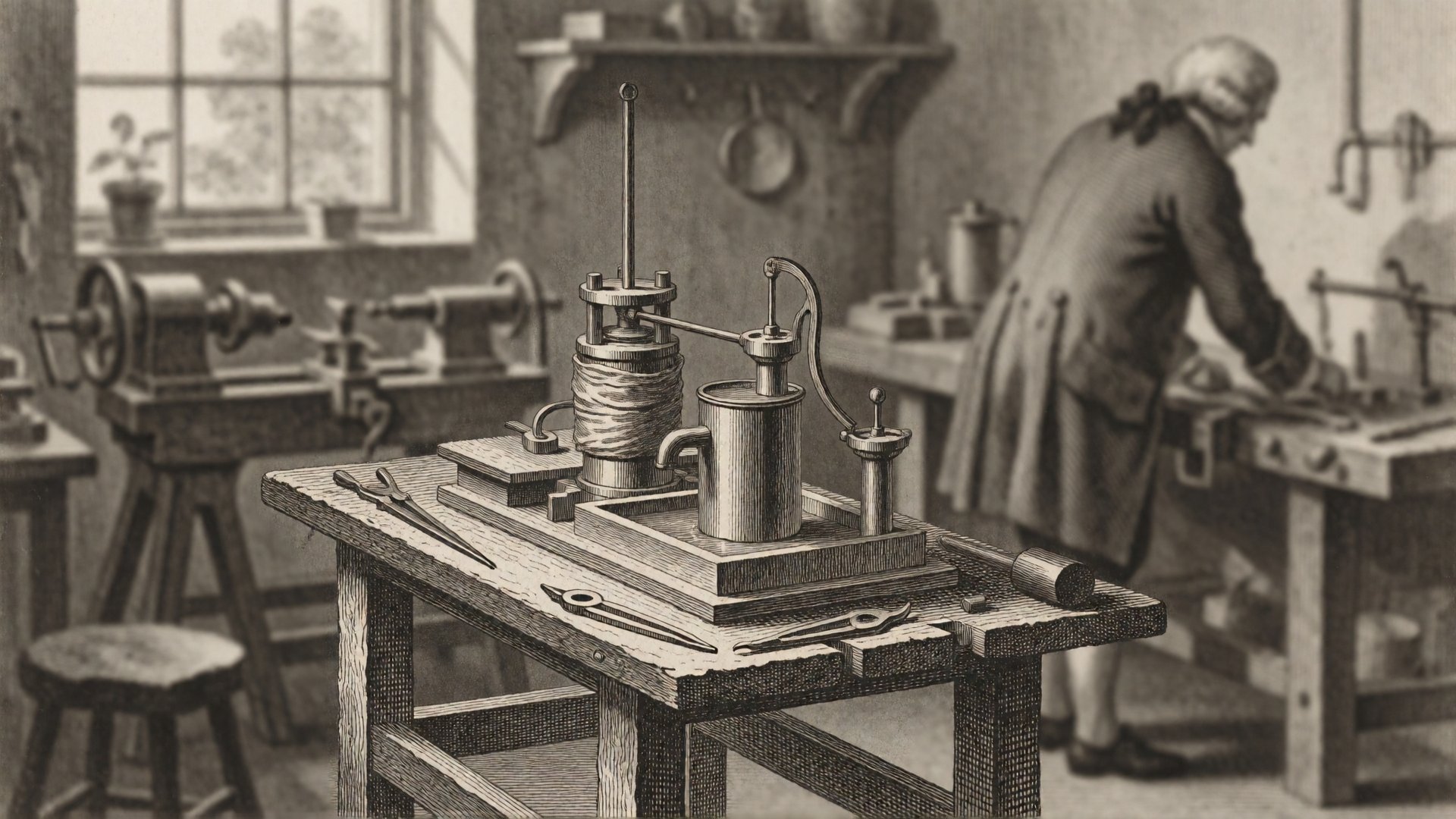
LONDON, JANUARY 1769 - The Scottish instrument maker James Watt has been granted patent number 913 for what he calls a new method of reducing the consumption of steam and fuel in fire engines, as steam engines are called today. It gives him the sole right to an invention he has been working on since 1765. Anyone who works in a mine will soon hear of it: the engine promises to pump the same water out of the shafts with far less coal.
How a steam engine works
Since Thomas Newcomen built his first engine in 1712, steam engines like his have stood at mines all over Great Britain. They are huge machines, as tall as a house. Above a boiler of boiling water stands an upright cylinder with a piston inside it: a disc that fits exactly and can slide up and down. The piston hangs from a heavy beam, a kind of seesaw, and from the other end of that seesaw hangs the pump rod that goes down into the mine.
The steam does not do the work itself. It only fills the cylinder below the piston, while the weight of the pump rod pulls the piston up. Then cold water is sprayed into the cylinder. In an instant the steam turns back into water and takes up almost no space, so an empty space forms below the piston. The air around the engine pushes the piston down with great force, the seesaw tips and the pump rod rises, bringing the mine water up with it. And so it goes, stroke after stroke.
Where the coal goes
Watt discovered the problem at the University of Glasgow, where he had to repair a small model of such an engine. The model could only manage a few strokes, because it used so much steam. The reason: the jet of cold water cools not only the steam, but also the whole cylinder at every stroke. When new steam then comes in, a large part of it turns straight back into water against the cold wall. That steam first has to heat the cylinder before it can fill it. So at every stroke a good shovelful of coal disappears into heating iron.
It is a tricky contradiction. The cylinder must be hot so as not to waste steam, and cold so that the steam disappears.
A second vessel solves it
Watt's solution: let those two things happen in different places. He connects a separate vessel to the cylinder, the condenser, which is always kept cold. When he opens the valve between them, the steam flows by itself into that empty, cold space and turns into water there. The cylinder itself stays hot. A small pump removes the water and air from the condenser, so that it is ready for the next stroke.
So nothing has to be heated up again and again. Watt even wants to wrap the cylinder, so that it hardly loses any heat.
Looking back from 2026
Watt was proved right, although it took years before his engine worked well. The businessman Matthew Boulton took over the stake in the invention, and in 1775 the British Parliament extended the patent until 1800. How much his engines saved differs by source and by comparison: between half and three quarters of the fuel. Boulton and Watt had their customers pay with part of the coal they saved.
Cheap power from fuel changed the world. Factories were no longer tied to water, wind or muscle power. The unit in which we measure the electricity use of a data centre today, the watt, is also named after him.