Nederlands
Michael Faraday generates electricity with an iron ring
In the basement of the Royal Institution in London, Michael Faraday has shown that a current in one wire can create a brief current in another wire, without the two touching. He did it with an iron ring.
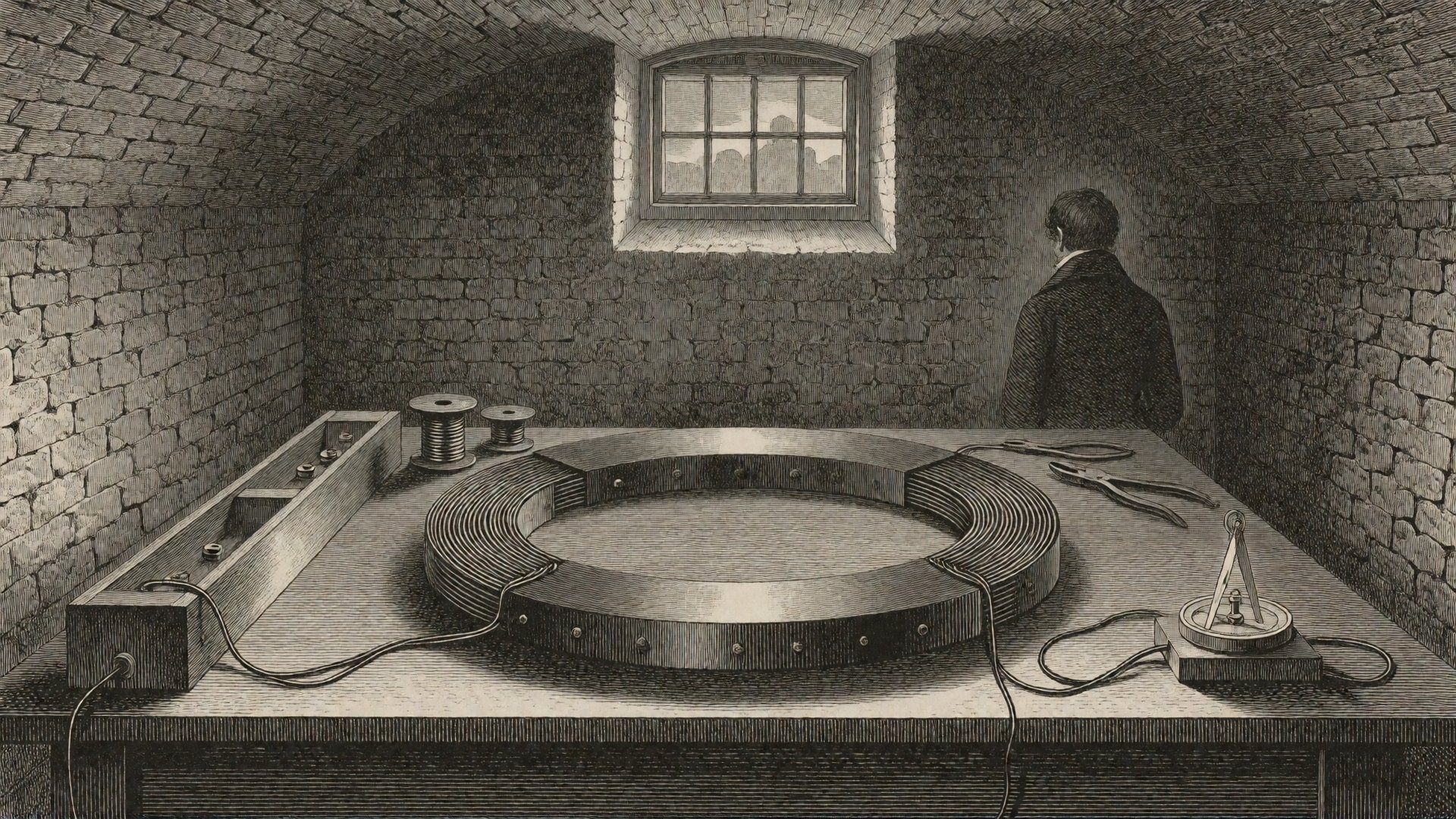
LONDON, AUGUST 1831 - In his laboratory in the basement of the Royal Institution, Michael Faraday has found what he had spent years looking for. On 29 August, using an iron ring and two lengths of copper wire, he managed to create an electric current in a wire that is not connected to a battery anywhere.
What we already know
Electric current has only recently become a tool for researchers. Since the Italian Alessandro Volta built his pile around 1800, a stack of discs of two metals with damp cardboard between them, researchers can keep a current flowing for as long as they want. But such a battery is expensive, and outside the laboratory it has few uses.
In 1820, the Dane Hans Christian Ørsted noticed something strange: a compass needle swings when a current flows through a wire close by. So a current creates magnetism. Not long afterwards, researchers wound wire around a piece of iron and saw that the iron becomes a strong magnet for as long as the current flows.
That raised a question that has occupied Faraday for years. If a current can create magnetism, can magnetism also create a current?
Two coils on one ring
For his experiment, Faraday used an iron ring about 17 centimetres across. On each side he wound copper wire, many turns around the iron. There is cotton between the turns, so the wires never touch and the current cannot jump across. He connected one coil to a battery. The other coil leads to a wire that runs past a magnetic needle. If that needle swings, a current is flowing.
Faraday expected the current on one side to make the iron magnetic, and that magnetism to create a current on the other side.
It is all about the change
When he connected the battery, the needle swung briefly and then came to rest again. The current kept flowing through the first coil, and yet the needle did nothing more. When Faraday disconnected the battery, the needle swung again, this time the other way.
That is the surprise. A magnet that stays the same does not create a current. Only at the moment the magnetism in the ring appears or disappears does a short burst of current pass through the other wire. The change does the work. Faraday will now investigate whether he can turn that short burst into a current that keeps flowing.
Looking back from 2026
He succeeded that same year. At the end of October 1831, he turned a copper disc between the poles of a strong magnet. Because of the turning, the change never stopped and he got a current that kept flowing: the forerunner of the generator. The American Joseph Henry made the discovery around the same time, independently of him. The ring is now seen as the first transformer and can still be seen at the Royal Institution.
This principle is called electromagnetic induction. It is at work in almost every power station and in the transformers of the electricity grid. Data centres in which AI is trained run on electricity that is largely generated in this way.