Nederlands
NVIDIA releases fast planner for robot arms: route in 4.4 milliseconds on average
NVIDIA researchers have released cuRoboV2-Fast, software that works out how a robot arm moves without hitting anything. In their own tests, this took 4.4 milliseconds on average. On a real robot, a work cycle became more than a third shorter than with its predecessor.
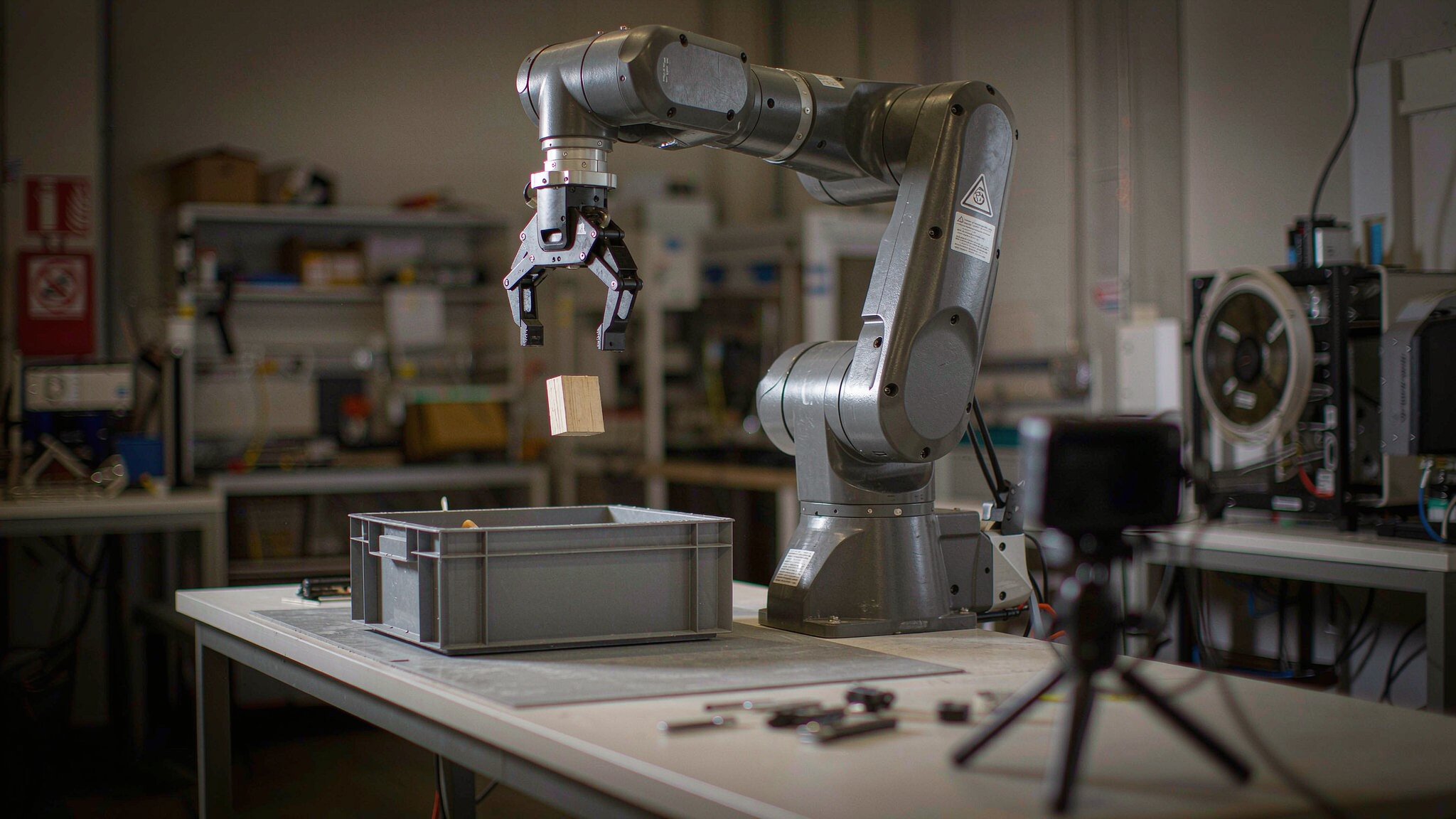
NVIDIA researchers have released cuRoboV2-Fast, software that works out how a robot arm should move. The code is on GitHub under the Apache 2.0 licence: anyone may use and adapt it for free, including companies. The makers, Balakumar Sundaralingam, Adithyavairavan Murali and Stan Birchfield, describe the work in a paper that appeared on the arXiv website on 4 November.
What such a planner does
A robot arm that has to pick something up cannot simply move in a straight line to its target. It must not hit anything, its joints can only turn in certain directions and its motors have a limit to their force. The heavier the object, the more that force limit counts. A planner looks for the fastest movement within all those limits.
This takes computing work, and the robot waits for it. According to the team, cuRoboV2-Fast needs 4.4 milliseconds on average, with a load of 3 kilograms in tests with the Franka Panda robot arm on an RTX 5090, a powerful graphics card. That is 14.7 times as fast as its predecessor, cuRoboV2. On the Jetson AGX Orin, a small computer for use inside robots, it takes 26 milliseconds on average, which is still faster than an earlier version of the planner on the large graphics card. All figures come from the team's own tests.
According to Sundaralingam, the first cuRobo prototype in 2022 still took 100 milliseconds and used up the whole graphics card.
Where the speed comes from
The planner works in steps. First it looks for a smooth path for the arm, then it works out how fast the arm can follow that path without exceeding the limits for speed, acceleration and force. That first step needs fewer rounds of calculation than in older versions: after 25 rounds it succeeded in 93 of the 100 test tasks, against 64 for the first version.
The heavy computing work has also been rewritten so that it runs much faster on the graphics card. If the load in the gripper changes, the planner can immediately calculate with the new weight, without the software having to be prepared again. This helps most with heavier work: with 5 kilograms the planner succeeded in 93 per cent of the tasks, against 78 per cent for the first version.
Faster on a real robot too
The team tested the planner on the robot YAM, which uses a stereo camera to pick up objects and drop them somewhere else. Such a cycle took 5.93 seconds on average, 34.6 per cent shorter than with cuRoboV2. The movements of the arm were 45 per cent shorter. Planning itself was only one per cent of the cycle, so the gain comes mainly from better movements. The planner ran on an RTX 6000 Ada graphics card.
The next step is up to others: now that the code is public, other researchers and companies can check the figures on their own robots.
What does this mean for the road to the singularity?
A robot that handles things skilfully must be able to work out quickly how to move. If that takes almost no time, it can recalculate more often when something changes around it. This now also works on small computers that fit inside the robot itself. Because the code is freely available, anyone can build on it. In this way, an important part of robots that do work independently becomes faster and available to more people.
What is the technological singularity? Read the explanation →