Nederlands
Robbyant releases AI model that gives robot hands a better sense of touch
Robbyant, part of Ant Group, has released LingBot-Touch: an AI model that translates signals from very different touch sensors into one shared language. According to the company, two robot hands succeeded at tasks clearly more often in tests as a result.
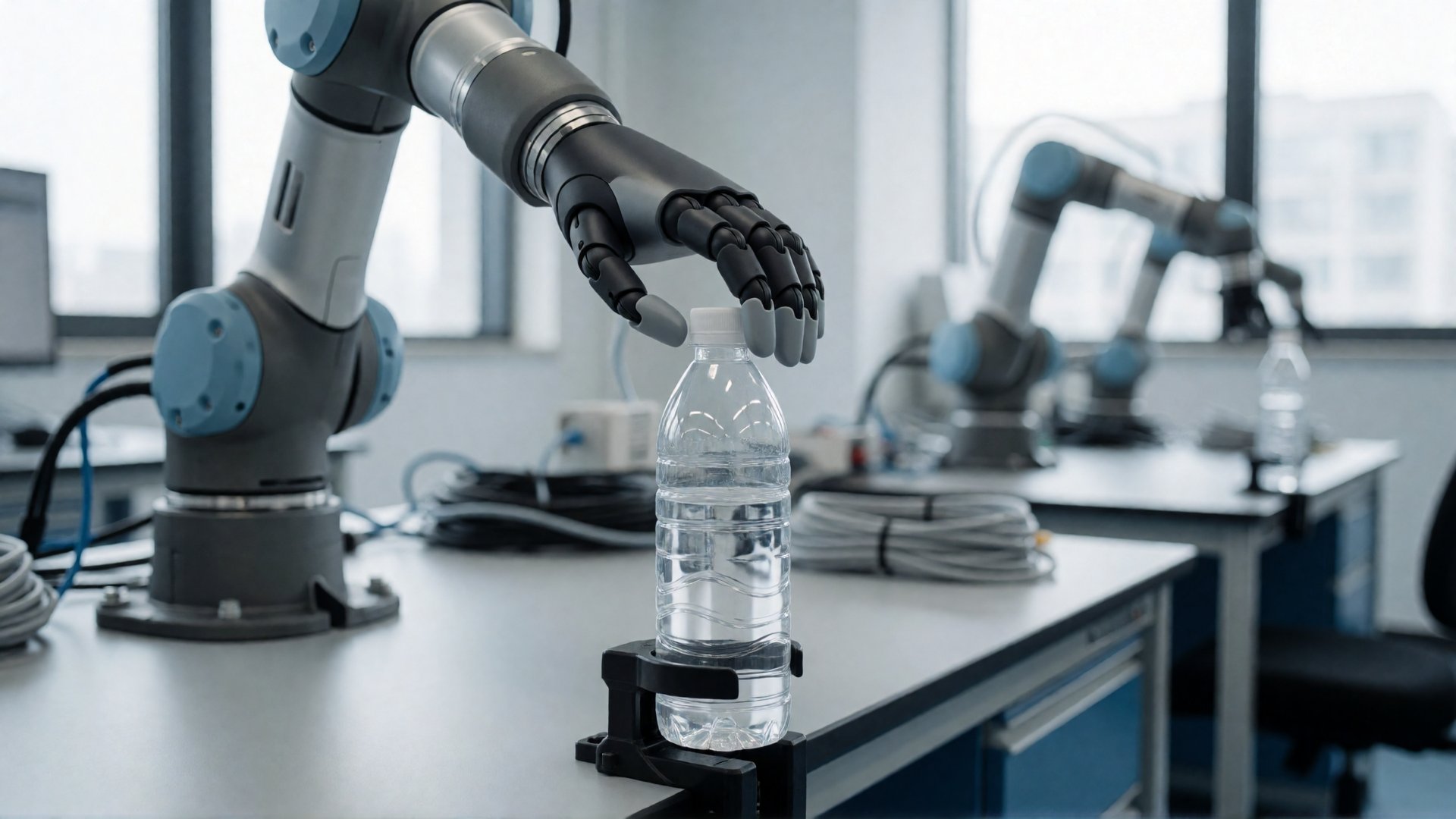
Robbyant, a company of the Chinese Ant Group that develops AI for robots, released LingBot-Touch on 10 November 2026. It is an AI model that helps robot hands understand what they feel. The code is on GitHub under an open licence; to get the model files themselves, you need an account with permission.
Every hand feels things differently
With their fingertips, people immediately feel whether something is smooth, is slipping or is being gripped too hard. Robot hands get touch sensors for this, but these come in very different kinds. Some measure how a magnetic field shifts when a soft layer is pressed in, others film that pressing with a tiny camera, and still others measure how the electrical resistance of a material changes under pressure. As a result, the same touch gives a very different signal with each sensor. An AI model that has learned to work with one sensor does not understand the others, and has to learn again for every new hand.
LingBot-Touch translates these signals into one shared language. Each kind of sensor first gets its own input. The model then puts all contact points on the same map of a fingertip, so it no longer matters which sensor measured them. A shared part of the model uses this to learn where a finger touches something, how the force is spread and how that changes over time.
To learn this, Robbyant used almost 5,000 hours of touch recordings (4,983 hours, spread over 464,431 actions). These came from people wearing gloves with touch sensors and from robot hands that were controlled remotely. Each time, part of the touch data was hidden from the model, and it had to predict the missing part itself. This way it learns without people having to describe everything.
Tests with two robot hands
Robbyant tested the model on 26 real tasks with two robot hands, the Sharpa Wave and the XHand. LingBot-Touch passed its touch information to four different AI models that control a robot's movements (LingBot-VLA, π0.5, Diffusion Policy and T-Rex). Each task was tried twenty times. According to Robbyant, the tasks succeeded on average 14 to 26 percentage points more often than without touch information.
One example is unscrewing the cap of a bottle with the Sharpa Wave. Without touch information this worked in 56 per cent of attempts. When the control model received the raw sensor signals, it was 63 per cent; with LingBot-Touch in between, it was 90 per cent.
The XHand has a magnetic sensor that was not in the training data. Robbyant left LingBot-Touch unchanged for this hand and only trained the control model with examples on it. The touch information still worked, the company reports.
For all tests, Robbyant used the smallest version of the model, with about 5.5 million adjustable numbers. Adding it makes most control models 0.13 to 0.16 per cent larger: hardly any difference. According to Robbyant, a larger version keeps improving as more training data is added. The results come from Robbyant itself; research by others still has to confirm them.
What does this mean for the road to the singularity?
Anyone who works with their hands relies on feel at least as much as on sight. A model that translates touch into one language for different robot hands makes it easier to reuse what one robot learns on another. That is a building block for robots that do delicate manual work, such as unscrewing a cap or turning a key, without every new hand having to learn to feel from scratch.
What is the technological singularity? Read the explanation →