Nederlands
Soft exoskeleton lets divers breathe up to almost 30 per cent less air
Researchers in Shenzhen have developed a soft exoskeleton worn around the hips that helps divers kick with their legs. In earlier tests, divers breathed 18 to almost 30 per cent less air per minute, depending on the movement.
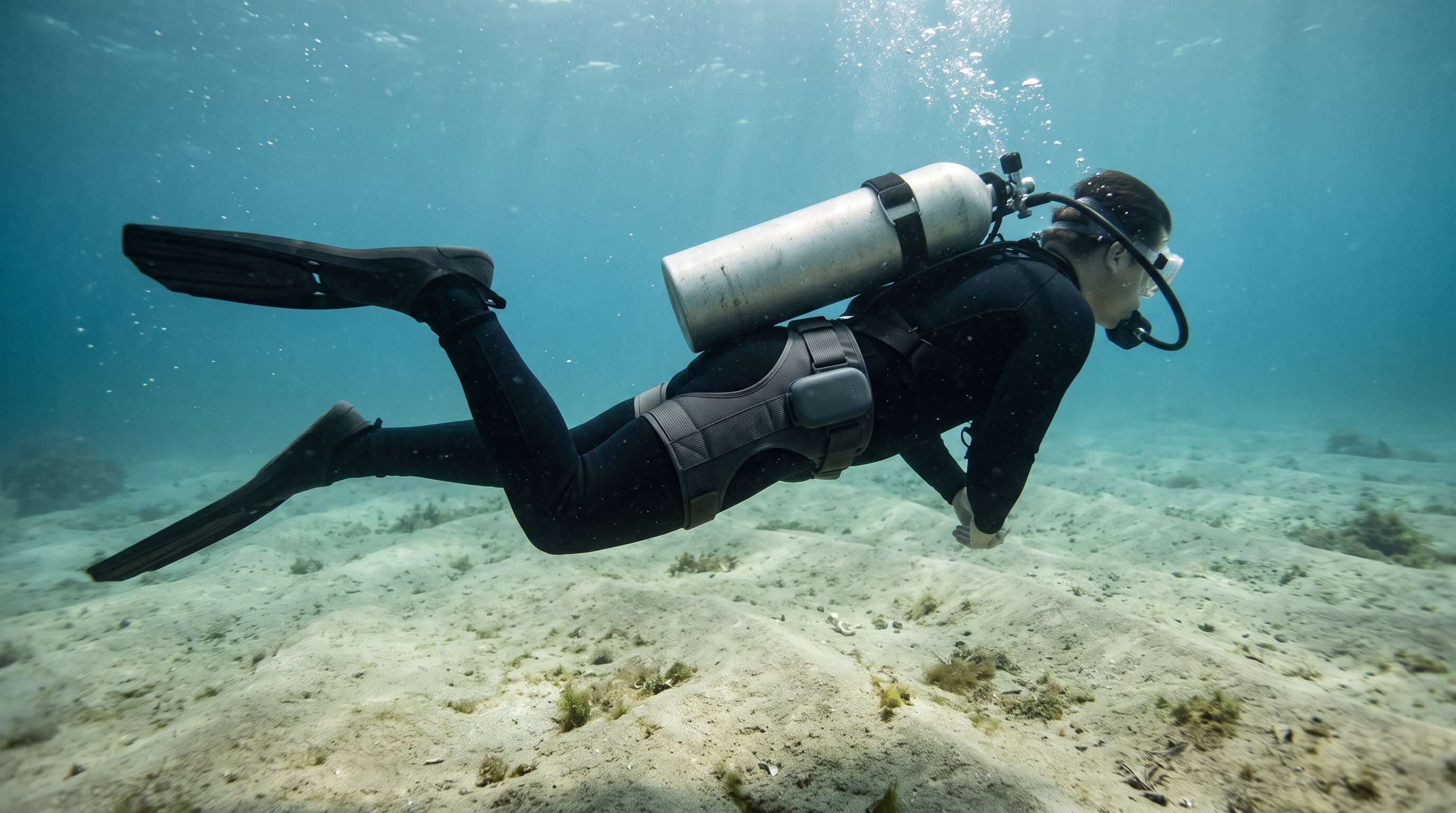
Diving is hard work. With every leg movement, you have to overcome the resistance of the water, and you are also carrying a diving cylinder and other equipment. How long a diver can stay underwater therefore depends on two things: how long the body can keep going and how much air is in the cylinder. The harder someone works, the faster they breathe and the sooner the cylinder is empty.
A team led by Professor Wu Xinyu of the Shenzhen Institute of Advanced Technology (SIAT), part of the Chinese Academy of Sciences, is working on a solution: exoskeletons for use underwater. An exoskeleton is a wearable device that gives the wearer's muscles a helping hand. This version supports the diver's leg movements, so the diver needs less force. The diver stays in control of where to swim and what to do. The team described the work on 21 October 2026 in a so-called Focus article in the journal Science Robotics.
How the suit works
The team's best-known system is called PEAKED. It is a soft suit around the hips, not a rigid robotic harness. It helps the diver both when swinging the leg forward and when pushing it back. Because the suit gives way, the diver can still move their legs freely and naturally. PEAKED helps with three ways of moving: the flutter kick (kicking up and down), the frog kick and walking along the bottom.
According to the researchers, divers using PEAKED breathed clearly less air per minute in earlier tests. With the flutter kick it was 29.8 per cent less, with the frog kick 25.7 per cent and with walking underwater 18.4 per cent. Less air per minute means a cylinder lasts longer.
Why does the suit help in two directions? On land, you mainly carry your own weight, and an exoskeleton mostly helps with pushing off. Underwater, buoyancy holds your body up, but the water slows your leg with every movement, forwards and back. That is why the help has to come with both movements.
Plenty of work before it can be used in practice
The researchers stress that an exoskeleton made for use on land cannot simply be used underwater. The shape of the device, the joints it supports and the timing and direction of the help must match how people move underwater. A usable suit must also work together with the diving cylinder and the weight belt, stay watertight under high pressure and be quick to remove in an emergency.
In April 2026, the Hong Kong newspaper South China Morning Post reported that researchers at the same institute had made a diving suit with motors at the waist that was said to reduce oxygen use by up to 40 per cent. According to that report, the suit continuously reads the leg movement and gives a push at the right moment in each kick, without having to get used to the diver first. The researchers themselves now give the lower percentages above.
They see two next steps. One is a suit that adjusts its help by itself to the diver, the movement and the task. The other is a suit that helps keep the body stable underwater. In this way, a simple aid could grow into a smart wearable system that lets divers do heavy work with less effort.
What does this mean for the road to the singularity?
Robots do not always have to work on their own. This suit shows how a wearable machine can make a person stronger in an environment where our bodies quickly reach their limits. The diver decides, and the machine supplies force at exactly the right moment. In tests, this led to measurably less breathing, and so more time underwater. If later versions adapt by themselves to the diver and the task, such a suit could make work like inspecting pipelines, researching the seabed and salvage safer and less tiring.
What is the technological singularity? Read the explanation →