Nederlands
FlexiQuad: ETH Zurich builds a soft drone that can survive a collision
Researchers at ETH Zurich built FlexiQuad, a drone with a flexible, ring-shaped frame. In a collision, the frame bends with the impact instead of breaking. The 405-gram prototype still reaches more than 80 kilometres per hour.
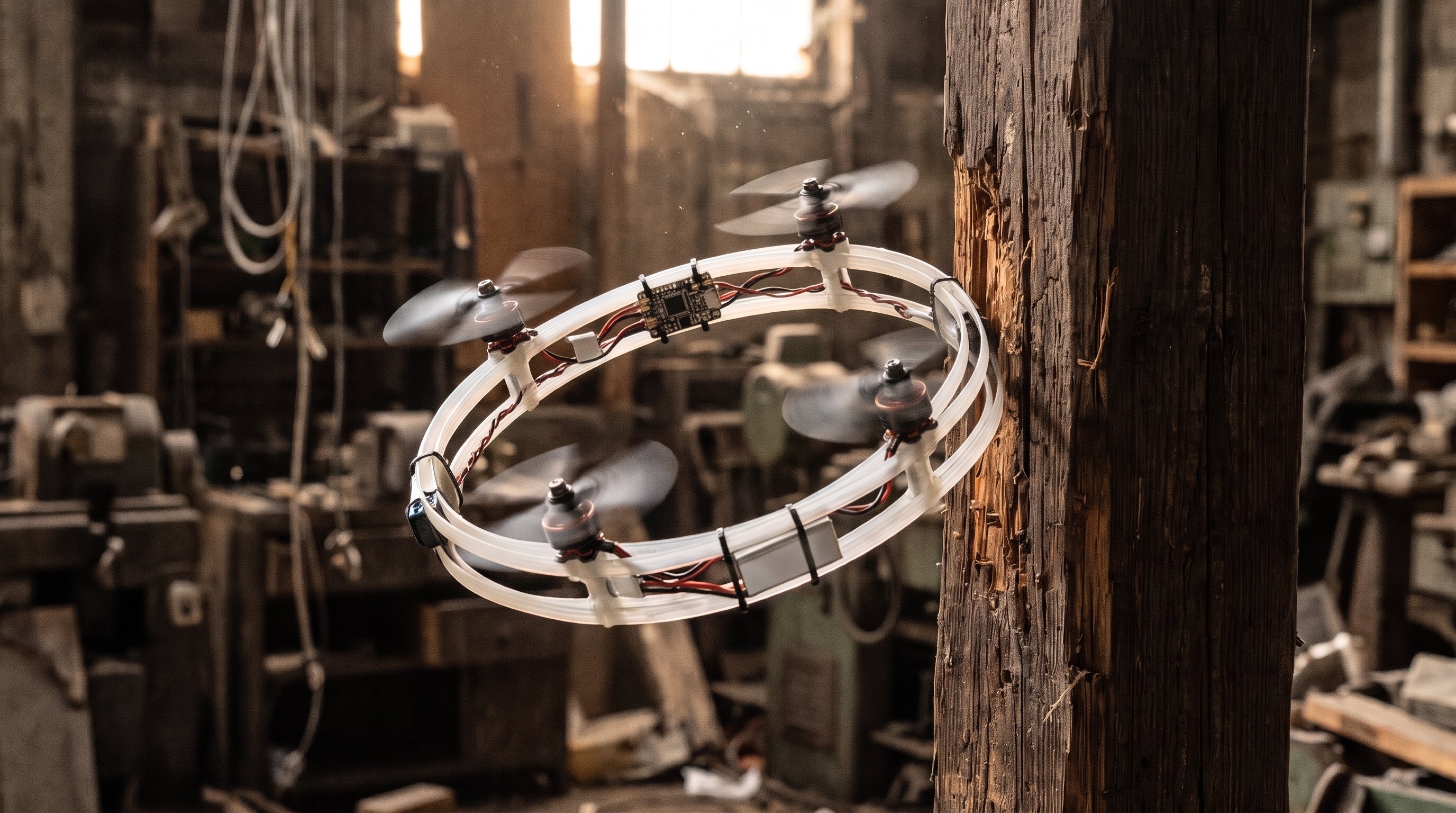
An ordinary drone with four propellers (a quadcopter) has a stiff frame: four arms fixed to a hard central body. This makes it precise and agile. But an unexpected knock against a wall or branch can throw it off balance or break it. That is why drones in cluttered spaces often fly carefully and slowly.
Researchers at the Swiss technical university ETH Zurich took a different approach. Their drone, called FlexiQuad, has no stiff central body but a soft, ring-shaped structure. The propellers, the batteries and the control electronics are spread around that ring. In a collision, the ring deforms for a moment and absorbs part of the blow. Then it springs back.
Playing loads YouTube, which may set cookies. More information
Soft where it must be, stiff where it counts
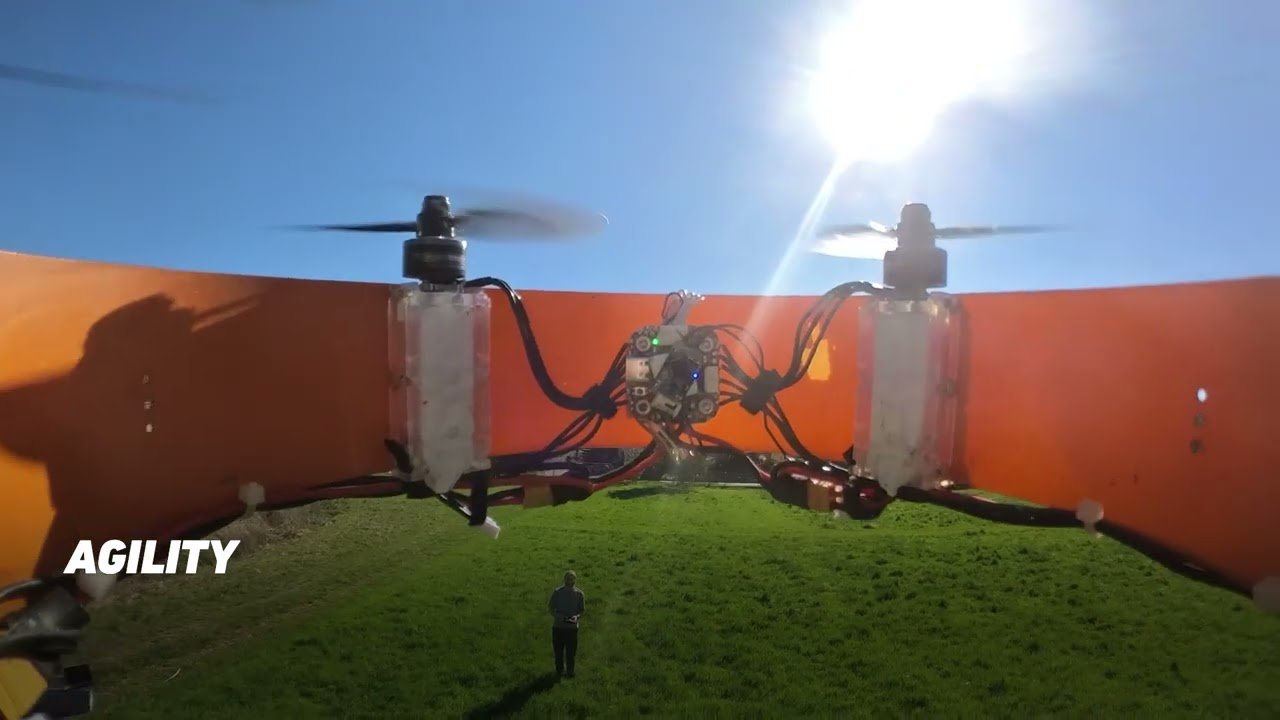
The frame is not equally flexible in every direction. Researcher Luca Girardi, who worked on it for about five years, and Stefano Mintchev looked at birds and insects for this. Their wings bend in some directions and stay stiff in others. FlexiQuad works the same way: sideways, the frame gives way, but from top to bottom it is stiff enough to pass on the force of the propellers. That means the drone can simply keep flying.
This flexibility costs little speed. According to the researchers, the 405-gram prototype reaches more than 80 kilometres per hour and accelerates about as fast as a drone with a stiff frame. The research paper, which has not yet been reviewed by other scientists, reports more results:
- the drone survived head-on collisions at 5 metres per second (18 kilometres per hour) without damage;
- according to the researchers, it withstands collisions four times better than a comparable stiff drone;
- in a glancing collision, the forces that push it off balance were 39 times smaller;
- the frame can be squeezed fully together, so the drone can fly through an opening only 70 per cent as wide as the drone itself.
ETH Zurich reports that the team flew the drone into obstacles at about 25 kilometres per hour in collision tests. The frame bent for a moment and the drone flew on.
The flexible ring can also grab things. In trials, FlexiQuad picked up a soft first-aid bag, carried it and put it down again. It also lifted a load heavier than the drone itself.
Cheap, foldable and made for difficult places
The material for the frame costs less than 15 Swiss francs. The flat parts of the frame fit in a medium-sized suitcase. With quick-release fasteners and plug-in batteries, the drone should in future be quick to assemble on site.
The researchers are thinking of places where a stiff drone quickly gets stuck: inspecting the ballast tanks of ships, searching for people in collapsed buildings and taking measurements in dense forests. Because the drone can compress, a larger version with more sensors and a longer flight time could still pass through narrow openings.
A patent has been applied for on the design. The invention is nominated for the ETH Zurich Spark Award, which will be presented on 26 November 2026. Mintchev is now a professor of agricultural robotics at the University of Bonn; Girardi now works at the Mobile Robotics Lab of ETH Zurich.
What still has to happen
After a collision, the flexible frame keeps vibrating for a moment. This blurs the camera images, which makes autonomous navigation harder. The team is therefore teaching the drone, using reinforcement learning (the computer learns by trying and being rewarded), to stabilise itself again after a hit with its own motion sensors and then keep flying on its own. Reliable autonomous flight outside the lab is the next step.
What does this mean for the road to the singularity?
Machines that work independently in the real world keep running into unexpected obstacles. Until now, a drone had to choose: fast and agile with a stiff frame, or safe and slow. FlexiQuad shows that a drone can be both. A robot that simply absorbs a collision does not have to avoid every obstacle perfectly. Together with control that learns from collisions, this brings drones closer to doing their work on their own in collapsed buildings, ship holds or forests.
What is the technological singularity? Read the explanation →