Nederlands
Robot works out what people really mean from a single correction
Researchers at MIT and New York University have built FLEX, a method that lets a robot work out from one ordinary sentence what a person really means. In simulations, a robot arm then also avoided objects that nobody had mentioned.
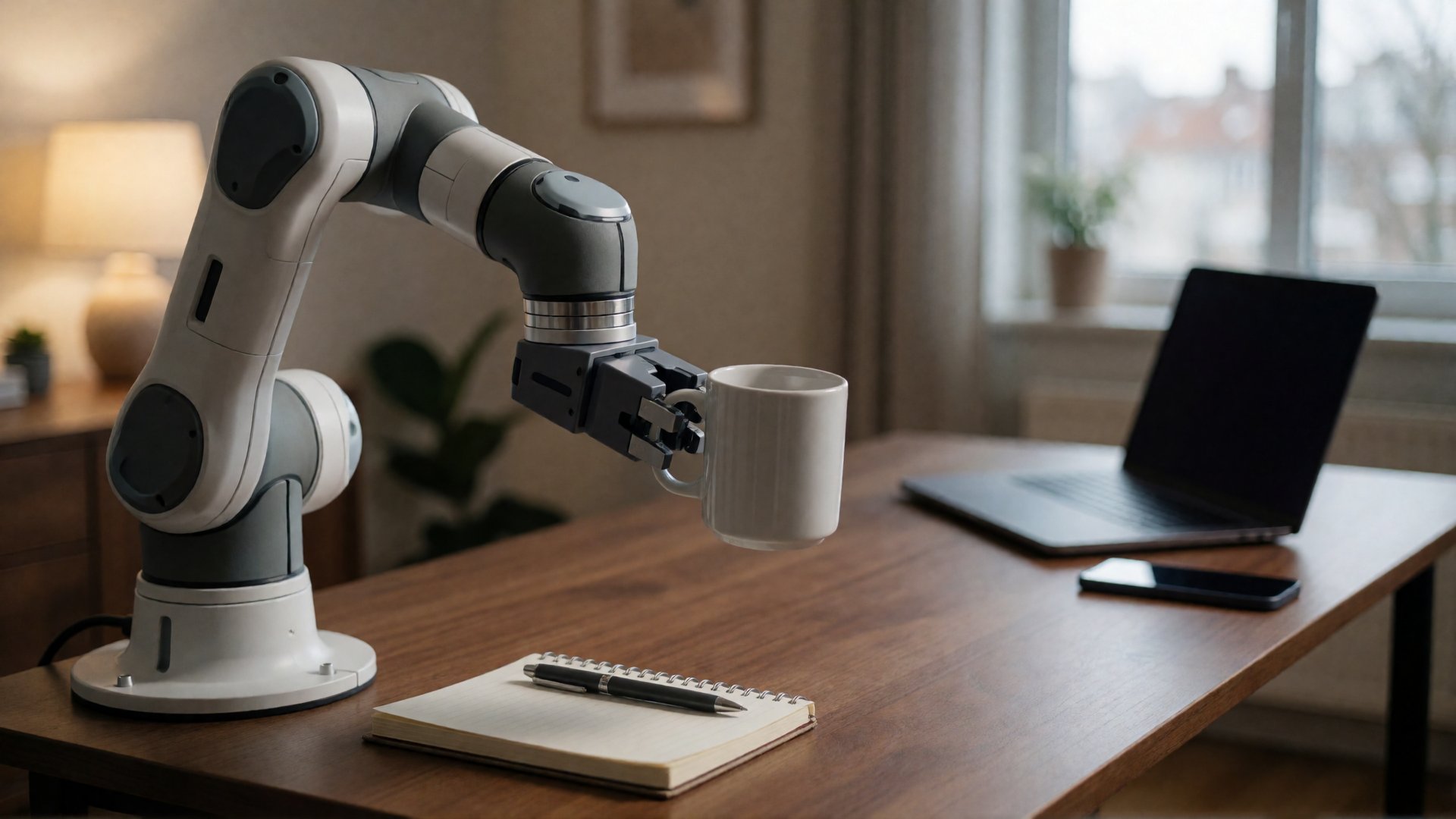
Anyone who asks a housemate not to spill coffee on the laptop does not need to add that the phone next to it should stay dry too. People understand the intention behind a sentence like that. A robot does not do this by itself: it avoids exactly what it is told about and nothing else. If it should also avoid the phone, someone has to say so separately.
Researchers at the Massachusetts Institute of Technology (MIT) and New York University have built a solution for this, called FLEX. With it, a robot works out from a short correction in everyday language which rule lies behind it. In a simulation, a robot arm carrying a cup of coffee across a crowded table was told not to spill on the laptop. It then chose a route that also went around a phone, although nobody had mentioned the phone.
The research was led by Andreea Bobu, an assistant professor of aeronautics and astronautics at MIT, where she heads the CLEAR Lab. The team is presenting the work in the week of 9 November 2026 at the Conference on Robot Learning in Austin, Texas.
A list that keeps up
A robot plans its movements using a list of things in its surroundings that matter, such as "stay away from the laptop". Earlier methods could only make such a list longer. After many corrections, the list fills up with separate rules that are too specific, including rules about objects that are long gone.
FLEX changes the list in three ways. First, it adds what the user mentions, for example the mug that the robot must not drop a bowling ball on. Then it makes the rule broader: a language model works out that the rule is really about fragile objects. Finally, it removes rules that no longer matter. The language model the researchers used was GPT-4o from OpenAI. According to MIT, such an update takes about five seconds.
Tested with volunteers
The team tested FLEX in simulations of a robot arm that carried coffee, moved a burning candle and transported a bowling ball. With the candle, the robot learned to avoid things that can catch fire; with the bowling ball, things that can break. In a simpler test on a floor plan, FLEX achieved the best result, or a shared best, in all seven situations tested. With the other methods, the list became more and more cluttered after a series of corrections.
Twelve volunteers, five of whom had never worked with a robot, typed their own corrections for the simulated robot arm. They felt that the robot understood their intention better with FLEX than with two earlier methods. This test took place on a computer, because some older methods made the arm move unpredictably. The researchers also tested FLEX afterwards with the typed corrections and with recordings of a real robot arm.
The researchers are clear about the limits. FLEX works for solid objects that can be described in words, and it relies on the common sense of the language model. It works less well for very personal preferences that go against what most people would expect.
What does this mean for the road to the singularity?
A household robot has to learn different rules in every home. According to Bobu, FLEX can pick up these rules from a sentence or two, without anyone having to spell out every rule. That is a step towards robots that people can simply talk to, like a housemate. The work was done with GPT-4o, a language model from 2024 that newer models have since overtaken. With a stronger model, a robot can probably guess even better what people mean. The next step is for robots to show this outside the simulation, in real homes.
What is the technological singularity? Read the explanation →