Nederlands
Skild AI releases fast simulator for training robots
Skild AI and Nvidia have released Steel: software that calculates on a computer how robots move. For a mix of many kinds of robot tasks, it is up to 13 times as fast as the widely used PhysX, according to the company's own measurements. Anyone can now use and test the code.
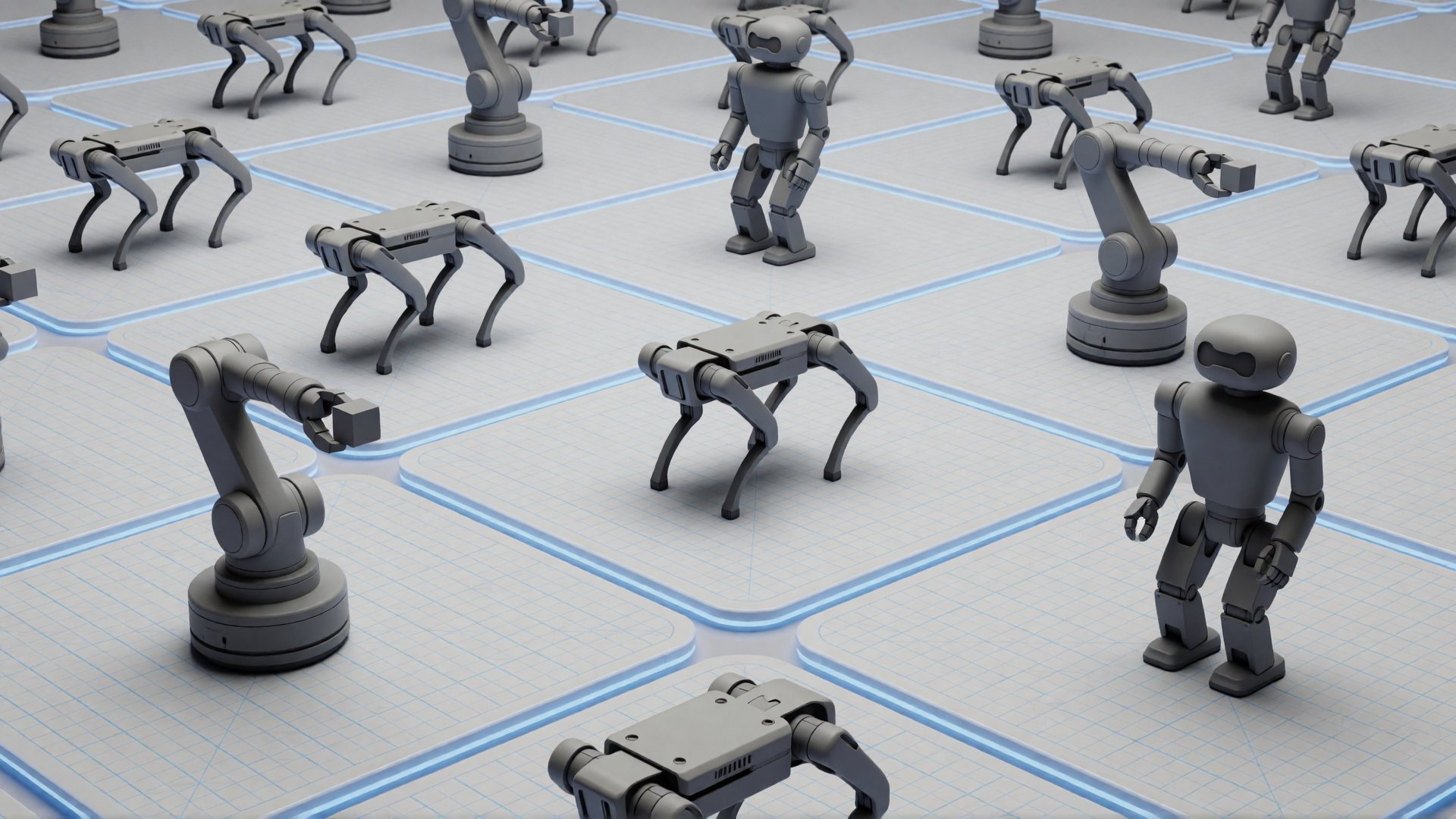
Robots learn many skills not in the real world but in a simulation: a computer calculates how a robot arm, a robot dog or a humanoid robot moves, bumps into something or picks something up. This way a robot can practise thousands of times at once without breaking anything. The faster that calculation software works, the more practice a robot gets for the same money.
The robotics company Skild AI released Steel for this on 9 November 2026, developed together with chipmaker Nvidia. Steel is part of Newton, an open physics engine: it is the part that calculates how rigid objects and robot joints move and touch each other. The code is free on GitHub under the Apache 2.0 licence, so anyone may use and change it. Steel is designed for Isaac Lab, Nvidia's training environment for robots.
Many different robots at once
Training robots broadly means letting not one robot practise, but many kinds of robots on many kinds of tasks at the same time, on a single graphics card. These simulations need very different amounts of calculation: a robot hand with many joints turning a small block takes more work than an arm pushing a box. According to Skild, Steel keeps track of how much work each simulation needs and groups robots with roughly the same number of joints together. That way, less computing time and memory is wasted.
What the measurements show
Skild tested Steel from 7 to 9 November on a single Nvidia RTX PRO 6000 Blackwell card. Steel was faster in nineteen of twenty separate training tasks than PhysX, the physics software in Nvidia's robot simulator Isaac Sim: on average almost four times as fast. Compared with MuJoCo Warp, another fast simulator, Steel was about a third faster.
The biggest difference is in mixed groups of five to twenty kinds of tasks, with humanoid robots, four-legged robots, robot arms and robot hands mixed together. There, according to Skild, Steel reached 9 to 13 times as many simulation steps per second as PhysX at its best. In a comparable test with twenty kinds of tasks and more than 61,000 simulations at once, Steel also used about 11 gigabytes of memory, compared with 29 gigabytes for PhysX.
The figures come from Skild itself and cover only the physics calculations, not the whole training: cameras, rewards and the learning itself were not part of the measurement. Skild compared Steel with PhysX from Isaac Sim 6.1 and reports that the previous version, 6.0, ran these mixed tests up to 2.7 times faster. Because the code and the test set-up are public, other researchers can now check the results. Anyone who wants to can also try Steel in the browser, with playful scenes such as a tower of wooden blocks and a wrecking ball.
What does this mean for the road to the singularity?
Robots that can handle many different jobs need an enormous amount of practice in many different situations. If that practice can be done faster and with less memory, training such broad robot skills becomes cheaper. Because Steel is open, smaller labs can also start using it. The next step is to see how much faster complete training runs become in practice.
What is the technological singularity? Read the explanation →