Nederlands
AI agent chooses gene therapy and injects the brain of a live mouse
The US biotech company Exin Therapeutics says an AI agent running on Claude Sonnet 5 chose a gene therapy and a brain region by itself and injected a mouse with epilepsy. Models from OpenAI and xAI ran the same test, each making its own choices. Now the team is measuring which therapy works.
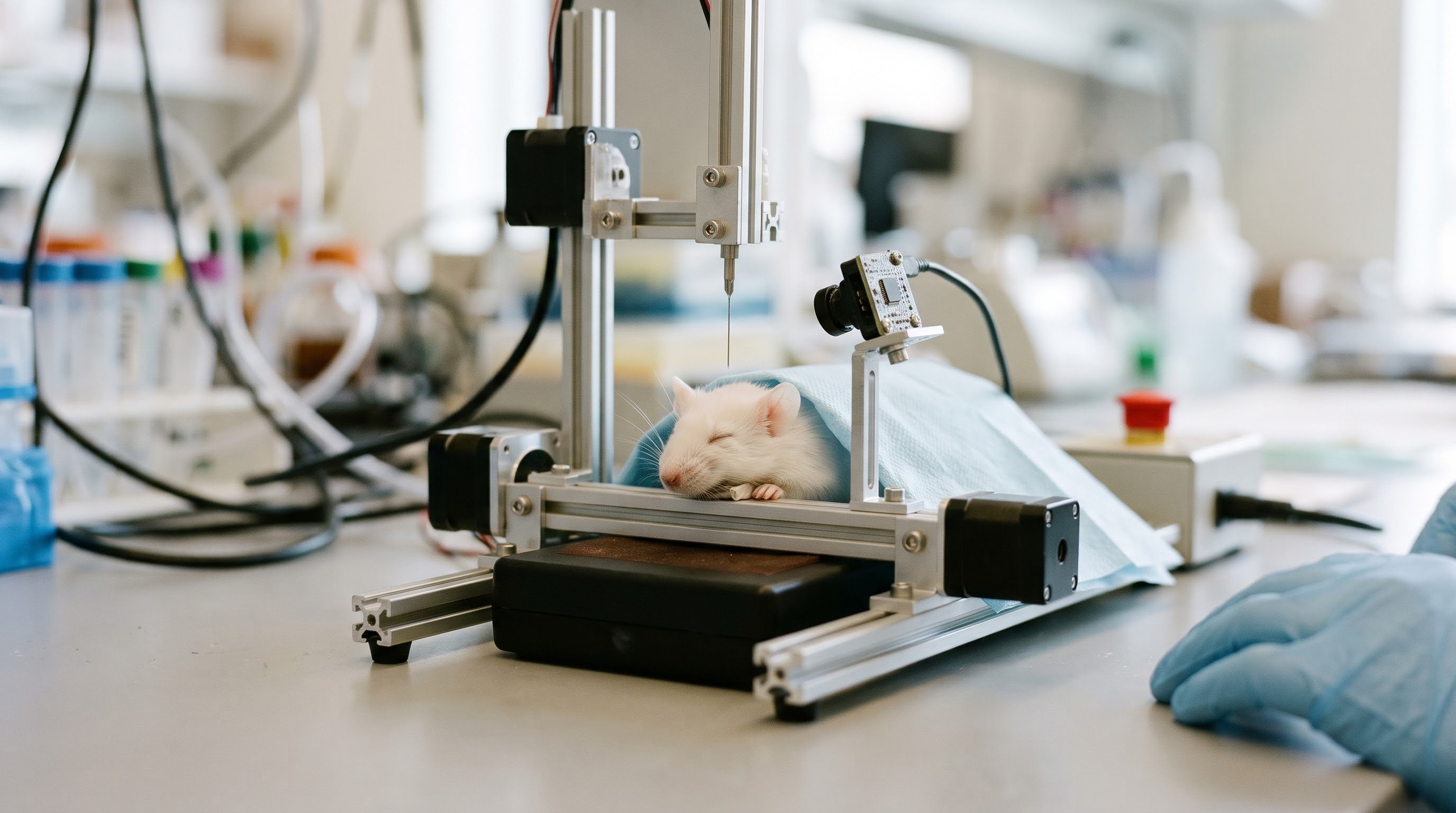
According to the US biotech company Exin Therapeutics, an AI agent has chosen a treatment by itself and given it to a living animal. The agent, an AI program that carries out tasks on its own, ran on Claude Sonnet 5 from Anthropic, the company behind Claude. It chose a gene therapy for a mouse with epilepsy, decided where in the brain it should go, and then controlled a self-built, motorised rig that positions the needle. Exin, based in San Francisco, uses AI to look for medicines for brain diseases and is starting with epilepsy. Co-founder and chief executive Gabriel Ocana-Santero, trained as a neuroscientist and pharmacologist in Oxford, described the procedure on 28 October 2026 in a series of posts on X and later spoke about it with the technology magazine WIRED.
The team gave the agent a spreadsheet with 19 possible gene therapies, a mouse strain that inherits epileptic seizures, and access to the rig, which has cameras. The only instruction: make the mouse have fewer seizures, especially the severe ones in which the body stiffens and jerks. A gene therapy here is a liquid containing harmless viruses, which carry a small piece of genetic material into brain cells. The cells then start making a protein of their own that changes how they work.
What the agent decided
During an epileptic seizure, very many nerve cells become overactive at the same time. The agent therefore chose a therapy that strengthens the calming signal GABA. GABA is the main substance nerve cells use to slow each other down. The therapy works only in the calming nerve cells themselves, the cells that release GABA.
As the target, the agent chose the lateral entorhinal cortex, a brain region that earlier research suggests is where this type of seizure begins. It rejected a second candidate because the effect there varied strongly in earlier studies. The agent took the exact needle position from three scientific papers and averaged it. It also set the amount and the speed itself: 250 nanolitres, a quarter of a cubic millimetre, injected slowly over five minutes. Meanwhile it looked at the injection site through the camera 32 times, among other things to see whether blood or liquid came back.
Why let an AI do this itself? AI models learn mostly from published papers, Ocana-Santero tells WIRED. Failed experiments, unexpected observations and the choices researchers make along the way are usually not in them. By letting agents work directly with lab equipment, the models become more reliable, he says. That goes a step further than the one-person company Mithril Medicine, which Anthropic recently acquired. There, Claude coordinated the work with eleven laboratories, such as contracts and planning, but people did the experiments. At Exin, the AI operated the equipment itself.
Safety first, even if it takes time
A veterinary surgeon made the small opening in the skull and closed the wound afterwards. For safety reasons, the agent was not yet allowed to do that part. The vet also approved every step that could not be undone, and held an emergency stop that cuts power to all motors. Fixed limits applied as well, such as a maximum amount of liquid, and the agent was not allowed to get around any of these rules or change the rig's software.
Those rules were tested halfway through the procedure. The connection between the agent and the rig dropped for a moment. When the agent then wanted to move the needle, the rig refused: according to the controller, one arm had to move to a point 34 millimetres away, while that arm can only travel 30 millimetres. The agent suspected the rig was no longer calibrated properly and did not want to try again, even after the team reset the zero point. It turned out to be right: the controller was tracking a wrong position because of an error in the software that drives the motors. Parts that had earlier been moved by hand played a role in this. The team fixed the error during the procedure itself. According to WIRED, it had a separate agent, running on Claude Opus 5, change the code for this, without telling it that an operation was under way. Because of the fault, the procedure took a little over an hour, against about 45 minutes normally. The mouse recovered well, according to Ocana-Santero.
The team had first tried the heavier Claude models. According to Ocana-Santero, Claude Opus 5.5 stopped immediately when it noticed that this was a biological experiment. Claude Opus 5 did a full practice run without an animal, using water and graph paper, but refused to start the real operation. The model said that its connection to the rig could drop halfway, and that stopping with a needle in the brain of an anaesthetised animal is worse than not starting. Of the Claude models, only Sonnet 5 carried out the procedure from start to finish. Anthropic did not respond to questions from WIRED.
Three AI models, three different choices
Two days later, Ocana-Santero reported that the team had also given the same task to GPT-6.1 Sol from OpenAI and Grok 4.7 from xAI, each with a different mouse. All three chose a different therapy and a different brain region:
- Claude Sonnet 5 chose the lateral entorhinal cortex and a therapy that strengthens the calming signal GABA.
- GPT-6.1 Sol chose the hippocampus, a region that is important for memory, and a therapy that targets small channels in the wall of exciting nerve cells (the cells that switch other nerve cells on), so that the calming effect already present works better.
- Grok 4.7 chose the part of the cerebral cortex that processes touch and sensation, and combined two therapies to strengthen the calming effect there.
The amount of therapy also differed: one model chose about twice as much as another. And the models behaved differently. Claude looked through the camera 32 times, Grok 28 times and GPT-6.1 Sol 59 times. GPT-6.1 Sol saw a small dark red droplet near the opening, thought of a bleed and left the judgement to the vet; according to the team it was a normal amount. With Grok, the vet accidentally pressed stop while the needle was being withdrawn. Grok then refused to put the needle back into the brain, because the dose was already in. The team calls that the right choice.
Ocana-Santero stresses that this is not a real comparison test: each model did it once, on one mouse, with different equipment problems each time. He sees it as a first look at how the models reason and behave in a real lab.
What still has to happen
All claims come from the company itself, and the results have not yet been reviewed by other scientists. Exin has announced a more detailed technical report. The team will follow the three mice over the coming weeks and measure their behaviour and brain activity. Only then will it be clear which therapy really reduces the number of seizures.
Ocana-Santero says that robots that operate on their own already exist and are mechanically more precise, but that in those systems a human always chose the treatment. As far as he knows, an agent has never before chosen both a treatment and a target area by itself and then given it to a living mammal.
Tom's Hardware points to questions about who is responsible if something goes wrong, and to the wider debate about animal testing. The news agency Reuters showed earlier this year that AI in the operating room can also bring new risks: after a navigation system for sinus surgery received AI in 2021, the US regulator FDA received at least 100 reports of malfunctions and incidents, against 8 in the years before. Such reports do not always say what the cause was; the manufacturer says there is no evidence of a link with the AI.
Exin now wants to connect its agents to more parts of the lab, such as equipment that measures brain activity and behaviour tests. It also wants to test how agents deal with faults, interruptions and ethical choices. For the time being, the team will not let the agents open the skull, to protect the animals. The company is also waiting for access to Anthropic's Model Hardware Standard, a shared way for AI agents to recognise and operate lab equipment. Anthropic opened it as a trial version for a first group of labs and manufacturers on 27 August 2026. Anthropic itself writes that Claude knows the world from text and images, and that its spatial understanding therefore still needs oversight by experts. Human oversight remains essential for the time being, according to Ocana-Santero, and letting an agent work on a human is still a long way off.
What does this mean for the road to the singularity?
If the claims hold, this is one of the first times an AI model has not only chosen a treatment but also given it to a living mammal itself. That is a step from AI that advises to AI that works alongside people in the lab. If agents can operate lab equipment reliably, they can run an experiment, read the result and design the next one, and that could speed up research into new medicines considerably. The test also shows what matters now: the models each chose a different treatment, and some refused or stopped rather than take a risk. Larger, repeated experiments and the measurements on the mice have to show which choices work best, and how to balance caution and speed well.
What is the technological singularity? Read the explanation →
Sources
- Tom's Hardware
- WIRED
- The Decoder
- Gabriel Ocana-Santero op X
- Gabriel Ocana-Santero op X (28 oktober, via Threadreader)
- Gabriel Ocana-Santero op X: vergelijking van drie modellen (30 oktober)
- Vergelijking van drie modellen (30 oktober, via Threadreader)
- Fathom News
- Anthropic: Model Hardware Standard
- Reuters: As AI enters the operating room