Nederlands
AI program AlphaFold predicts the shape of proteins almost as accurately as the laboratory
At the CASP14 competition, DeepMind's AI system AlphaFold predicts the 3D shape of proteins almost as accurately as laboratory measurements. The protein folding problem, which biologists worked on for fifty years, is thereby largely solved.
LONDON, NOVEMBER 2020 - One of the oldest puzzles in biology seems to have been solved. The AI system AlphaFold from the company DeepMind has predicted the three-dimensional shape of proteins at the CASP14 competition with an accuracy close to that of laboratory measurements. The organisers of the competition call it a solution to the protein folding problem, which researchers have worked on for about fifty years.
What is a protein, and why does its shape matter?
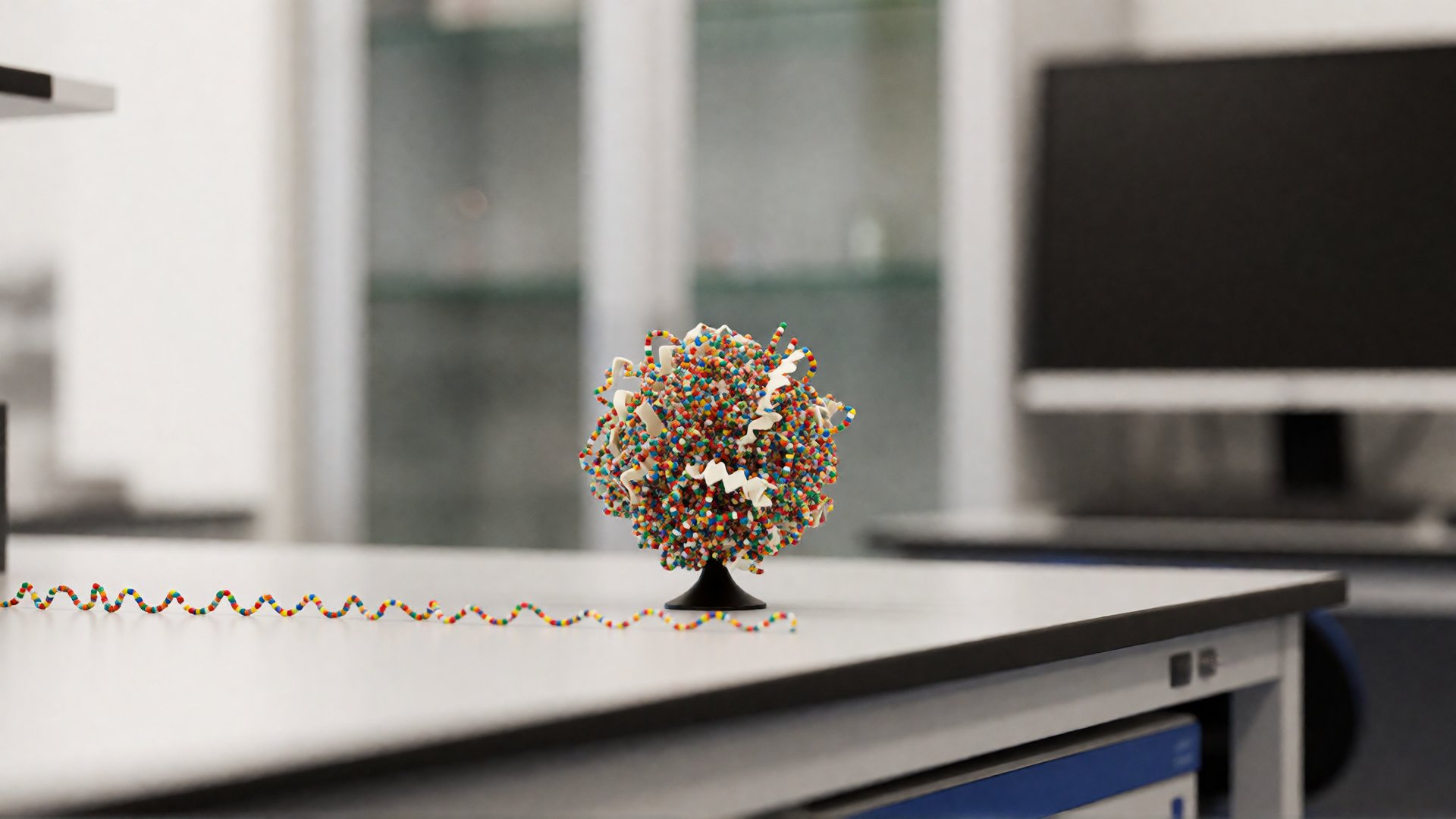
Proteins are the workhorses of the body: they digest food, pass on signals and build tissue. Each protein is a long chain of building blocks called amino acids. The cell makes that chain, and then the chain folds itself into a three-dimensional shape. That shape decides what the protein does, just as the shape of a key decides which lock it fits.
So the chain is a list of letters, but the function lies in the shape. Biologists measure that shape in the lab, for example with X-rays. This is laborious, and for most proteins it has not been done yet. It would help a lot if the shape could be predicted from the list of letters alone. In 1972 the scientist Christian Anfinsen proposed that this should be possible in principle, because the chain fully determines the shape.
Why it is so hard
An average protein can fold in an unimaginable number of ways. In 1969 Cyrus Levinthal estimated about 10^300 possibilities, a 1 followed by 300 zeros. Trying all shapes is therefore impossible, yet proteins in the cell find the right shape, some within a few thousandths of a second.
How AlphaFold tackles this
AlphaFold is a neural network that relies on attention, the technique of the Transformer from 2017: the system looks at which parts of the chain influence each other. It receives the chain and the chains of related proteins from other species. Over millions of years, evolution has changed such related chains. If two positions keep changing together, they are probably close to each other in the folded shape. The system draws such clues from large databases and uses them to make a first estimate.
It improves that estimate over several rounds. The design is run through again and again, with the clues about pairs of positions and the predicted shape adjusting each other. At the end, AlphaFold indicates for each part of the protein how certain it is.
It learned from about 170,000 protein shapes that were measured in the lab and are stored in a public archive. The training took several weeks on computing chips from Google.
The result
CASP is a competition held every two years in which teams predict the shape of proteins and the predictions are compared with the measured shape. The score runs from 0 to 100, and about 90 counts as comparable with a laboratory measurement. AlphaFold scored 92.4 on average. For the hardest proteins it scored 87.0. The average error was about 0.16 nanometres, about the width of an atom. For 88 of the 97 targets, AlphaFold gave the best prediction. John Moult, one of the founders of the competition, says that researchers had been stuck on this one problem for almost fifty years.
Looking back from 2026
The result turned out to be only the beginning. In July 2021 DeepMind made a public database of predicted protein shapes available, at first for more than 365,000 proteins, including almost all human ones. In July 2022 it grew to about 200 million proteins from about a million species, so that researchers worldwide can look up a prediction free of charge. In 2024 Demis Hassabis and John Jumper of DeepMind received the Nobel Prize in Chemistry for predicting protein shapes, together with David Baker, who was honoured for designing new proteins.
A prediction is not the same as full understanding. A shape is a snapshot, and what a protein does in a cell also depends on how it moves and which other molecules it works with. Even so, AlphaFold shows that AI can solve an important scientific question that people failed to solve for years. It is one of the clearest examples of AI speeding up science itself.