Nederlands
Apple II at the computer fair: a ready-made computer for the home
At the West Coast Computer Faire in San Francisco, Steve Jobs and Steve Wozniak show the Apple II: a computer with a keyboard and colour picture that sits on a table at home and connects to the television.
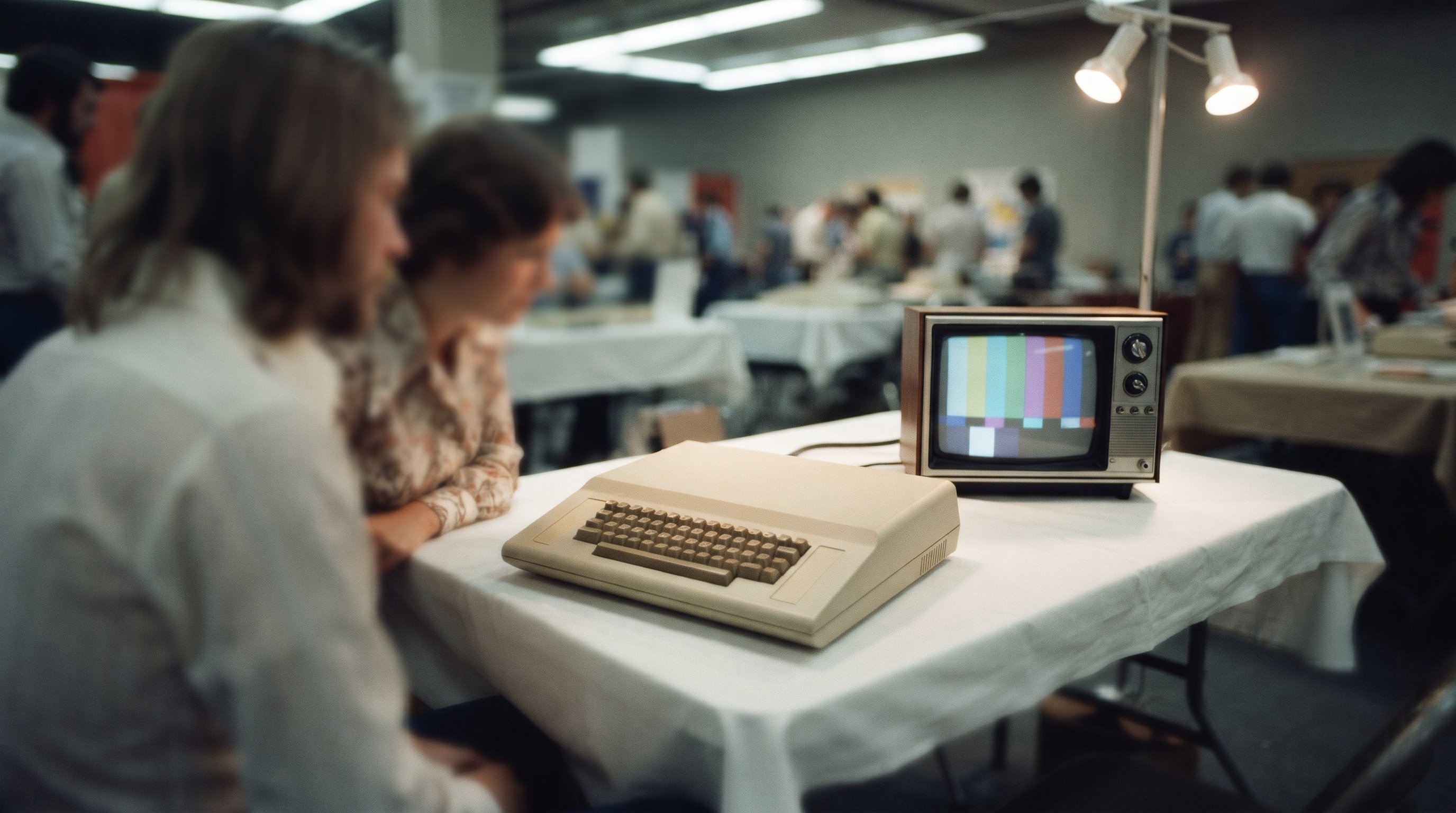
SAN FRANCISCO, APRIL 1977 - At the first West Coast Computer Faire, held from 15 to 17 April in San Francisco's Civic Auditorium, Steve Jobs (22) and Steve Wozniak (26) have shown the Apple II. It is a computer in a beige plastic case with a built-in keyboard that sits on a table at home and connects to the television. The fair drew more than twelve thousand visitors, more than twice as many as the organiser Jim Warren had expected. About 180 companies had stands.
From kit to ready-made
Until now, computers have been found in companies and universities, in cabinets that fill a room. Hobbyists build their own computer from a kit of loose parts. The Apple II is different: it comes out of the box assembled, with a case, a keyboard and a plug for the wall socket. Also at the fair is the Commodore PET by Chuck Peddle, another computer for the home.
What is inside
At its heart is a chip of the 6502 type from MOS Technology, which takes about a million small steps per second. That chip reads instructions from memory and carries them out. The working memory is 4 kilobytes and can be expanded to 48 kilobytes. Four kilobytes is enough for just over four thousand characters. A program that runs on the computer therefore has to be small.
Programs are not stored in the computer itself but on an ordinary cassette tape. A cassette recorder is connected, and the computer reads the tape into its working memory. That is necessary because the chip only works with what is in the working memory, and that memory is wiped as soon as the plug is pulled. There is also memory that is never wiped: it holds BASIC, a programming language that uses ordinary English words. As soon as the computer is switched on, commands can be typed in and the computer carries them out. No program needs to be loaded for this.
The screen is the television in the living room. Part of the working memory is reserved for the picture: whatever is placed there, the computer sends to the television screen. In this way the computer can show text, 40 characters wide and 24 lines high, but also colour images and detailed graphics. The rainbow stripes in Apple's logo are meant to show that the computer can display colour.
The main circuit board has eight slots for expansion cards. Anyone who wants to add something later, such as a printer, plugs in a card.
Price and delivery
The Apple II costs 1,298 dollars with 4 kilobytes of memory, and 2,638 dollars with the maximum of 48 kilobytes. A television or monitor and a cassette recorder come on top of that. According to Apple, the computer will be in the shops .
Looking back from 2026
The Apple II did indeed go on sale on 10 June 1977. In June 1978 it was followed by Disk II, a floppy disk drive designed by Wozniak that was faster and more reliable than cassette tape. At the April fair the Apple II was not alone: the Commodore PET had already been shown as a working model at a trade fair in January, and the first hundred units were delivered in October 1977. Radio Shack announced the TRS-80 in New York on 3 August 1977. It cost 599.95 dollars, including a monitor and cassette recorder, and was sold in more than 3,000 Radio Shack shops. More than 10,000 were sold in the first six weeks. The magazine Byte called the three computers the 'trinity' of 1977, and the Computer History Museum counts them among the most popular computers in history.
On the road to AI, this is the moment when computing power reached ordinary people. A computer was no longer something for specialists. Schools and families could use it to learn programming, and more people wanted computers and networks. That broad base of computer users is what the internet grew out of, and AI models now learn from the text and images on that network.