Nederlands
Astronomers find the first star that would look green
A burnt-out star full of dust from rocky planets would glow green to the human eye. Astronomers at the University of Warwick calculated this. It is the first star for which a green colour has been credibly reported.
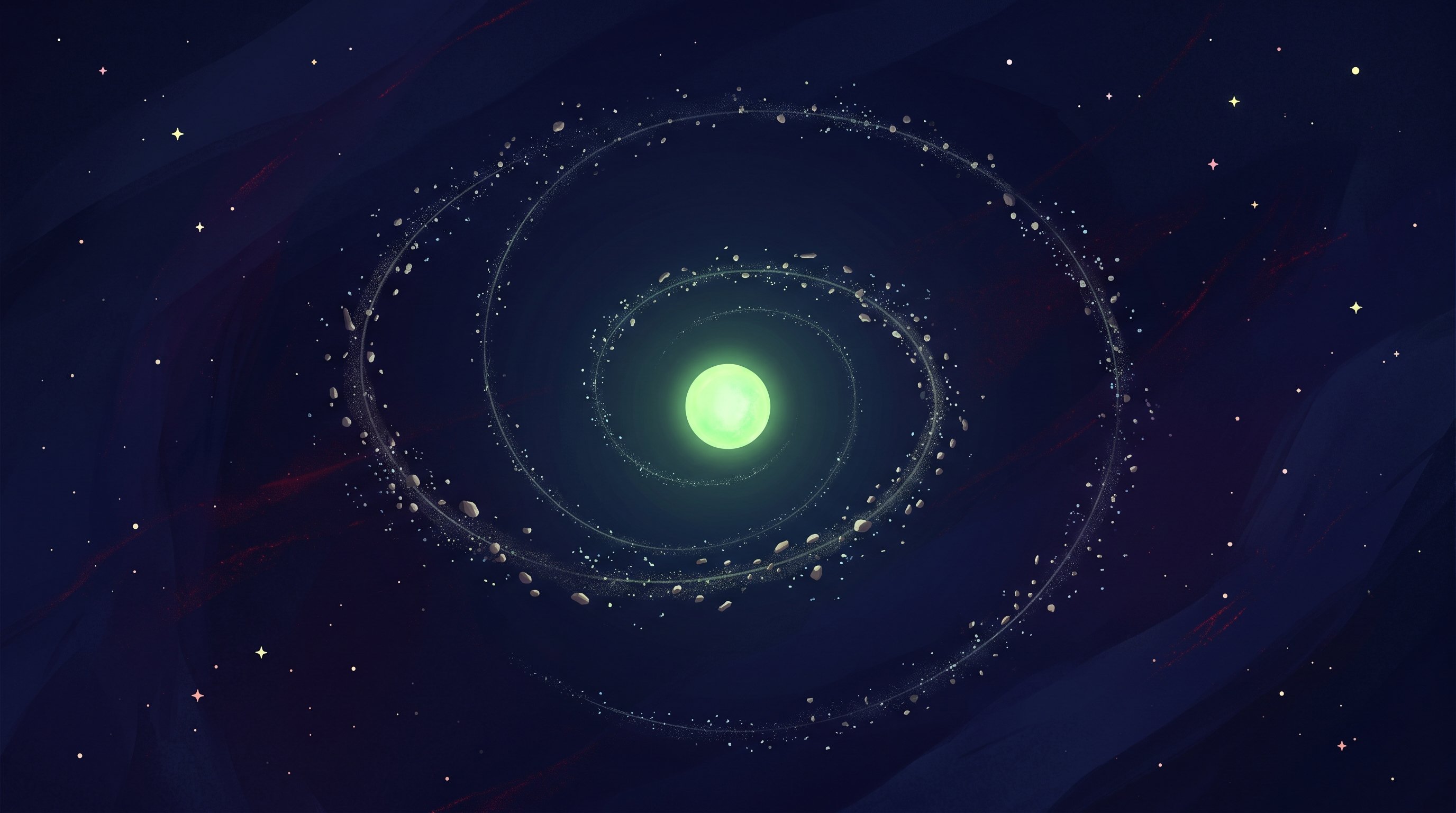
Stars are red, orange, yellow, white or blue. Astronomers have always been taught that green stars do not exist. A star gives off light in all colours at once, and when the green part is strongest, you mainly see white. Yet researchers at the University of Warwick in England have now found a star that would look green to the human eye.
It is a white dwarf called WD J1330+6435. The researchers call it the first star in our Milky Way for which a truly green colour has been credibly reported. The research appeared in the journal RAS Techniques and Instruments.
What is a white dwarf?
A white dwarf is what remains when a star like our Sun has burnt out. The star throws off its outer layers and the core remains: a ball about the size of the Earth, but extremely heavy. Over billions of years that ball slowly cools down. Sometimes the remains of planets still orbit such a remnant.
How a star turns green
In the case of WD J1330+6435, rocky material from that old planetary system has fallen onto the star. As a result, the star's atmosphere contains calcium, lithium and sodium, among other things. Sodium is the same element that gives old-fashioned street lamps their orange colour.
In the star's atmosphere it works the other way round. The researchers explain that the sodium actually swallows up the yellow, orange and red light. The atmosphere of such a cool white dwarf is about as dense as water. Because of that, the sodium does not swallow just one narrow colour, but a broad part of the spectrum. What remains is a greenish glow. Lead researcher Mark Hollands calls it a "ghostly green glow". At about 4,000 degrees Celsius, the star is also considerably cooler than our Sun.
Colours calculated as the eye sees them
No white dwarf is close enough to look at with the naked eye. The researchers therefore calculated the colour. They took existing measurements of the light of white dwarfs, which show how much light there is in each colour. They ran those measurements through a model of how the human eye sees colours. That produced a colour for each star, as you would see it if you stood close by.
This led to more surprises. The redder star WD J1011+2845, about 48 light years away, has carbon on its surface and would look salmon pink. Stars with a lot of carbon tend towards pink or purple, stars with planetary remains towards yellow, and some cool stars towards light blue.
Most white dwarfs are simply white
The team also looked at all 151 white dwarfs within about 65 light years of the Earth. Of these, only five had a striking colour: two yellow and three pink. The rest look white. According to the researchers, about one in thirty white dwarfs therefore has a special colour.
Many people think white dwarfs are blue. According to the team, that is because the hot, blue ones shine much more brightly and so are seen more often. Fellow researcher Boris Gänsicke says the average white dwarf really is white.
The green colour is for now a calculation based on measured light. The next step is to find more such stars and to map their atmospheres even more precisely.
What does this mean for the road to the singularity?
This research shows how much there is still to discover in measurements that already exist. The data had been there for years. The new part lay in combining two fields: astronomy and the science of how our eyes see colours.
That is exactly where AI can come to play a big role. Telescopes now collect the light of millions of stars, far more than people could ever look at one by one. AI systems can search such enormous piles of data for outliers, such as a star that gives off slightly different light. And because large language models have knowledge from many fields at once, they can suggest connections that a specialist might not see, such as the link between starlight and colour perception. Who knows how many green, pink or purple stars are still hidden in the data we already have.
What is the technological singularity? Read the explanation →