Nederlands
Chinese catalyst turns CO2 into methanol, as a fuel for Mars
Researchers in Hefei made a catalyst of copper and sodium that turns carbon dioxide and hydrogen into methanol eleven times faster than without sodium. The aim: to make liquid fuel from the air on Mars one day. The experiments have now been done in the lab on Earth.
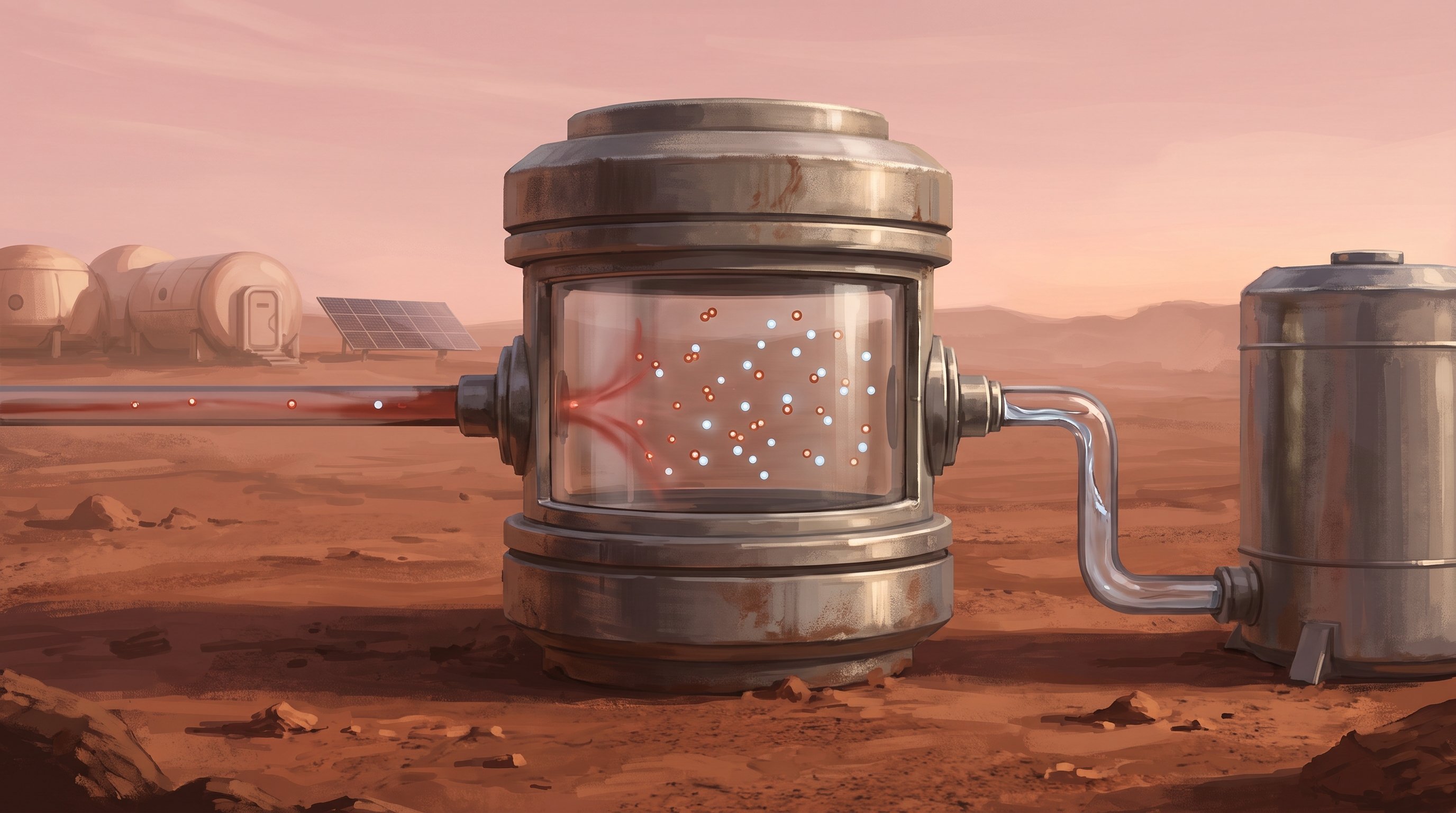
Anyone who wants to live on Mars for longer will have to make fuel and raw materials there. Bringing everything from Earth is too heavy and too expensive. Chinese researchers have now made a catalyst that could help with this: a powder that turns carbon dioxide (CO2) and hydrogen into methanol, a liquid that can serve as a fuel and as a raw material.
Zhang Zhe's team at the Deep Space Exploration Laboratory in Hefei described the work on 14 October in the Chinese scientific journal Journal of Deep Space Exploration. The experiments were done in the lab on Earth.
Why methanol?
The air on Mars is about 95 per cent CO2. So there is plenty of this raw material everywhere. Together with hydrogen, it can be turned into fuel. On Mars, the hydrogen would have to come from water ice: with electricity, water can be split into hydrogen and oxygen.
The best-known plans are based on methane. SpaceX wants to make methane on Mars as fuel for its Starship rocket. But methane is a gas: to store it as a liquid, it has to be cooled to about −161 degrees Celsius. Methanol stays liquid at normal temperature and air pressure, just like water. It can therefore be stored in a simple tank, without heavy cooling equipment. At a base, methanol could be used to generate electricity and heat and to power vehicles. It is also a raw material for other products, such as antifreeze and building materials.
How the catalyst works
A catalyst is a substance that speeds up a chemical reaction without being used up itself. Copper has long been the standard metal for turning CO2 and hydrogen into methanol. But CO2 is a very stable molecule: it does not react easily. It first has to be held firmly and 'loosened up' before the copper can attach hydrogen to it. If that does not go well, little methanol is formed, and often an unwanted by-product as well: carbon monoxide.
The researchers built their catalyst inside a metal-organic framework: a material full of tiny cavities, a kind of sponge on the scale of molecules. In it they placed single copper atoms, with sodium right next to them. The sodium attracts CO2, holds it in place and changes the molecule so that it reacts more easily. The copper next to it then turns it into methanol. Compare it with two people at a workbench: one holds the workpiece firmly, so that the other can work on it.
Eleven times more methanol
With sodium, the catalyst made 245 grams of methanol per kilogram of catalyst per hour, just over 0.3 litres. The same catalyst without sodium reached 22 grams. So the sodium makes it about eleven times more productive. Less carbon monoxide was formed as well. Besides sodium, the researchers also tried potassium and caesium, metals that are similar to sodium; the version with sodium worked best. In tests lasting twelve hours, the catalyst kept working steadily.
The design builds on earlier work. A catalyst with the same name and structure was already described in 2024 in the journal National Science Review, at that time without the focus on Mars. What is new is the comparison between different metals next to the copper, and the use as a fuel factory on another planet.
The next steps
China has big plans for Mars. In 2021 it landed there with the Tianwen-1 mission and the Zhurong rover. With Tianwen-3, which is due to launch around 2028, China wants to be the first country to bring rock from Mars back to Earth, around 2031. Making fuel on the planet itself fits these ambitions for longer missions.
Before the catalyst can work on Mars, more steps are needed. The air there is very thin: the air pressure is less than 1 per cent of that on Earth. Engineers are therefore working on light compressors that can collect the thin air and compress it. Hydrogen production from ice also has to get going, so that all the parts together form one working system.
What does this mean for the road to the singularity?
Anyone who wants to live on another planet for a long time must be able to make what is needed there. This research shows how clever materials design helps with that: by placing two kinds of atoms exactly next to each other, a difficult reaction becomes eleven times more productive. On top of that, the reaction produces a fuel that can be stored without heavy cooling. Every part of such a fuel factory on Mars makes a base less dependent on supplies from Earth. The next step is to test the catalyst, the compressor and the hydrogen production together. That brings a base that largely runs on its own another step closer.
What is the technological singularity? Read the explanation →
Sources
- Interesting Engineering
- Journal of Deep Space Exploration: In-Situ Conversion of Martian Atmospheric Carbon Dioxide into Fuel (methanol)
- National Science Review (2024): MOF-808-NaCu, single-atom Cu met Na+
- CAS: Tianwen-3 gepland voor 2028, monsters terug in 2031
- Wikipedia: In situ resource utilization (SpaceX-plan methaan op Mars)