Nederlands
Bacteria turn sand into building material, without a hot kiln
Researchers at ETH Zurich let bacteria glue grains of sand together into a kind of stone, at room temperature. They print and spray facade and wall elements with it. The material is now about as strong as mortar; the next step is to make it stronger and cleaner.
Making cement takes a lot of energy. Limestone is heated in large kilns to around 1,450 degrees Celsius, and a lot of CO2 is released in the process. The cement industry thus causes about 8 per cent of global CO2 emissions. Researchers at ETH Zurich in Switzerland show that it can be done differently: they let bacteria do the work, without a kiln.
Bacteria as bricklayers
Behind the work is architect Karen Antorveza Paez, who has just completed her doctorate at the Department of Architecture of ETH Zurich. She leads the project in Professor Benjamin Dillenburger's Digital Building Technologies group. For the printing work she also collaborated with André Studart's Complex Materials group.
They use a bacterium that lives naturally in the soil, Sporosarcina pasteurii. This bacterium breaks down urea, a substance also found in urine. This produces carbonate, one of the building blocks of lime. When that comes into contact with calcium, tiny lime crystals grow between the grains of sand. These crystals hook into each other and hold the grains together, a bit like ice freezing loose snow together. This creates biocement: sand that bacteria have turned into a hard mass.
Antorveza Paez compares it to baking a cake: you start with dough that is still soft and fragile, and only the oven turns it into something firm. In her method, the bacteria take over the role of the oven.
Bacteria like these have been studied for some time, for example to strengthen loose ground or to let small cracks in concrete close up by themselves. What is new is that biocement here is a building material in its own right, which can be used to make free-form shapes.
Printing and spraying
The researchers have developed two ways of building with it.
The first is 3D printing. They make a kind of printing ink from water, sand, living bacteria and two natural binders (alginate from seaweed and xanthan, which is also used in food). The printed object then goes into a bath with urea and a calcium salt. Depending on how hard it needs to become, this takes two to five days. The bath is refreshed every day. After that the object dries at room temperature and the bacteria become inactive. What is left is stone. The team has already made a facade element this way that can serve as a sunshade or as a partition wall.
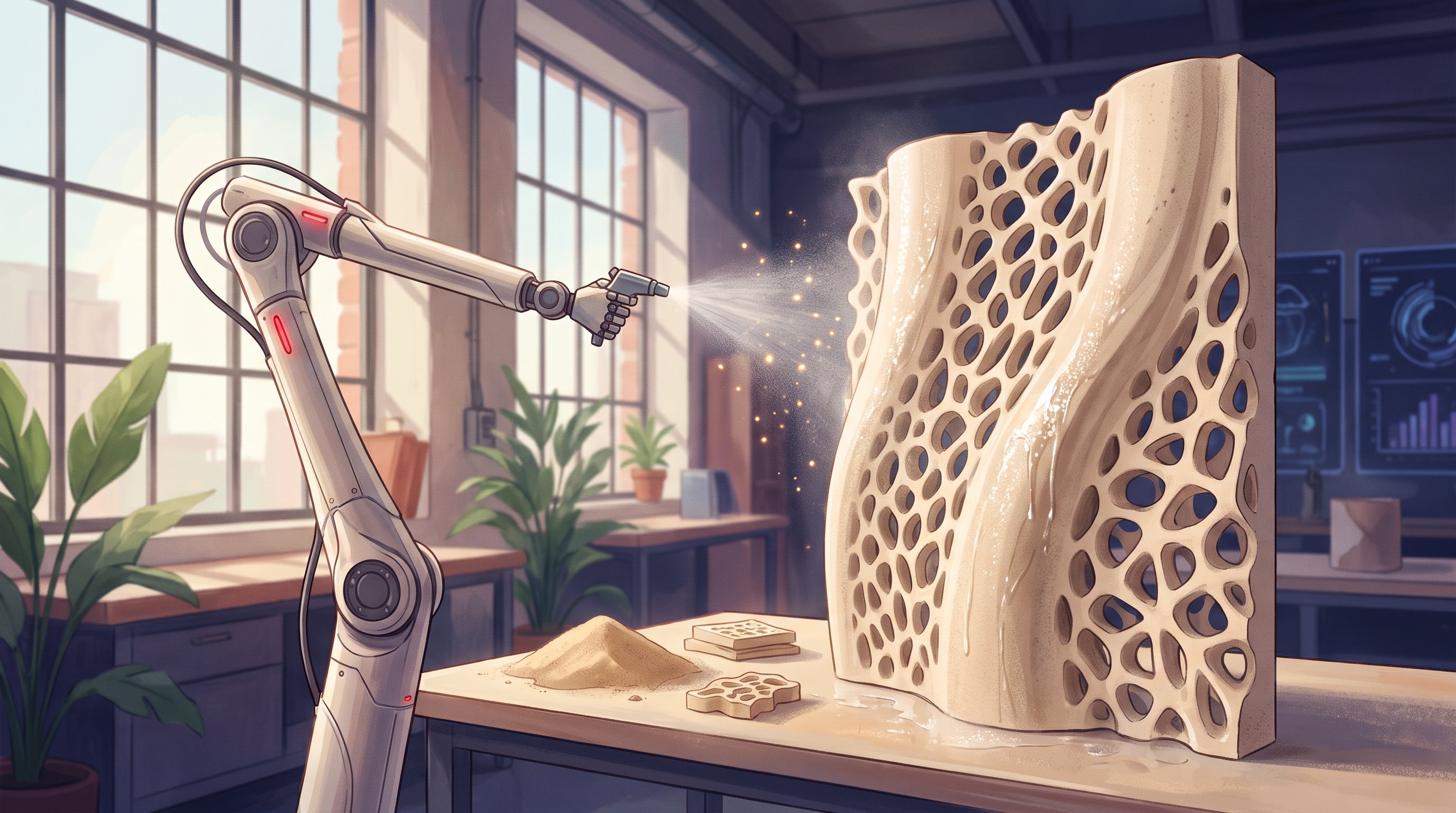
The second way is spraying. A robotic arm sprays bacteria, sand and the necessary substances onto a surface layer by layer. No bath is needed for this. The idea comes from nature: stromatolites, rocky mounds that bacteria build up layer by layer over long periods of time. At the 2025 Venice Architecture Biennale, a robot grew an object this way for six months without interruption, in full view of the public. With this, the team showed that the whole process can be automated.
According to Antorveza Paez, the two methods complement each other: printing is suitable for separate building parts, spraying for surfaces. The results appear in three scientific papers published this year.
What still needs to happen
The biocement is now about as strong as mortar, the material between bricks. It is not yet strong enough for load-bearing walls or floors. It therefore suits mainly parts that do not have to carry weight, such as partition walls and facade panels. On the other hand, the recipe for concrete has been refined for more than a hundred years, while research into biocement is only just beginning. The best mix of sand and grain sizes has yet to be found.
There is also a by-product: breaking down urea produces ammonium, a substance that places a heavy burden on the environment. Antorveza Paez herself says that building with biocement is only truly sustainable if what happens to that ammonium is also properly handled. She is now working on this in a new study of the environmental effects and possible solutions. For the spraying method, the team also wants to understand better how grains and lime arrange themselves inside. According to Antorveza Paez, the big question is no longer whether biocement works, but how well we can control its properties.
What does this mean for the road to the singularity?
Building with living organisms instead of with fire and heat is a welcome change in thinking. Nature has been making strong materials at ordinary temperatures for millions of years, such as shells, coral and bones. This research shows that we are learning to use that art step by step, with modern tools such as 3D printers and robots.
AI can speed this up. How strong biocement becomes depends on many dials at once: the type of sand, the amount of bacteria, the composition of the bath and the shape of the printed object. AI models can learn from experiments which combinations work best and so predict which next experiment will yield the most. And a large language model knows both microbiology and building engineering. It can make connections that a specialist in a single field would miss, for example with bacteria from wastewater treatment, which already convert ammonium every day. This brings closer a future in which we can let buildings grow instead of baking them.
What is the technological singularity? Read the explanation →
Sources
- ETH Zürich
- Interesting Engineering
- ETH Zürich, Digital Building Technologies: Geological Microbial Formations
- npj Materials Sustainability: 3D biocement printing
- Architectural Intelligence: Robotic biocementation spraying
- Biotechnology Design: Design workflow for porous 3D-printed biocement geometries
- Chatham House: Why cement is a major contributor to climate change