Nederlands
Biologists search for new antibiotics with AI agents and find a first candidate
Google had biologists search together with AI agents through databases full of proteins whose function nobody knows. They arrived at a small protein from a respiratory bacterium that, according to the predictions, tackles hard-to-fight bacteria. It is now being tested in the lab.
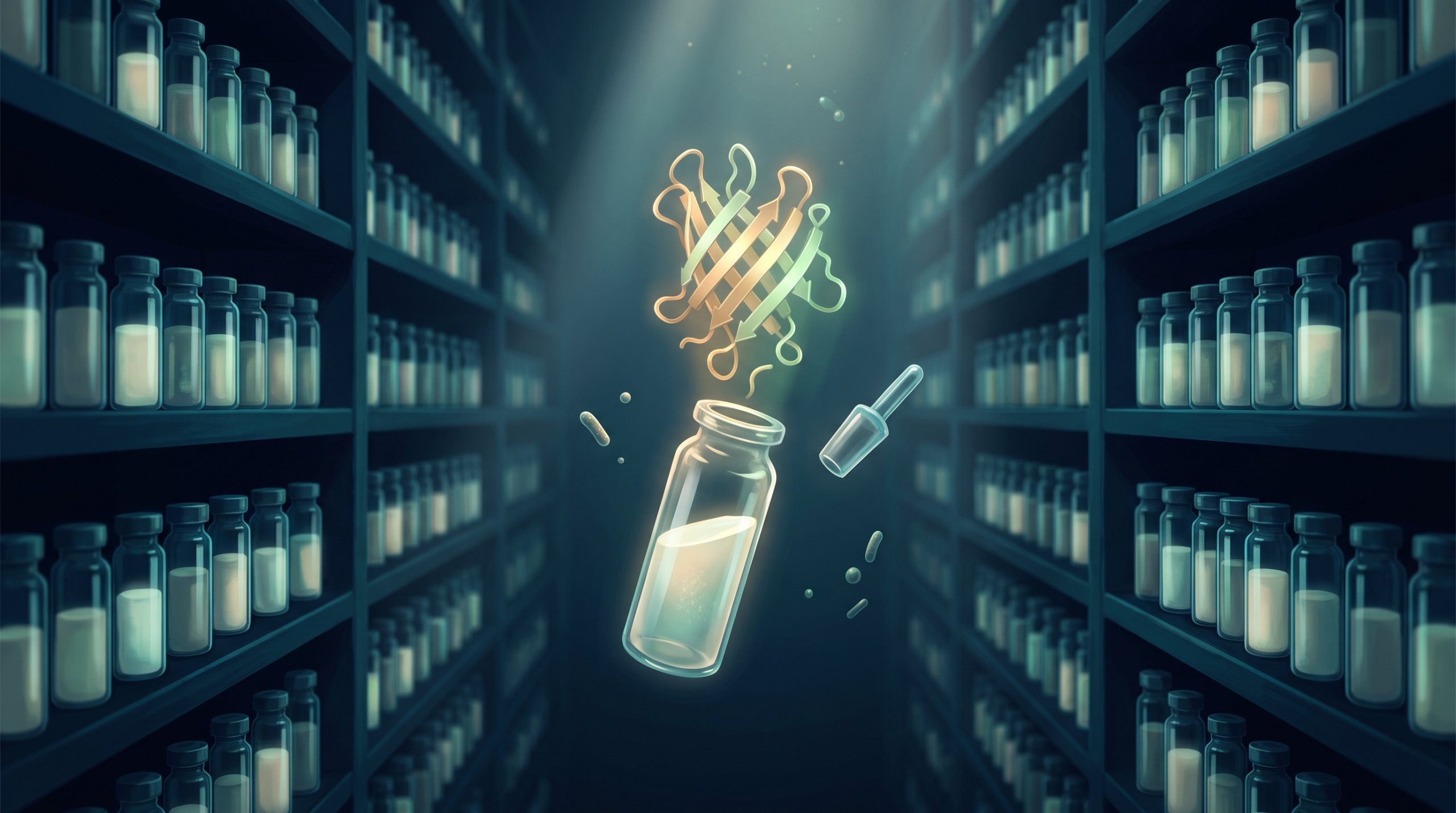
Antibiotics are losing their power: more and more bacteria are no longer sensitive to them. That is why researchers are looking for medicines that work in a different way. A promising area is the weapons that bacteria themselves use against each other. These are small proteins, called antimicrobial peptides, that knock out a competitor. They target vulnerable spots that a bacterium cannot simply change, such as the structure of its cell wall. This makes it harder for disease-causing bacteria to become insensitive to them.
Google has now searched for such a protein together with AI agents, and found a first candidate. The team describes how it went.
Millions of proteins without a name
Years of DNA research have mapped billions of proteins, but for a large part of them nobody knows what they do. UniProt alone, the public database in which researchers worldwide keep track of proteins, contains millions of these nameless proteins. The medicine of the future could be among them, but searching by hand is not an option.
Google therefore built ProtNLM, a model that can deduce from the building blocks of a protein what it does in a cell. That model has already given millions of nameless proteins in the database a name and a probable function. This creates a list to search through.
There is some urgency. A frequently cited estimate arrives at 10 million deaths a year from resistant bacteria in 2050. A more recent study in the journal The Lancet puts it at almost 2 million deaths in that year caused directly by resistance, and more than 8 million in which resistance plays a part.
How the search went
The researcher set the goal: to find a new bacteria-killing protein in Streptococcus pseudopneumoniae, a bacterium that lives in the airways. The AI agent did the detailed research work involved, in Antigravity, a development platform with AI agents that here serves as a workbench for research.
The agent sifted millions of proteins down to a short list, and one candidate remained: a small protein of 97 building blocks. Three checks followed.
Is it really new? The agent compared the protein with the part of the database that has been checked by people, and found no close relative. Is the shape right? The 3D model of the protein closely resembles that of a bacteria-killing protein whose shape has been measured in the lab. Who are its neighbours? The gene lies right next to genes for the machinery that pushes such a protein out of the cell, and next to another known bacteria-killing protein. According to Google, together this is a strong indication that the protein really works this way.
Finally, the agent proposed how the protein would tackle bacteria, namely by disrupting their cell division, and against which disease-causing bacteria it might work, including bacteria that cause respiratory infections. The agent wrote a test plan to go with it: make the protein, try it out on bacteria, check whether it indeed acts at the intended spot and see whether it does no harm to human cells. Those tests are now under way, for this candidate and for a few others from the same search.
Looking at the same model together
Antigravity has gained a 3D window in which researcher and agent look at the same protein model. The agent can load a model into it and highlight important spots. When the researcher rotates the model, adds a note or marks a spot, the agent sees that too. A question like "what is happening here?" is thus about the piece of protein that is on screen at that moment, without it first having to be explained in words.
According to Google, work that normally takes days, spread across separate databases and programs, fits into one session this way. Exactly how much time that saves has not yet been measured.
What does this mean for the road to the singularity?
This is an example of AI that does not just answer questions, but does part of the research work itself, while the human sets the direction. Note what becomes faster: the searching and combining, not the proof. Whether this protein kills bacteria has to be shown on the lab bench.
That is exactly where the gain lies. Lab time is expensive and scarce, so every candidate that has been better investigated beforehand yields more. If this way of working also succeeds with other bacteria, the path from hunch to candidate becomes shorter, and the rest of UniProt can be searched. The coming lab results will show how good the predictions are.
What is the technological singularity? Read the explanation →