Nederlands
Brains of male and hermaphrodite worms respond differently to smell and taste
For the first time, researchers followed all the brain cells in the head of a tiny worm at once. In males and hermaphrodites, almost all sensory cells respond differently to smells and tastes. That difference does not show up in how the cells are connected to each other.
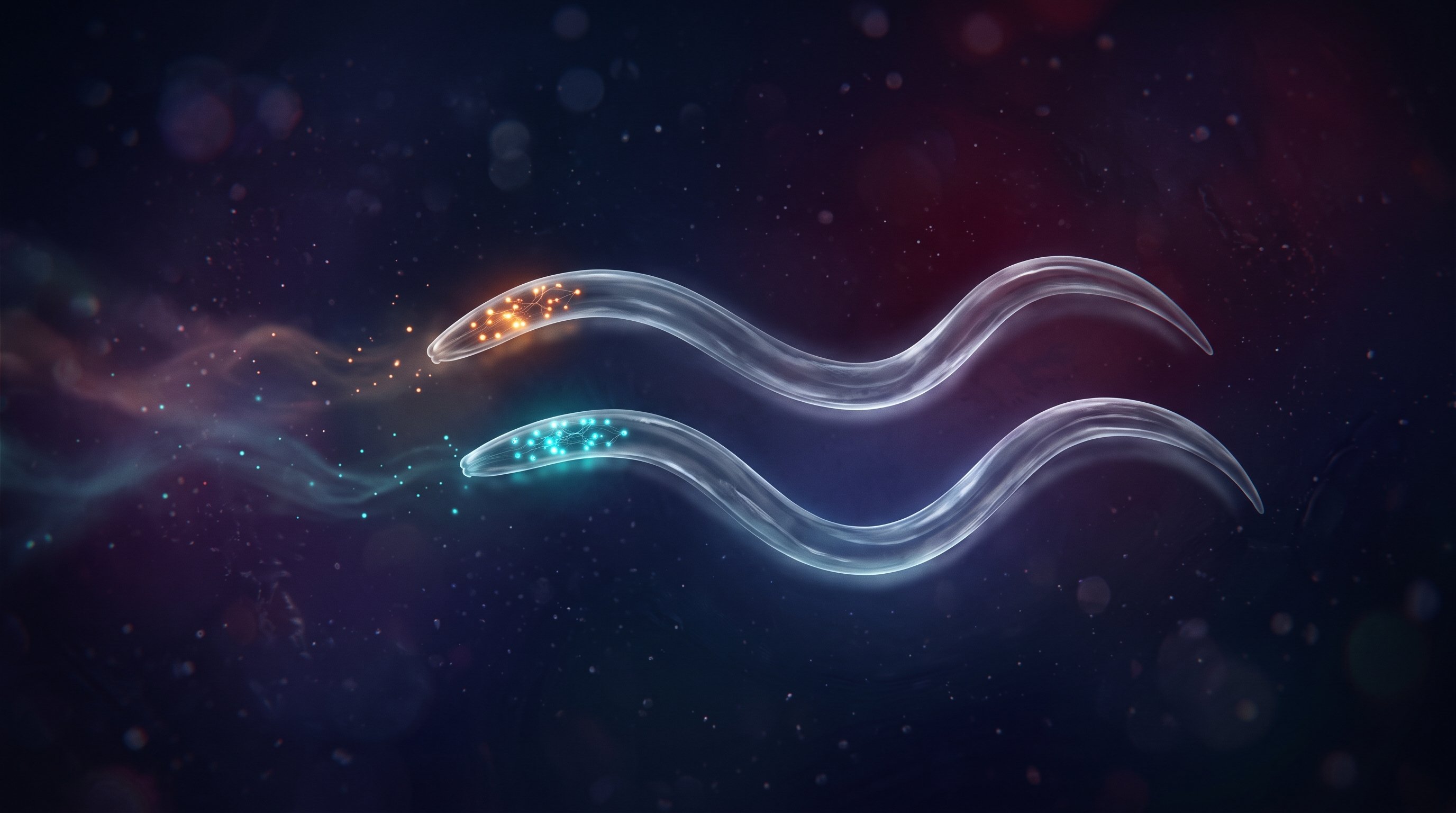
The worm Caenorhabditis elegans, C. elegans for short, is about a millimetre long and transparent. Biologists have been using it for decades to understand how nervous systems work. It has only a few hundred nerve cells, and for all those cells researchers know exactly how they are connected to each other.
Yet such a wiring diagram tells only part of the story. Researchers at Northeastern University in Boston therefore looked at what the brain cells actually do. They compared the two sexes of the worm and found differences everywhere. Their research appeared in the journal Current Biology.
Two sexes, no females
C. elegans has no females. There are hermaphrodites, which make both eggs and sperm and can fertilise themselves, and there are males. A hermaphrodite has 302 nerve cells, about 200 of them in the head. A male has almost 390.
A so-called connectome exists for both sexes. Earlier research had already shown that in this worm the wiring predicts little about the activity of the cells.
Watching all the brain cells at once
The researchers used worms whose nerve cells light up more brightly when they are active. Under the microscope, this let them follow the activity of all the cells in the head in one go. Meanwhile, the worms were offered all kinds of smells and tastes: smells of food, salt, substances that signal danger, and pheromones. Those are scent substances that animals use to pass signals to each other.
According to the researchers, this is the first comparison of activity in the whole brain of both sexes. The worm lives mainly by smelling and tasting, so it was precisely with such stimuli that they expected to see something.
Almost every sensory cell responds differently
Almost every sensory cell responded differently in males and hermaphrodites to at least one substance. To other substances, the same cell responded in exactly the same way in both sexes. So a cell that works the same way for one smell can respond very differently to another smell.
The differences were mainly in the sensory cells themselves. In the relay cells that pass the signals on, they were smaller. In the cells that control the muscles, they were smallest.
The part of the nervous system that controls eating also responded differently to food, salt and pheromones depending on the sex. So males and hermaphrodites also process stimuli differently while eating.
Perhaps the most important point is that these differences do not coincide with the differences in the wiring. According to the researchers, the activity adds something to what the map shows. Biologist Javier Apfeld of Northeastern says that a wiring diagram tells only a limited amount about how a brain really works.
From worm to general principles
Physicist Vivek Venkatachalam, one of the leaders of the research, stresses that the results do not apply directly to humans. The aim is to find principles of how nerve cells process information that apply to many animals. Many genes of the worm's nervous system are also found in other animals.
Apfeld now wants to know what the differences mean for how males and hermaphrodites age. The worm lives for about three weeks, so such research goes quickly. The researchers worked with UMass Chan Medical School, Columbia University and Cornell University, and share their measurements openly with other scientists.
What does this mean for the road to the singularity?
One of the big dreams around the singularity is to rebuild a brain completely in a computer. This research shows what that takes. A map of all the connections is not enough: you also have to measure what each cell does, under many different conditions. Even in a worm with a few hundred cells, that differs by sex and by smell.
This is exactly where AI can mean a lot. Measurements of all cells at once produce enormous amounts of data. AI models can find patterns in it and learn to predict how a brain responds to a new stimulus. Openly shared datasets like this one are the building blocks for that. The millimetre-long worm is thus a good candidate to become the first animal whose whole brain we truly understand, and that would be an important step towards understanding larger brains.
What is the technological singularity? Read the explanation →