Nederlands
Magnetic brain treatment tuned to the patient's own rhythm cleared for PTSD
In the US, a PTSD treatment has been cleared that tunes magnetic pulses to the patient's own brain rhythm. In a trial with 158 adults it worked better than a sham treatment, without serious side effects. A scientific publication is still to follow.
People with post-traumatic stress disorder (PTSD) have a new treatment option in the United States. The US regulator, the FDA, has cleared a system that treats the brain with magnetic pulses, at a pace that is tuned for each patient to the natural rhythm of their own brain. The system, called MeRT, comes from the Californian company Wave Neuroscience. The company carried out the research together with Texas A&M University.
In the trial behind the clearance, the group that received the real treatment improved clearly more than the group that received a sham treatment. Two to four months after the end of treatment, 68 per cent of the participants who received the real treatment no longer had PTSD according to the standard criteria, the company says.
Why something new is needed
PTSD can develop after a shocking event, such as war, a serious accident or violence. People relive the event again and again, sleep badly, startle easily and avoid everything that reminds them of it.
The usual treatments are therapy and medicines. Therapy asks a lot of people: they have to face the painful memories, and some stop early for that reason. In the US, two medicines have been approved specifically for PTSD, sertraline and paroxetine, both antidepressants. In a large study in the ordinary care for American veterans, at most 11 per cent of patients were free of the disorder with medicines of this kind.
Magnetic pulses that give brain cells a push
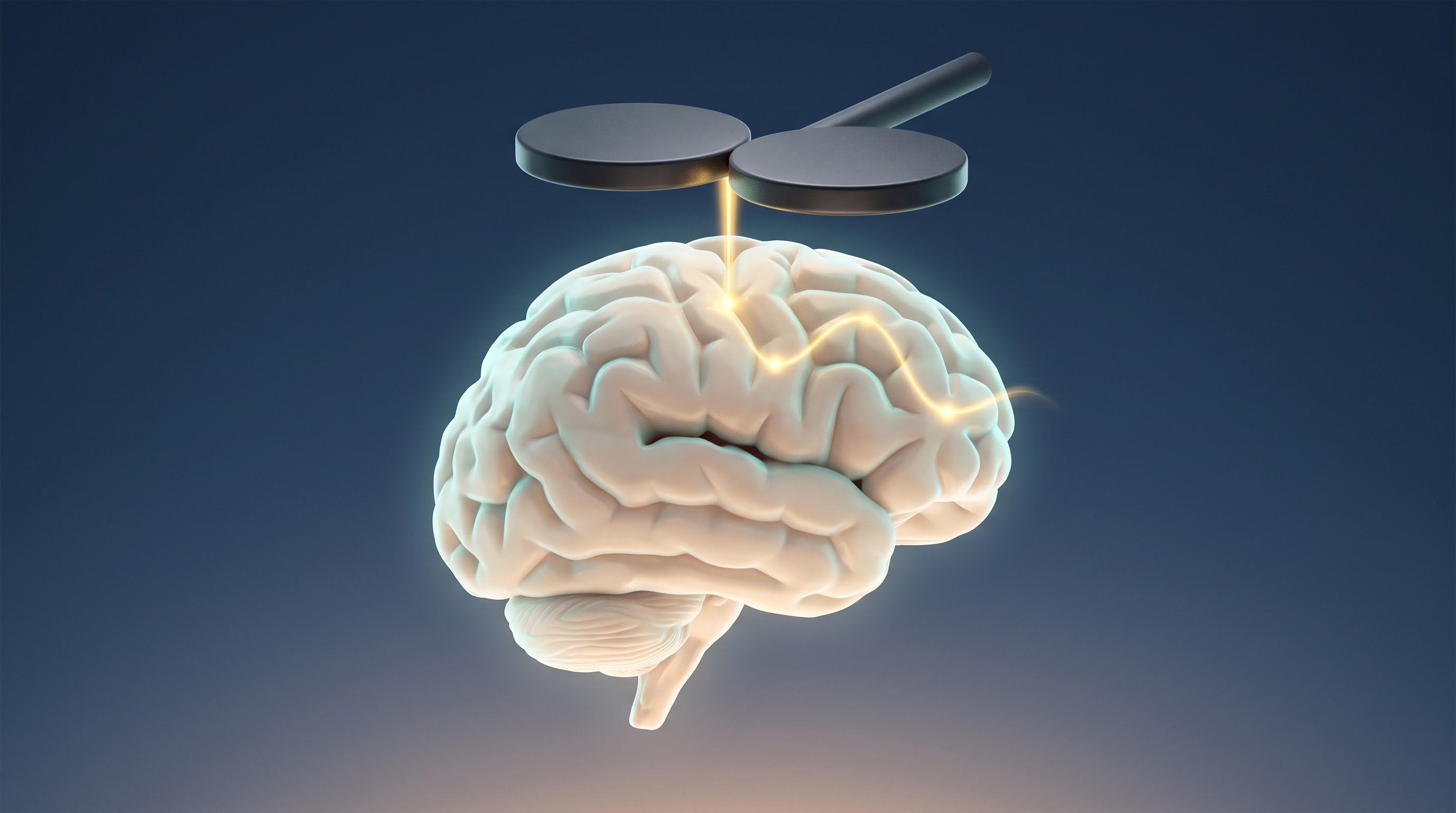
MeRT builds on a well-known technique: transcranial magnetic stimulation, or TMS for short. A practitioner holds a coil against the head. The coil produces short, strong magnetic pulses. A rapidly changing magnetic field creates a small electrical current in the brain cells underneath, without anything having to go into the head. This way a brain area can be made more active. TMS has been used for years against severe depression and obsessive-compulsive disorder.
With ordinary TMS, everyone gets the same pace, for example ten pulses per second. For PTSD, such a fixed pace has so far not worked reliably better than a sham treatment in research.
First measuring the brain's own rhythm
The brain has its own rhythm. When you sit relaxed with your eyes closed, the electrical activity in your brain goes up and down about eight to thirteen times per second. That pace differs from person to person.
MeRT first measures this rhythm with an EEG: electrodes on the head that pick up the electrical activity of the brain. At the same time, the system measures the heart rate. A computer program developed with machine learning, a form of AI, uses these measurements to choose a personal pace for each patient between eight and thirteen pulses per second. The patient then receives TMS at that pace, aimed at the front part of the brain, in the middle behind the forehead.
The idea behind it is like a child on a swing. If you give a push each time at the moment that fits the rhythm of the swing, small pushes make it go higher and higher. If you push at random moments, little happens. Wave Neuroscience assumes that the brain likewise responds better to pulses at its own pace. The company also uses weaker pulses than in ordinary TMS.
A course of treatment consists of twenty to twenty-five sessions of about half an hour, five days a week. The system is cleared as an add-on: patients can receive it alongside their existing therapy or medicines.
What the trial showed
The trial included 158 adults with PTSD at several locations. 77 of them received the real treatment, 81 a sham treatment that looked the same but gave no active pulses. Neither the participants nor the researchers knew who received which. Of all participants, 84 per cent completed the treatment.
Symptoms were measured in two ways: with a questionnaire that participants filled in themselves, and in an interview with a trained clinician. On both measures, the real group improved more than the sham group. On the questionnaire, with a scale from 0 to 80, the score in the real group fell by 27 points on average. According to the national PTSD centre of the US veterans' health service, a patient already clearly notices a drop of 8.5 to 12.5 points.
People in the sham group improved too, as often happens in trials of this kind. According to Wave, the difference between the real treatment and the sham treatment is about as large as for the two approved medicines in their own trials, but without pills.
At a measurement two to four months after treatment, 68 per cent of the group that received the real treatment no longer had PTSD, as judged in the interview with the clinician. That was clearly more than in the sham group. The symptoms also continued to decrease during that period. There were no serious side effects; milder complaints occurred about equally often in both groups.
Wave compares that 68 per cent with the 11 per cent for medicines in ordinary care. These are different studies, with different patients and a different design, so the numbers cannot be compared one to one.
Not the first device, but the first tailored one
MeRT is not the only device against PTSD in the US. In 2023, Prism was cleared: software with which patients learn to influence their own brain activity. In May 2026 came Modius Spero, a headband that stimulates the nerve of the balance organ at home. According to Wave, MeRT is the first system that tunes the stimulation to measurements of the patient's own brain. It is also the first device against PTSD backed by a trial in which the real treatment was tested against a sham treatment, without anyone knowing who received which.
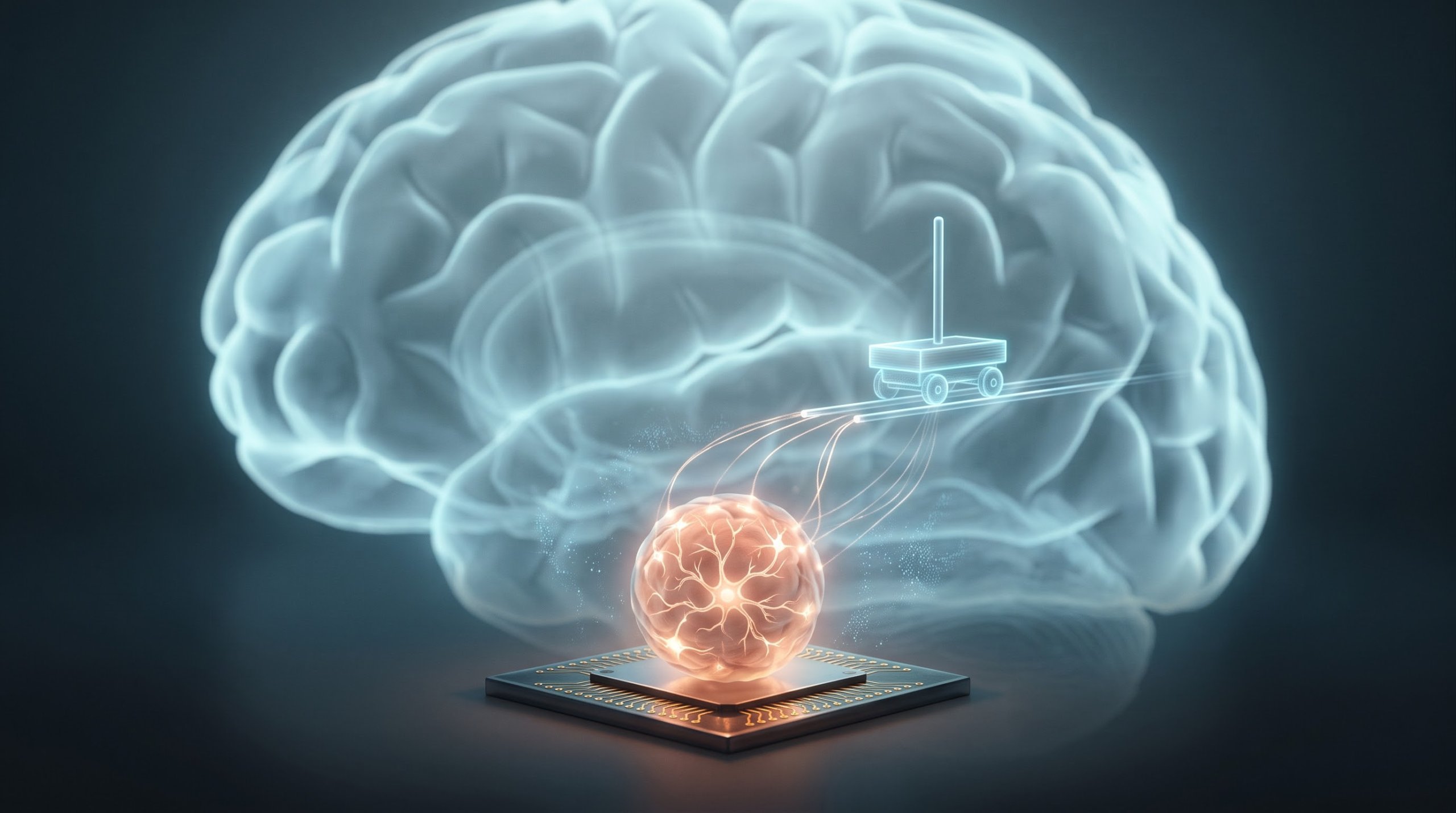
The idea of tuning brain stimulation to what happens in a person's own brain can also be seen in other research. At the Swiss university EPFL, researchers built a tiny chip that measures how brain areas work together and gives a signal to stimulate at exactly the right moment. That chip is placed inside the head and reacts to what is happening at that moment; so far it has been tested on recordings from people and in rats. MeRT works entirely from outside the head and sets the pace based on a measurement at rest, but it may already be used with patients.
What still needs to happen
The full results still have to appear in a scientific journal, so that other researchers can assess them. The trial was designed to test the whole system. Whether the personal pace makes the difference, or whether TMS at a fixed pace works just as well with this approach, is for follow-up research to show.
The clearance applies to the US. Wave Neuroscience and Texas A&M are working to get the treatment covered by insurers; from 2027 there is a US billing code with which doctors can charge for the measurement and the calculation. The company thinks the approach may later also help with depression and anxiety disorders.
What does this mean for the road to the singularity?
Mental health care still works largely with questionnaires and trial and error: if one medicine does not suit you, you try the next. Here, a measurement of the brain itself determines how the treatment is set, with a computer program developed with AI. That is a step towards brain care that works as it does for many physical diseases: first measure, then treat in a targeted way.
The next steps are already in sight: showing that the personal pace is what makes the difference, and systems that keep measuring and adjusting during the treatment, like the EPFL chip. If that succeeds, people with PTSD and other mental health conditions may soon receive a treatment that is truly tuned to their own brain.
What is the technological singularity? Read the explanation →