Nederlands
Topic
#Hersenonderzoek
-
Fifteen computers built with human brain cells work together and do better than one
Australian company Cortical Labs linked fifteen computers that use lab-grown human brain cells. In early tests they did better together than a single machine and a common AI program. The results are preliminary and come from the company itself.
-
Magnetic brain treatment tuned to the patient's own rhythm cleared for PTSD
In the US, a PTSD treatment has been cleared that tunes magnetic pulses to the patient's own brain rhythm. In a trial with 158 adults it worked better than a sham treatment, without serious side effects. A scientific publication is still to follow.
-
Low-power brain implant recognises mental state from how brain regions work together
Researchers at EPFL have built a chip of 4 by 2 millimetres that measures how brain regions work together and so recognises concentration and emotional arousal. It uses very little power. The chip already works on recordings from people and in rats; patients are the next step.
-
Nearly 2,000 AI agents from OpenAI work through an atlas of 7.7 million brain cells in 32 minutes
OpenAI had nearly 2,000 AI agents work at the same time on one large dataset of mouse brains. In 32 minutes they came up with explanations and new research ideas, work that would take people months. The next step is to test the best ideas in the lab.
-
Antibody keeps immune cells out of the brain and slows Alzheimer's damage in mice
Researchers in St. Louis blocked the route immune cells take into the brain in mice. The mice kept about 40 per cent more brain tissue and remembered better, while the harmful protein tau simply stayed in place. The next step is finding out whether this can be done safely in people.
-
AI company Odyssey lets a recreated fly brain move through a world that AI makes up
Odyssey linked a computer model of a fruit fly's brain to its world model Odyssey-3, an AI that creates an environment on the spot. It is a first demonstration; a description of exactly how it works is still to follow.
-
One-gram wireless microscope follows thousands of brain cells in freely moving mice
Chinese researchers built a one-gram microscope that a mouse wears on its head. Without cables, it films the activity of more than 8,500 brain cells at once while the mouse walks around, swims and interacts with other mice.
-
Brains of male and hermaphrodite worms respond differently to smell and taste
For the first time, researchers followed all the brain cells in the head of a tiny worm at once. In males and hermaphrodites, almost all sensory cells respond differently to smells and tastes. That difference does not show up in how the cells are connected to each other.
-
Brain enzyme helps keep memory sharp in old age
Researchers in Boston have discovered an enzyme that the brain itself makes more of as we get older, and that seems to protect memory. In old mice, an extra dose kept memory in better shape. The next step is to find out whether this can also be done safely in humans.
-
Lab-grown human brain tissue learns to balance a virtual pole with an AI coach
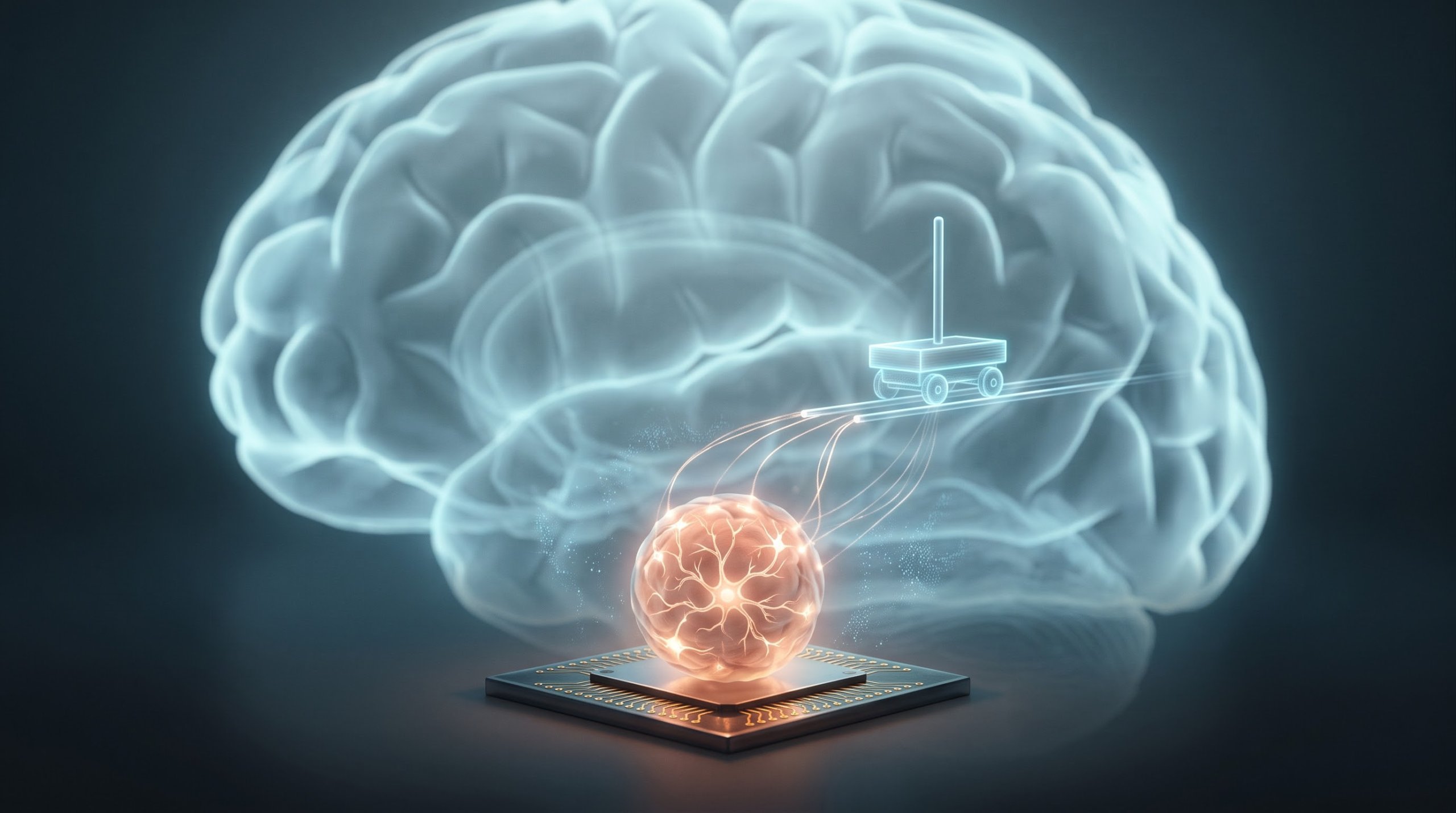
At a meeting in Silicon Valley, a team from UC Santa Cruz showed how cultured human brain tissue learns a classic control task: keeping a pole upright on a cart. An AI algorithm acts as the coach. A volunteer with a keyboard could barely keep up with the tissue.