Nederlands
Air conditioners and fridges without refrigerant move closer: metal tube survives 100 million cooling cycles
Air conditioners and fridges use refrigerants that can harm the climate if they leak. Researchers in Hong Kong have taken a step towards cooling with metal: their cooling tube survived more than 100 million cooling cycles in tests, an estimated ten years of use.
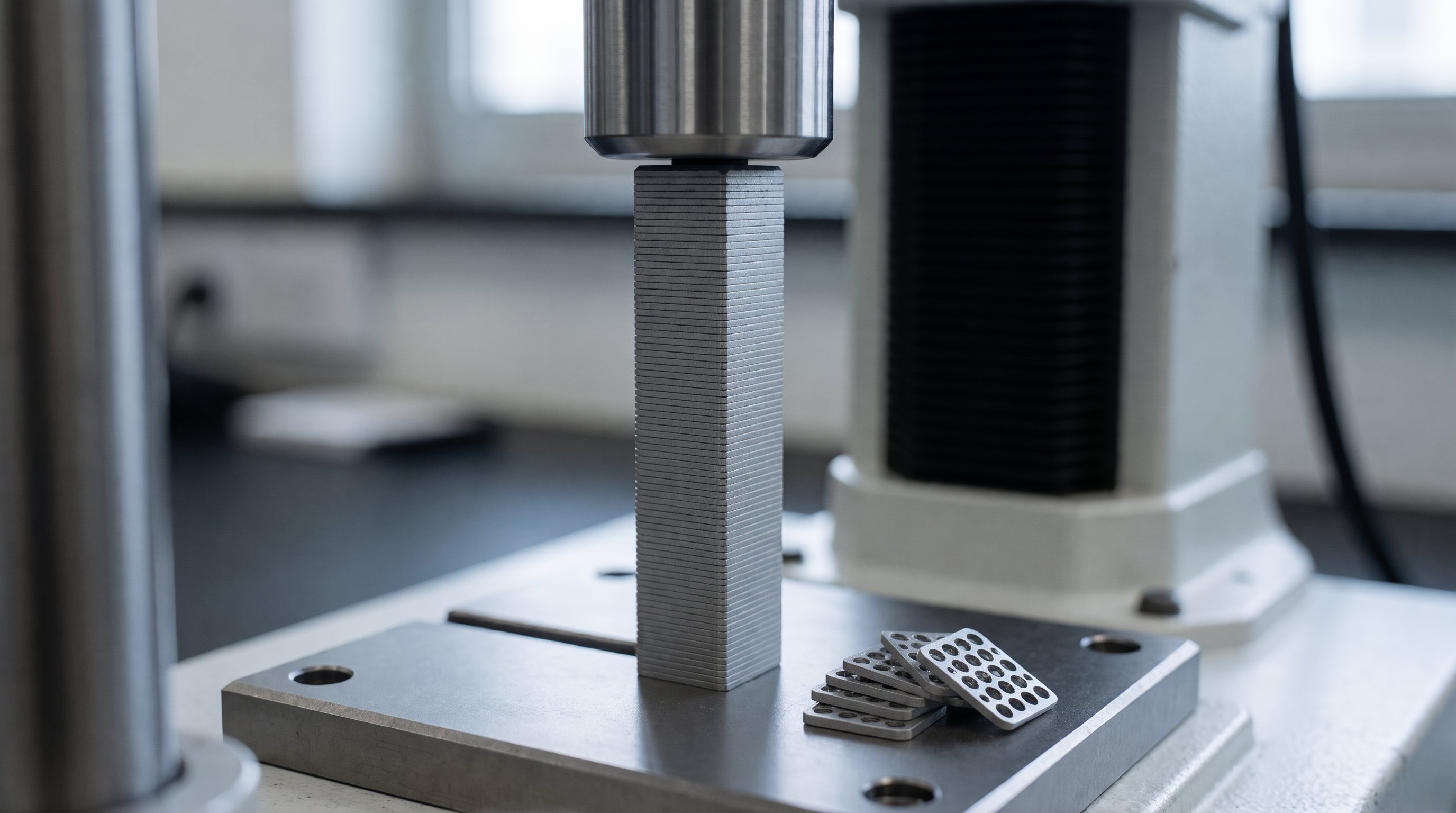
Researchers at the Hong Kong University of Science and Technology (HKUST) have made a cooling tube that survived more than 100 million cooling cycles in tests. It works with metal instead of a refrigerant, which makes it a step towards air conditioners and fridges that no longer need such substances. According to the team, 100 million cycles equal more than ten years of use under the conditions of the test. The tube is made of small stacked plates of an ordinary, commercially available metal alloy. According to the university, it is much faster and cheaper to make than the parts used so far. The team of Professor Qingping Sun published the work in the journal Science.
Cooling by putting metal under stress
An ordinary fridge or air conditioner pumps a refrigerant around: a substance that is alternately compressed and allowed to expand, and so moves heat from the inside to the outside. This takes a lot of energy, and some refrigerants add to the greenhouse effect if they leak.
Elastocaloric cooling works without such a substance. It uses an alloy of nickel and titanium, a so-called shape-memory metal. If you put this metal under stress, the arrangement of its atoms shifts and heat is released. If you remove the stress, the atoms move back and the metal takes in heat again.
A cooling machine does this again and again. The metal is loaded, the heat that is released goes outside, the metal is released and then draws heat out of the space that has to stay cool. That is one cooling cycle.
The weak point: metal fatigue
Every cooling cycle puts a load on the metal. After very many cycles, tiny cracks appear and keep growing until the part breaks. This is called metal fatigue. The tubes, plates and wires used so far therefore break after some time or buckle under the pressure.
They are also expensive and slow to make. Thin-walled parts are often made with wire erosion: a technique in which sparks between a thin wire and the metal burn the shape out of the metal bit by bit.
Punching and stacking
The team chose a different approach. The researchers punch small plates with holes out of thin sheets of nickel-titanium, of the kind that can simply be bought, and stack them on top of each other to form a tube. The holes give the metal a large surface along which heat can be carried away. The design was inspired by the structure of bamboo and honeycombs.
Stacking is also the reason the tube lasts so long. If a crack appears in one plate, it stops at the border with the next plate. In a tube made from one piece, such a crack can run along the whole length, and the part then fails all at once.
According to HKUST, punching is also much faster: about 100 plates per minute. The university says this is more than 100 times as fast as wire erosion, and costs one twentieth of the price.
A first test model
The researchers built a test model with a cooling tube 3 centimetres long, made of 200 plates. It produced a temperature difference of up to 11.7 degrees between the warm and the cold side. That is the difference inside the device itself, not how much a room cools down.
How efficient a complete cooling machine with these tubes will be, and what it will cost to run, is for follow-up research to show. The team is now working on better heat removal, a more efficient drive for loading the metal and alloys that perform even better. Several international patents have been applied for. The research was funded by the Research Grants Council and the Innovation and Technology Commission of Hong Kong.
The team's third result in a year
According to HKUST, this is the team's third major result within a year. In January 2026 it described in the journal Nature an elastocaloric freezer that reached 12 degrees below zero. Then followed, in the journal Joule, a cooling device that ran for a million cycles without getting worse, using a specially developed alloy of nickel, titanium, copper and cobalt. In an accelerated test, that alloy also lasted 100 million cycles. The new tube reaches this durability with ordinary sheets of nickel-titanium and a cheap way of making it.
What does this mean for the road to the singularity?
Cooling uses a lot of electricity worldwide. According to the International Energy Agency (IEA), almost 10 per cent of all electricity in the world went to air conditioners and fans in 2016, and without action the energy use of air conditioners could triple by 2050. A cooling technique without refrigerant at least removes the problem of leaking greenhouse gases.
According to Professor Sun, this technique has to meet three requirements to move from the laboratory to mass production: heat must be able to leave quickly, the parts must be reliable and they must be cheap to make. This research makes progress on the last two. The next step is a complete cooling machine that is efficient enough to compete with today's air conditioners. If that succeeds, cooling with metal instead of gas moves a good deal closer.
What is the technological singularity? Read the explanation →
Sources
- Interesting Engineering
- hkust.edu.hk
- Tech Xplore
- Science: Stacked porous NiTi structure with low cost and ultrahigh fatigue life for elastocaloric cooling
- IEA: The Future of Cooling
- Interesting Engineering: zero-degradation elastocaloric cooling device (Joule)
- Additive Manufacturing Letters: elastocaloric effect in porous NiTi structures