Nederlands
ETH Zurich humanoid robot climbs ladders and gets back up by itself after a fall
Researchers at ETH Zurich have a humanoid robot climb ladders, jump over obstacles and get up after a fall, all with one learning system. In a simulation, the robot completed 92.5 per cent of the obstacle courses.
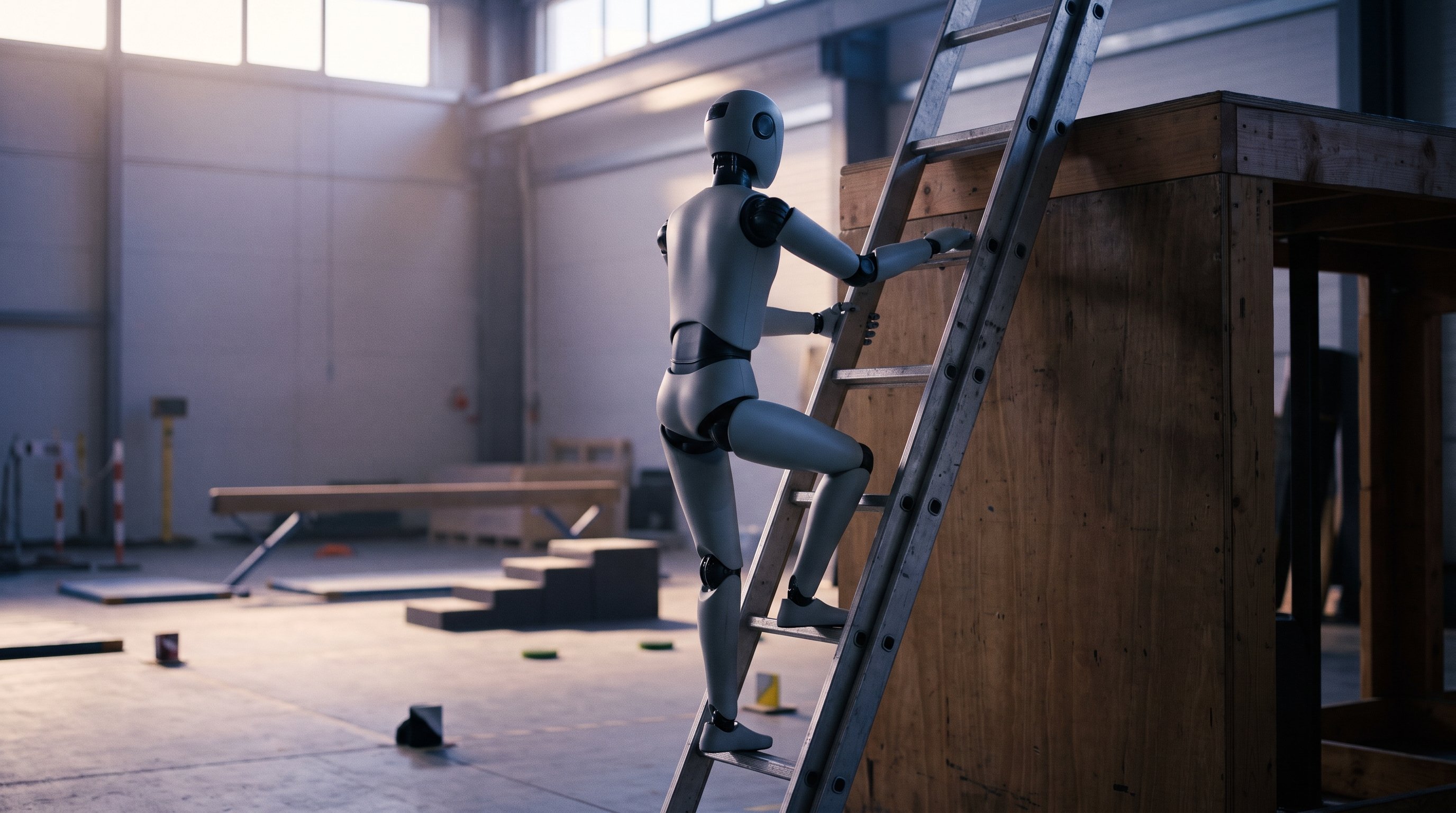
A robot that walks on two legs across a flat floor is no longer unusual. But the human world is full of ladders, stairs, ledges and obstacles. There, a robot also has to use its hands, elbows and knees, just like we do. Researchers at the Swiss technical university ETH Zurich have now built a control system that lets a humanoid robot do all of this with one and the same learning system. The robot climbs ladders and stairs, jumps over obstacles and down from them, walks along a narrow beam and across stepping stones, and gets back up after a fall.
The research comes from the Robotic Systems Lab of ETH Zurich, together with researchers from Apple, the ETH AI Center and chipmaker Nvidia. They tested their approach on the G1, a humanoid robot made by the Chinese company Unitree. The study has been online since 22 October and is now being reviewed by other scientists.
First decide where to hold on
In many robots, the control system learns a fixed movement for each skill: one program for climbing stairs, another for getting up. That works well on familiar ground, but less well when the surroundings are slightly different.
The Swiss approach, called ACP, works differently. The system first works out where the body has to touch the surroundings. To do this, it looks at nine body parts: hands, elbows, knees, feet and the pelvis. For each part, it predicts where that part has to land in the next one and a half seconds. A second part of the system then controls the robot's 23 joints so that those points are actually reached.
A person on a ladder does the same: you first choose the rung where you put your hand, and your body follows. In the same way, the robot chooses for itself which rungs it uses, without a fixed climbing order.
To see its surroundings, the robot has a laser sensor on its head. It scans the surroundings ten times per second, with 20,000 measuring points each time. A small computer inside the robot turns this into a height map within 30 milliseconds, with squares of 3 centimetres. The whole system runs inside the robot itself, without a connection to a large computer.
Learned from a quarter of an hour of human movement
The robot learned from 13.2 minutes of recordings of people moving. From these, the system mainly took where hands and feet land. The robot learned the rest by itself, by practising very often in a computer simulation and learning from what worked and what did not. That last round of practice makes sure it can also handle terrain that was not in the human recordings.
The results
In the simulation, the researchers had the robot complete eight obstacle courses that combine different skills, for example first climbing a ladder and then jumping down. On average, their system reached the finish in 92.5 per cent of attempts. An existing approach, which calculates a movement in advance and then copies it, reached 58.8 per cent. In that test, disturbances such as noise in the sensors and delay in the motors were switched off, so that only the terrain counted.
The real robot also performed all the skills. The researchers' video on X shows it climbing, jumping and getting up. How often it succeeds in the real world is something future measurements will have to show. The team also openly shows what went wrong, such as a hitch on the ladder, a failed jump and a fall caused by an error in the height map. After each such mistake, the robot got back into a position from which it could carry on.
The next steps
The system guides the robot over a short distance to a goal; finding the way through a whole building is not yet part of it. The robot sees the world as a height map from above. Hanging from something, grabbing something above its head or moving objects requires a full three-dimensional picture of the surroundings. According to the researchers, that is the next step.
What does this mean for the road to the singularity?
If a humanoid robot is really going to help in our world, it has to be able to do more than walk. On a building site, when inspecting installations or during rescue work, it has to climb, step over things and get up when it falls. This research shows that one learning system can control all these movements, with computing power that fits inside the robot itself. This brings robots that move through a messy environment as freely as people one step closer.
What is the technological singularity? Read the explanation →