Nederlands
Four-legged robot climbs ship walls on magnetic feet to weld
South Korean company Diden Robotics has a robot that walks across steel walls and ceilings on magnetic feet while carrying welding equipment. According to the company, its welds are already part of ships that are being built now.
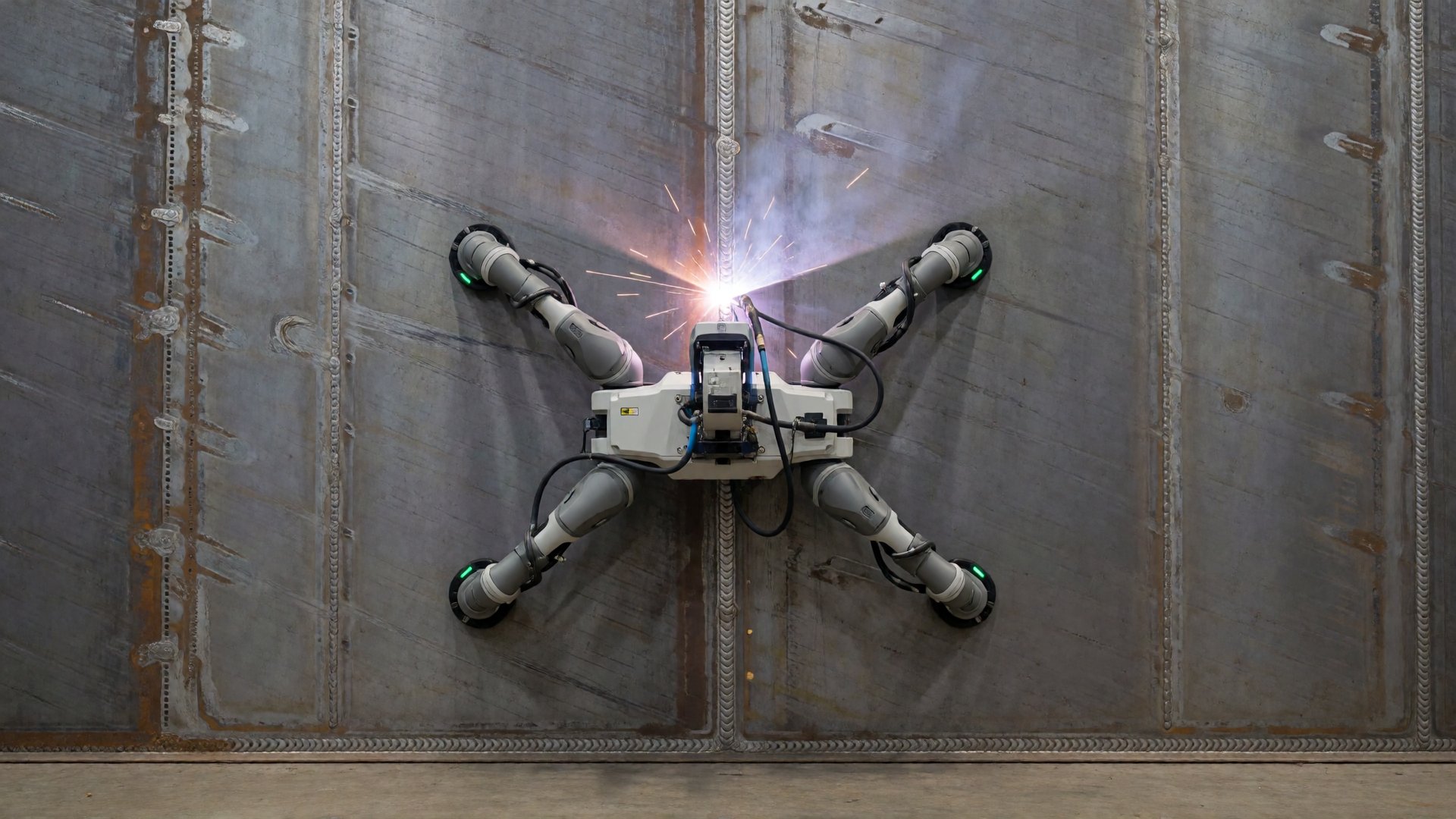
Building a ship involves a lot of welding in places that are difficult or dangerous for people to reach: high up on a steel wall, on a ceiling, or between the obstacles inside the large steel blocks a ship is built from. South Korean company Diden Robotics has built a robot for this work. Their robot, called Spider 30, has four legs with magnetic feet, so it can walk across steel walls and ceilings with tools on its back.
According to Diden, the robot has already been used at large Korean shipyards, and welds it made are part of ships that are being built now. In May 2026, the Korean business daily Maeil Business Newspaper reported that Diden had sold robots to several large Korean shipbuilders. In April 2026, Spider 30 appeared in the opening video of NVIDIA GTC, a large conference held by the chipmaker, walking across a vertical ship hull.
Magnets that hold on without power
The feet use what are called electropermanent magnets. An ordinary electromagnet only holds on as long as current flows through it. With this type, one short pulse of current switches the magnet on or off, and after that it stays in that state without needing any power. So only the switching uses energy. The robot's motors, sensors and computers do still need power as normal. Small lights in the feet show whether a foot is firmly attached.
According to Diden, the magnets hold up to 1,500 newtons, comparable to a weight of just over 150 kilograms, and switch in 7 thousandths of a second. The robot weighs 45 kilograms and can carry 30 kilograms of equipment. It is about 96 centimetres long, 46 centimetres wide and 49 centimetres high, and has twelve drive units in its four legs. Interchangeable parts fit on its back: welding equipment, inspection equipment or a robot arm.
The company says the robot moves from the floor onto a wall in less than 30 seconds. Its top speed is 0.1 metres per second, or six metres per minute: a calm pace that suits precise work.
Why a spider and not a dog
The first designs looked more like a dog, co-founder and chief operating officer Youngha Shin told Yanko Design. When such a robot turned sideways on a wall, its feet did not always land flat on the steel, and it could tip over. By placing the legs further out, the body stayed closer to the wall and the feet made better contact.
To know where it is, the robot compares what its 3D cameras see with the digital construction drawing of the ship. Depth cameras map obstacles nearby. Diden makes the parts and the software itself. The company is also adding a technique in which the robot first learns its movements in a computer simulation, by trying very many times and rewarding what goes well. Those learned movements are then transferred to the real robot.
The next step is to show that the robot works reliably day after day at the shipyard: with the same welding quality every time, little maintenance and as little help from people as possible. Use in practice will also show how much time and money it saves shipyards. The magnetic feet only work on steel, but that is exactly what ships are made of.
What does this mean for the road to the singularity?
For a long time, robots in factories mostly worked in one fixed place, on an assembly line. Spider 30 shows that a robot can also walk to the work itself, across walls and ceilings, and do skilled work there. This is possible by combining three things: walking learned in a simulation, finding the way with a digital construction drawing, and tools that can be swapped. If this works reliably at shipyards, such robots could also take over other heavy work on large steel structures.
What is the technological singularity? Read the explanation →