Nederlands
Google launches Gemini Decisions API for choosing between fixed options
Google has released an AI model that does not write text, but chooses from fixed answers. Developers can ask up to 1,000 questions at once about the same text, photo or video, and see for each answer how sure the model is.
Anyone who builds an AI program often has it make many small choices. Is this question easy or hard? Does this photo follow the rules? Which tool is needed now? An ordinary language model writes out a whole answer for this, word by word. That costs time and money.
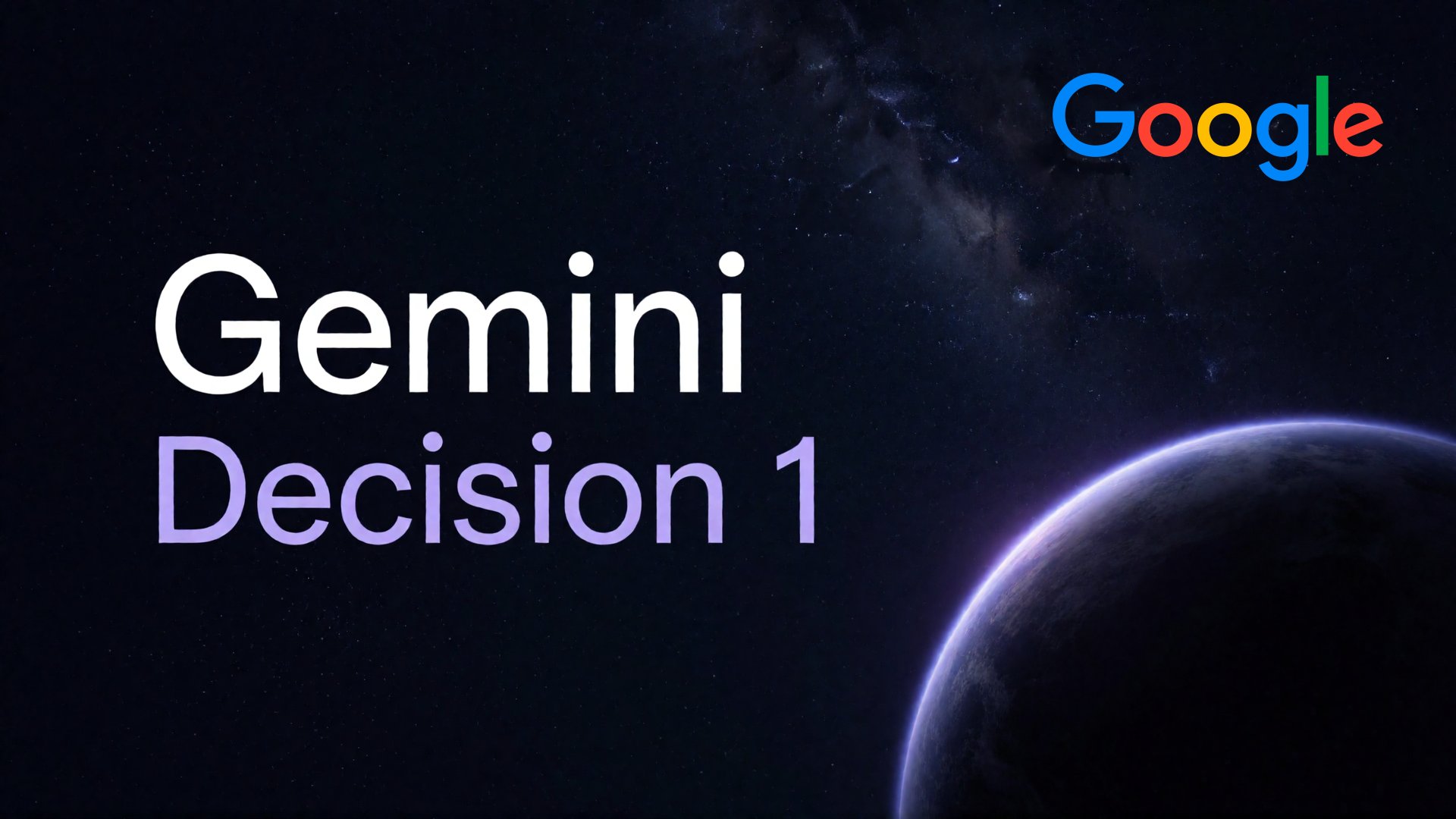
So Google has released the Gemini Decisions API. An API is a connection that lets one program use the service of another company. Behind this connection is a new model, Gemini Decision 1. It only chooses from answers that the developer sets in advance.
Developers have been able to use it since 11 November 2026 through Google AI Studio, the website where they build with Google's AI models. They give the model one piece of input: text, photos, sound, video or PDFs, together up to 256,000 tokens, the small chunks of text that an AI model reads. About that input they can ask up to 1,000 separate questions in one go.
There are three kinds of question: yes or no, multiple choice with 2 to 255 answers, and a score on a fixed scale. Instead of writing out an answer, the model calculates in one step how likely each answer is. Each answer comes with a confidence score between 0 and 1. If the model is in doubt, the program can pass the question on to a person or another system.
Fast and cheap, according to Google
According to Google, a request takes 150 to 250 milliseconds from start to finish, measured with input of up to 16,000 tokens. Asking 100 questions at once hardly slowed it down, the company says. Google also says the model is better than other models at judging how sure it is. If it says it is 80 per cent sure, the answer is also right about that often. These are Google's own measurements.
One million tokens of input costs 0.10 dollars; the answers are free. The shared input is charged once per request, even with 1,000 questions. According to Google, that makes it almost five times cheaper than doing the same tasks with Gemini 3.5 Flash-Lite, another Google model. There is a free version to try it out.
Google already uses the model itself, for example in Gemini Notebook to choose which model answers a question. In Google Search it spots misuse of tools that AI agents can call there. Developers can try it out in a test environment in Google AI Studio.
OpenAI and Microsoft came first
Google is not the first. On 6 October 2026, OpenAI opened a similar Decisions API to all developers as a test version. On 9 October 2026, Microsoft released the decision model Microsoft-Decision-1. So all three big AI companies are now betting on separate models that only make fast choices.
What does this mean for the road to the singularity?
AI agents that work on their own make many small choices along the way: which tool to use, whether a step is safe, which model can best answer a question. A separate model that makes such choices quickly and cheaply lets those systems run faster and more efficiently. And because the model says how sure it is, a person can step in exactly where there is doubt. In this way, AI can do more on its own, with people involved where it counts.
What is the technological singularity? Read the explanation →