Nederlands
Google's AI agents find leaner programs for future quantum computers
Teams of AI agents running on Gemini 4 have found programs for quantum computers that need far less computing work, including for research into nuclear fusion and medicines. A mathematical checking program approved the proof for every improvement.
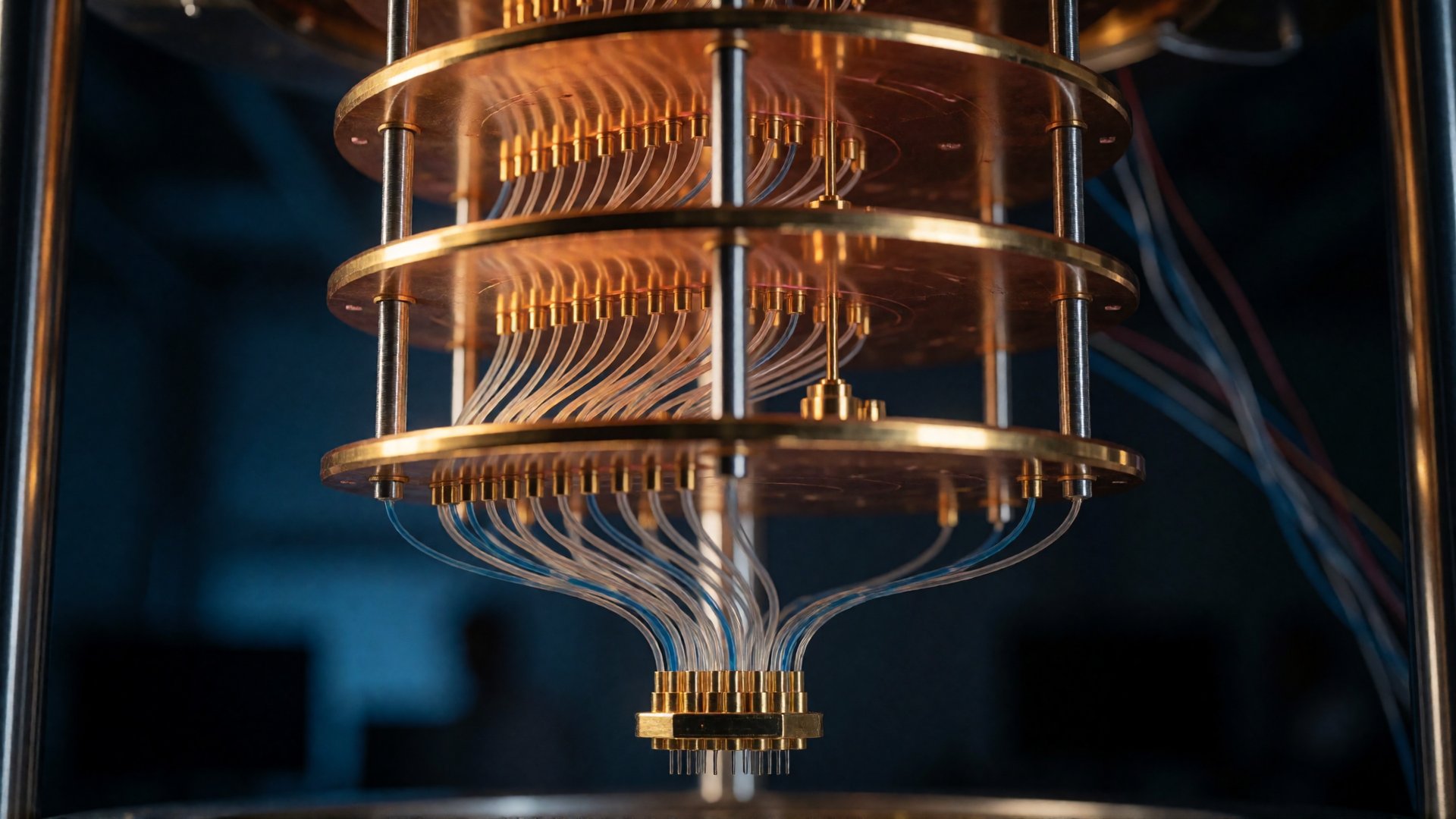
Quantum computers could one day simulate molecules and materials that are too complex for ordinary computers. But the programs for this demand an enormous amount from such a machine, more than the first good quantum computers will probably be able to deliver. So every leaner program brings such calculations closer. Google DeepMind and Google Quantum AI set teams of AI agents to search for leaner programs, and they found several.
Google DeepMind announced the work . The research paper is available as a preprint on the website arXiv.
Proving instead of testing
A quantum program consists of a series of operations on qubits, the computing units of a quantum computer.
The programs in this research are meant for quantum computers with error correction: machines that catch their own calculation errors and can therefore carry out long calculations. Such machines do not exist yet, and ordinary computers cannot imitate these programs. So it is not possible to simply try out whether a new program works.
That is why the team used Lean, a computer program that checks mathematical proofs step by step. For every idea, the agents had to prove that the program gives the right answer and how much it costs. Only ideas whose proof Lean approved went into a shared notebook.
The agents worked with Gemini 4, Google's AI model, in separate teams for each problem. Every four hours, agents from the teams met in a kind of virtual conference to exchange and compare ideas. The researchers chose the problems and kept an eye on progress. Google DeepMind does not say exactly when the experiments were carried out.
Nuclear fusion and medicines
The team measures the cost with a single number that combines the number of qubits and the number of operations. For a calculation in nuclear fusion in which a pellet of fuel is compressed in a flash, for example with lasers, that cost became 11.8 times lower, according to Google DeepMind. The number of error-corrected qubits needed fell from 5,650 to 4,338.
For medicines, the work focused on cytochrome P450, an enzyme in the body that breaks down most medicines. The program to simulate this enzyme became 2.5 times leaner and needed 333 qubits instead of 481. A calculation on a widely used light-sensitive molecule became 8 times cheaper. Calculations like these may later help in designing medicines.
The agents also improved building blocks that appear in many quantum programs. One particular version of Grover's search algorithm, a well-known method for searching an unsorted list with a quantum computer, became 2.57 times faster. A small calculation step that many programs use to load numbers into qubits even became 290 times faster.
Even with these improvements, the scientific calculations still demand more than the first error-corrected quantum computers will probably be able to handle, Google DeepMind writes. The company is making its library of specifications and proven solutions public on GitHub, so that other researchers can build on it.
What does this mean for the road to the singularity?
A quantum computer only becomes useful when the machine and the programs meet each other halfway. This research shows that AI can speed up the program side: if a calculation becomes 11.8 times leaner, the machine no longer has to close that gap by itself. According to Google DeepMind, this kind of design work normally takes people years.
The proof makes the difference. An AI that suggests an idea can be wrong. An AI that delivers a proof with it, approved by a checking program, produces something other researchers can build on straight away. If this way of working spreads, teams of AI agents can keep searching for better methods day and night, while people decide which questions matter. Calculations for cleaner energy and better medicines would then come within reach of the first real quantum computers sooner. And in this way AI helps build the machines that can take science, and eventually AI itself, another step further.
What is the technological singularity? Read the explanation →