Nederlands
Hopfield lets a network of switches recall a memory
The physicist John Hopfield describes a network of simple on-off switches that recovers a whole pattern from a small part of it, the way people recognise a tune from a few notes.
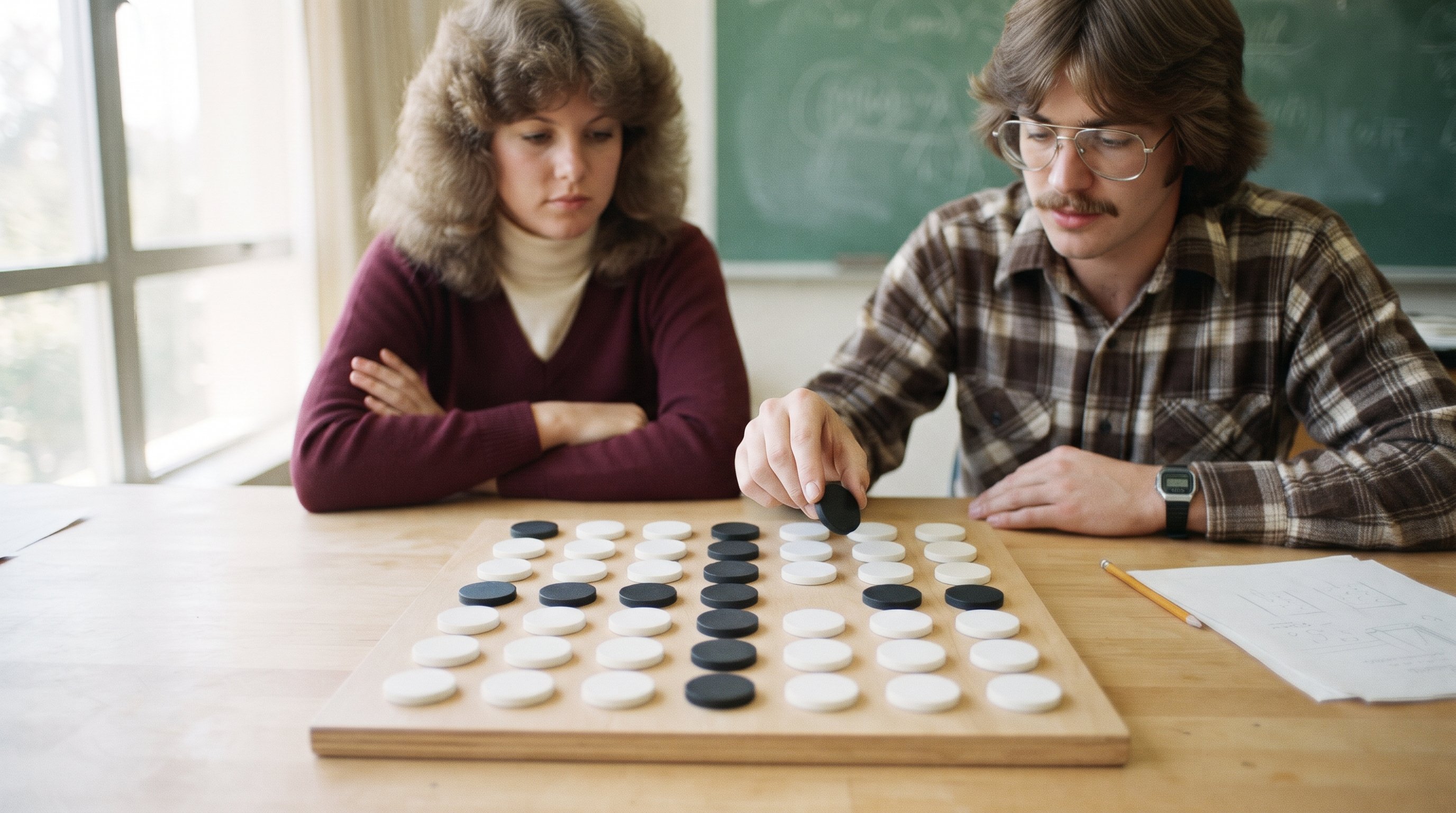
PASADENA, APRIL 1982 - In the Proceedings of the National Academy of Sciences, the physicist John Hopfield of the California Institute of Technology (Caltech) describes a network of simple switches that can recall a memory from a small piece of it. A computer stores data at a fixed address and needs to know that address. Hopfield's network retrieves a memory the way people do: by its content.
How a computer remembers, and how we do
In a computer, every piece of data has a number: the address of its place in the memory. Without the number, the data cannot be found. People remember differently. A few notes of a song or half a face is enough to recall the whole. Such a memory is called a content-addressable memory: a memory that is reached through its content. In his paper, Hopfield shows that a network of many simple parts can be such a memory.
Switches with connections
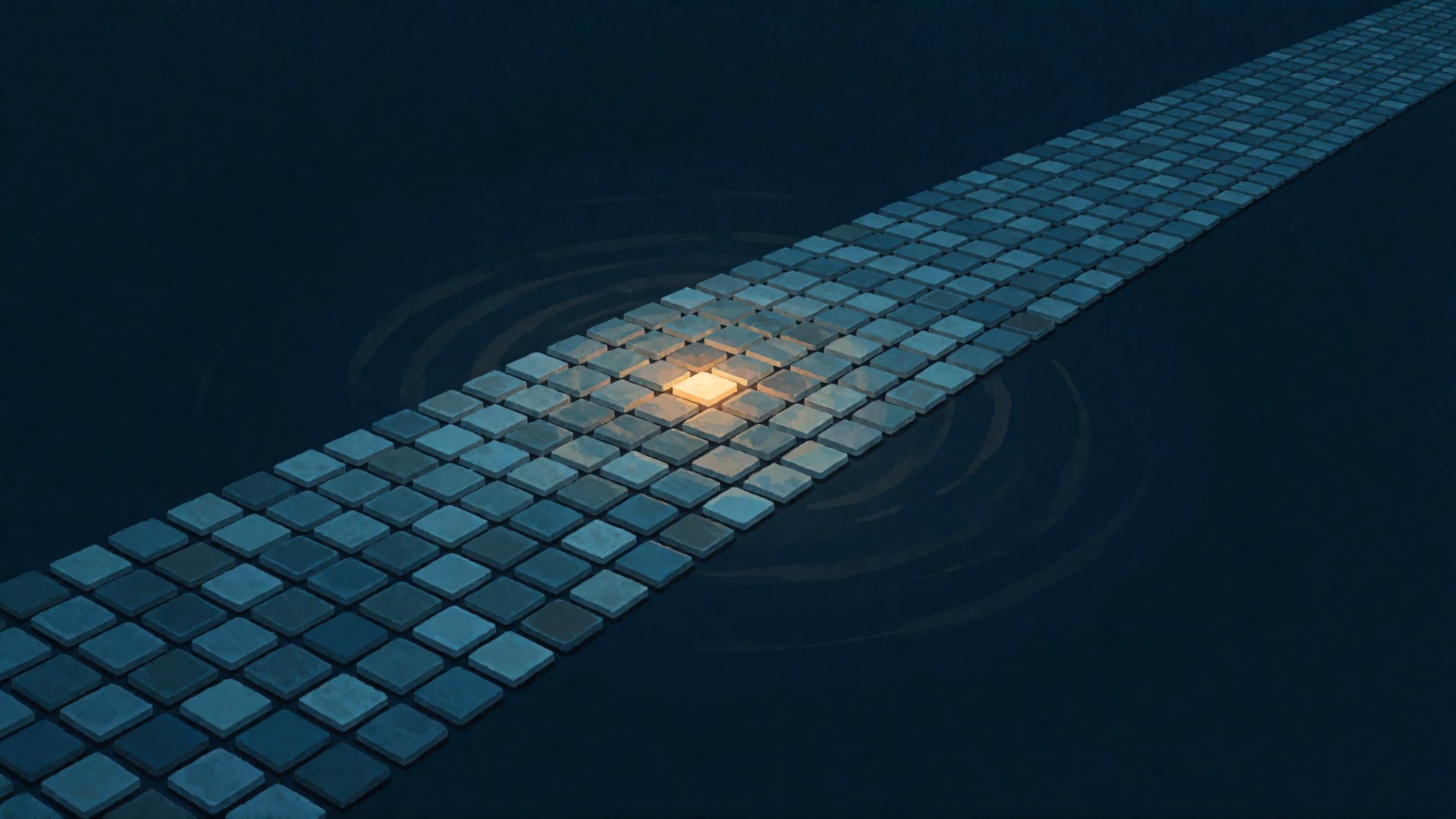
The network consists of many identical, simple units. Hopfield calls them neurons, after the nerve cells in the brain. Each unit is either on or off. Each unit is connected to all the others, and each connection has a strength: positive if the two units prefer to be in the same state, negative if they prefer opposite states.
Storing a pattern means setting the strengths so that the pattern fits. Units that are both on or both off in the pattern get a positive connection. Units that differ in the pattern get a negative one. When several patterns are stored, each pattern counts towards the same connections.
How the network recalls the memory
The network is set to the state of an incomplete or damaged pattern. Then each unit takes its turn. It adds up the influence of all the other units (state times connection strength) and then decides: if the sum is high enough, it switches on, otherwise off. There is no central controller. All units do the same simple job.
Take an example with five units and the stored pattern on-off-on-off-on. If the network is set to on-off-off-off-on, the middle unit is wrong. Its neighbours push it towards 'on', because in the stored pattern they belong together. It switches, and the whole pattern is back.
Hopfield sees in this behaviour a familiar idea from physics: energy, as with tiny magnets that influence each other. The energy of the network is a number that shows how many connections are 'against their will'. Each switch can only lower that energy or keep it the same, as long as the connections are equally strong in both directions. As a result, the network looks for a resting point by itself, where nothing wants to change any more. It is like a ball in a hilly landscape that rolls to the lowest point of its valley: each stored pattern is a valley, and the starting state is where the ball begins. In this way a damaged pattern rolls to the stored pattern that most resembles it.
What else the network can do
In his summary, Hopfield names more properties that arise by themselves, without anyone building them in separately: generalising, recognising familiarity, sorting into groups, correcting errors and remembering a sequence of events. These properties also largely keep working when a part fails or when a detail of the model is different. That fits the brain, where cells die without memories disappearing. Hopfield also writes that his model could be built with integrated circuits, the chips in today's computers.
Looking back from 2026
In 1982 Hopfield was working at Caltech, after sixteen years at Princeton. His 1982 paper and a follow-up from 1984, in which the units can be not only on or off but also take values in between, are his most cited work. Later calculations show that such a network can store about 14 patterns per 100 units. With more patterns, errors start to appear. The network can also get stuck in a pattern that was never stored, such as the mirror image of a stored pattern. As a practical tool, the classic Hopfield network is rarely used in today's machine learning.
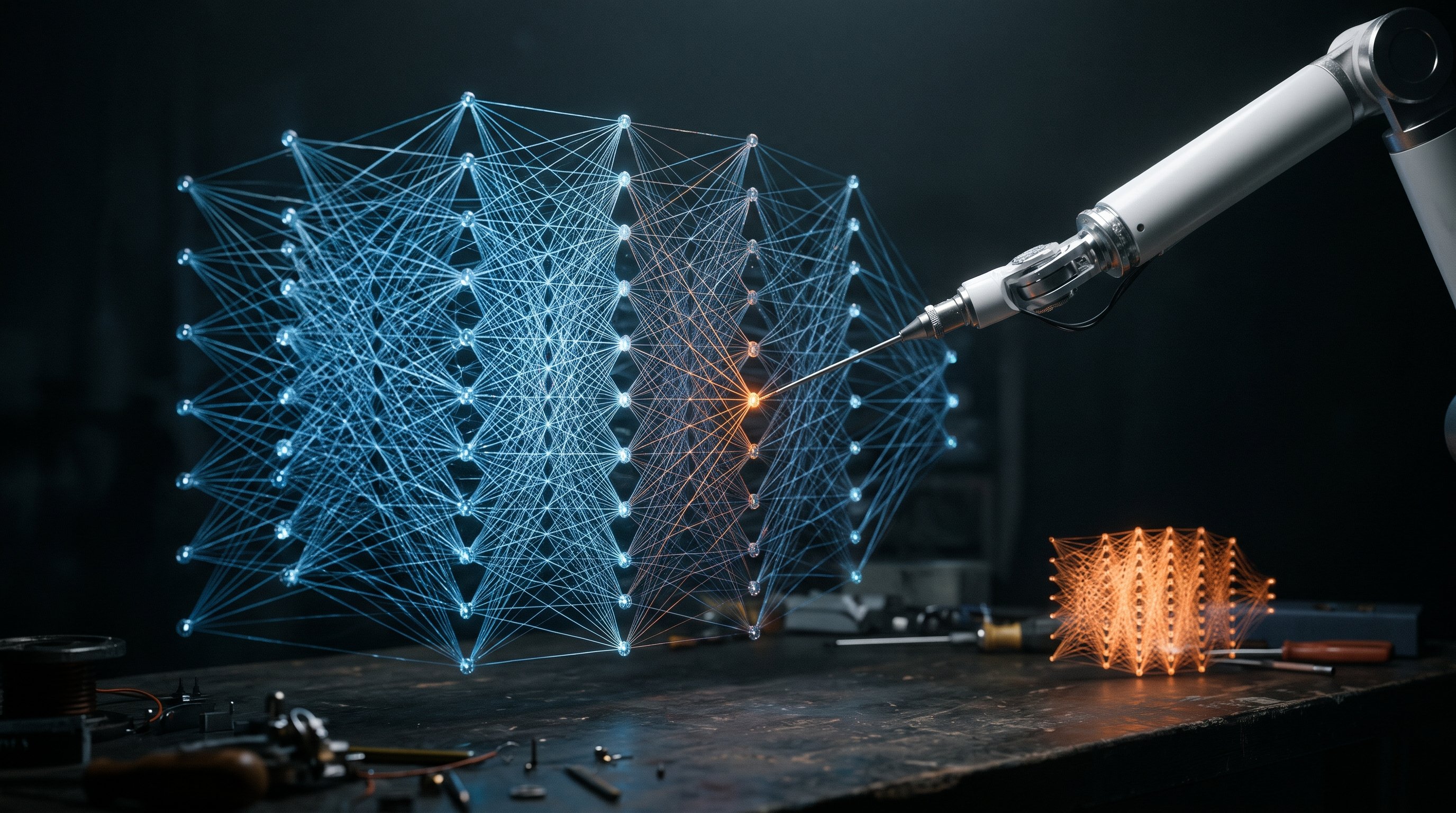
What remained is the idea: a network of simple units that carries its knowledge in the strength of its connections, and a method of calculation that comes from physics. In 2024 Hopfield received the Nobel Prize in Physics for this, together with Geoffrey Hinton. A separate article tells how Hinton built on this work: where Hopfield's network recalls a memory that someone put into it, Hinton's Boltzmann machine learns by itself from examples which features occur in data, and it can create new examples. So there is a line from this network of switches to today's AI.