Nederlands
Humanoid robot walks 560 kilometres on a treadmill in nine days
A humanoid robot from the American company Figure AI has been walking on a treadmill for nine days in a row: more than 560 kilometres and 1.2 million steps, reports chief executive Brett Adcock. The trial is meant to find weak spots in the hardware and is still running.
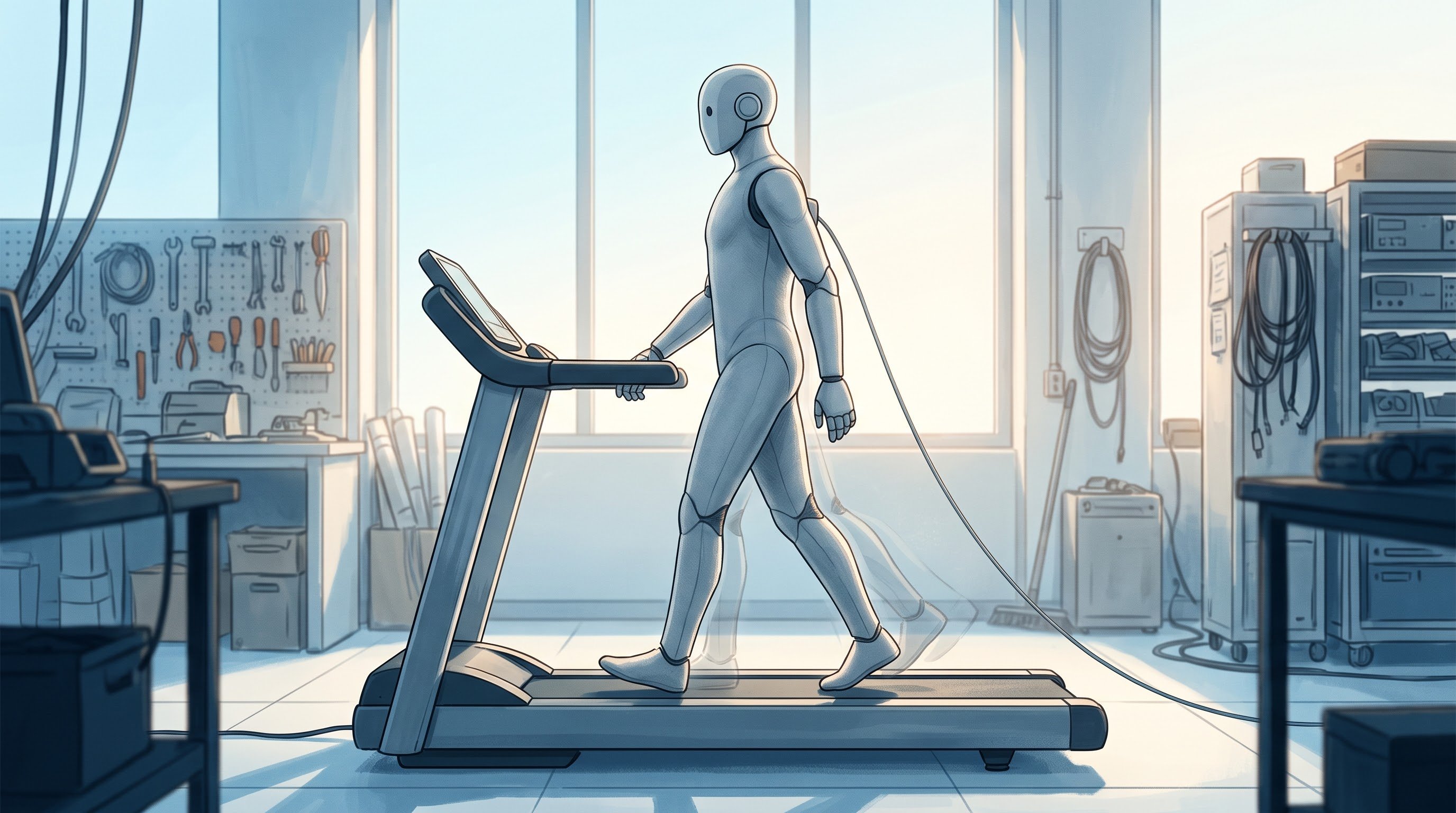
The American robotics company Figure AI is putting its newest humanoid robot to the test with an unusual endurance trial. According to chief executive Brett Adcock, the robot, called Figure 03, had been walking on a treadmill non-stop for nine days on 19 October 2026. In that time, according to Adcock, it covered more than 560 kilometres and took 1.2 million steps. Over nine days and nights, that comes to an average of about 2.6 kilometres per hour: a gentle walking pace, but without a break.
Adcock says he started the trial as a side project. The idea is simple: let the robot walk until something breaks. In a demonstration lasting a few minutes, wear and small defects stay invisible. They only come to light after days or weeks. The test is still running: Adcock wants to see how long the robot can keep going.
A sped-up video shows the robot walking on the treadmill in a test room, connected to a power cable. Figure has not yet explained how the trial is set up in more detail, for example whether the same robot walked all the time.
A robot meant to be made in large numbers
Figure presented Figure 03 on 9 October 2025 as the third generation of its humanoid robot. The company designed it for household work and for work at businesses, and so that it can be built in large numbers. The robot is made for Helix, Figure's own AI model that combines vision, language and movement.
According to Figure, the cameras capture twice as many images per second as in the previous version, respond four times as fast and each camera sees 60 per cent wider. Each palm contains an extra camera, so that the robot can also see what it is doing when it reaches into a cupboard. According to the company, the fingertips can feel a pressure of just 3 grams, about the weight of a paperclip. Touch is a fast-growing research field in robotics: researchers in Hong Kong recently built a robot arm with an artificial skin that feels touch.
The robot can also charge wirelessly, like an electric toothbrush. It steps onto a special plate, and coils in its feet take up the power at 2 kilowatts.
Earlier: 200 hours of sorting parcels
In May 2026, Figure already showed another endurance trial live. Three Figure 03 robots sorted parcels for about 200 hours, 249,560 in total. According to the company, not a single robot dropped out because of a hardware fault. The robots took turns: when one robot's battery ran low after about four hours, another took over the work and the first walked to the charging station.
That trial showed that a group of robots can keep working together day and night. The treadmill test looks at something else: how well motors, joints and feet stand up to the same movement, hundreds of thousands of times in a row.
Farewell to the previous generation
Now that production of Figure 03 is growing, Figure has retired the previous version, Figure 02. The company announced this on 30 September 2026. Figure 02 was the first robot Figure deployed at a customer: at the BMW factory in Spartanburg, in the American state of South Carolina, it picked up sheet-metal parts. According to Figure, it thereby helped build more than 30,000 cars of the BMW X3 type.
How the company disposed of the old robots is striking. Taking them apart would take a lot of time because of the many custom-designed parts, and Figure did not want to give away its own technology. So it taught the robots to jump into a melting furnace themselves, at a foundry in Imatra, Finland. From the metal, Figure is making a small series of keepsakes. A handful of Figure 02 robots will be kept at the headquarters.
What is still to come
The figures on the treadmill trial come from Adcock himself. More details, such as whether parts were replaced along the way, will make it clearer what exactly the test shows. For now, Figure is simply letting the robot keep walking, and every extra day produces new measurement data.
What does this mean for the road to the singularity?
A smart AI model in a robot only has real value if the body it controls keeps working day in, day out. Helix teaches the robot to see, feel and move; the treadmill shows whether knees, ankles and motors can also keep that up for thousands of hours. That step from short demonstration to long endurance test is needed before humanoid robots can run full working days in factories, warehouses and later perhaps at home.
Such long trials also produce exactly the data that AI handles well. A model that learns how a joint vibrates or heats up just before it breaks can send a robot to the workshop in time, before anything goes wrong. Figure says its robots already walk to a service corner by themselves when they notice a problem, while a colleague takes over the work. The longer the treadmill runs, the better robots learn to see such problems coming.
What is the technological singularity? Read the explanation →