Nederlands
Japan launches space probe that is to be the first to bring soil from a moon of Mars to Earth
The Japanese space agency JAXA has launched the probe MMX. In 2031 it is to bring at least 10 grams of soil from the Martian moon Phobos to Earth. That has never been done before, and it could explain how the moons of Mars came to be.
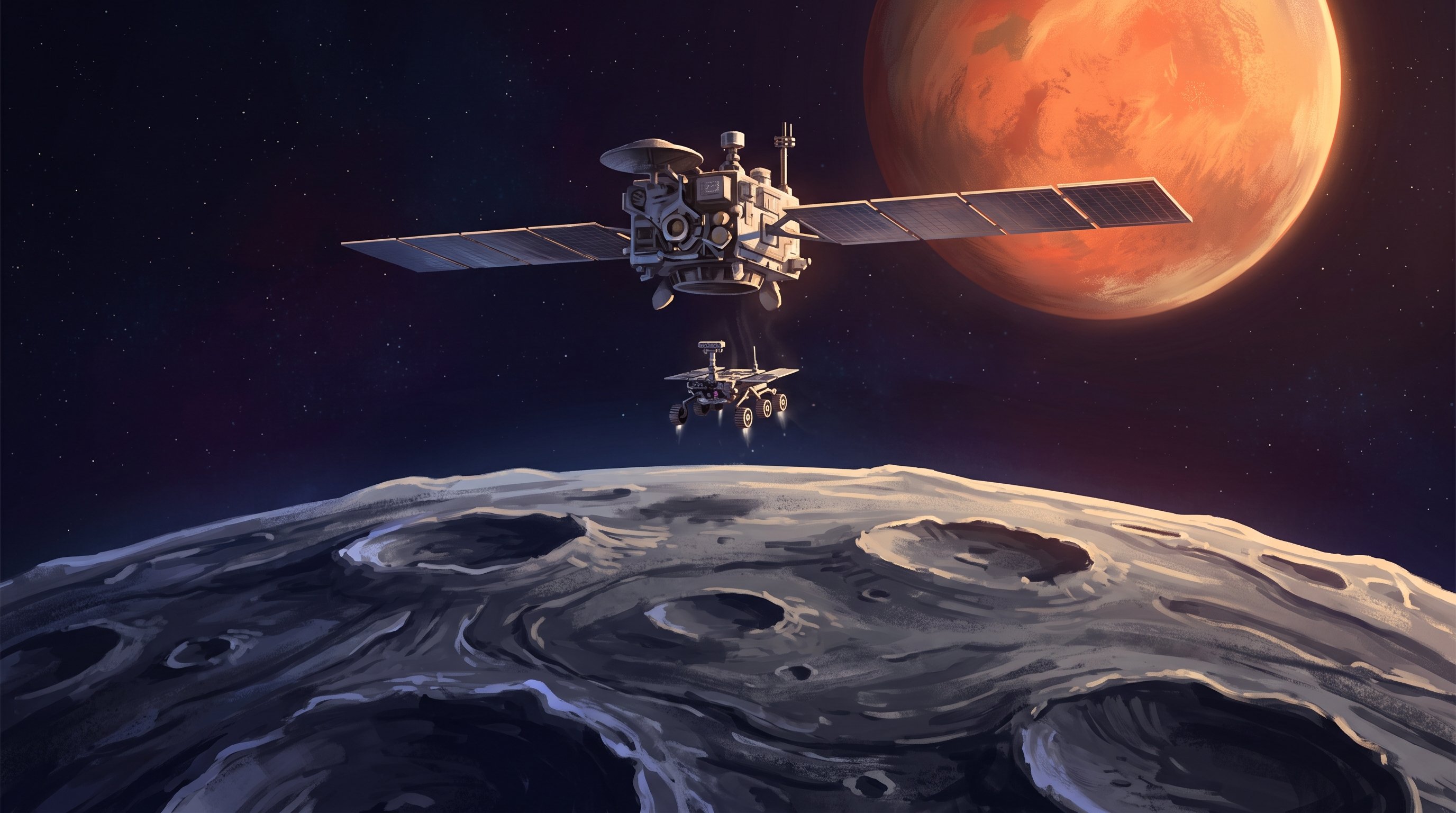
Japan is on its way to Mars. On 20 October at 04:41 Japanese time (21:41 Central European Summer Time on 19 October), an H3 rocket lifted off from the Tanegashima launch site in southern Japan. On board: the space probe MMX, short for Martian Moons eXploration. Just over 71 minutes after launch, the Japanese space agency JAXA confirmed that the probe had separated cleanly from the rocket and was on course.
The goal is special: MMX is to collect soil from Phobos, the largest moon of Mars, and bring it to Earth. That has never been done before for a moon of Mars.
Two mysterious little moons
Mars has two small moons, Phobos and Deimos. They are nothing like our own round Moon. Phobos is an irregular, potato-shaped lump of rock about 22 kilometres across; Deimos is even smaller. Nobody knows for sure how they formed. Perhaps they are asteroids that were once captured by Mars. Or perhaps they were formed from debris that flew into space when something large struck the young Mars long ago.
Those two explanations lead to a different make-up of the rock. A piece of real Phobos soil in a laboratory on Earth can therefore give the answer. It also tells us more about how planets such as Mars and the Earth formed.
How it will work
According to the plan, MMX will arrive at Mars about a year after launch. The probe will then stay near Phobos for about three years to map the moon. Deimos and the climate of Mars will also be studied.
First, a small vehicle goes down: IDEFIX, a rover of about 25 kilos, built by the French and German space agencies CNES and DLR. On Phobos, gravity is so weak that the rover weighs only as much as a few sugar cubes there. IDEFIX examines the ground up close and tests how to drive on such a small moon.
Then the probe itself lands. With a tube it brings up soil from as deep as 2 centimetres, and with a puff of gas it blows loose material into a container. The target is at least 10 grams. A capsule is to deliver it to Australia in 2031. From there, the soil will go to a JAXA laboratory near Tokyo, where researchers from all over the world can work with it.
Experience with soil from space
Japan knows how to do this. The probe Hayabusa2 brought back soil from the asteroid Ryugu in 2020. MMX is an international project: besides JAXA, the American NASA, the French CNES, the German DLR and the European Space Agency ESA are taking part. ESA supplied communication equipment, among other things, and is helping to keep in contact with the probe through its ground stations.
The journey is long and landing on such a small moon is difficult. In the coming months MMX will fly through space to Mars, where the probe is due to arrive in the summer of 2027.
What does this mean for the road to the singularity?
Bringing back soil from another celestial body is one of the hardest jobs in space travel. That this is now possible at Mars too shows how far robots and space probes have come. At a distance of hundreds of millions of kilometres you cannot steer a probe live: it has to be able to do a lot by itself, such as landing safely on unknown ground.
AI can contribute a lot to that in the coming years, for example in navigating and landing independently. AI can also help with studying the soil itself: models that combine knowledge from geology, chemistry and astronomy can see connections that stay out of sight for a single specialist. In a few years, a piece of a Martian moon will be on Earth for the first time, ready to give up its secrets.
What is the technological singularity? Read the explanation →