Nederlands
Japanese researchers control five quantum bits in silicon at once, with almost no errors
Researchers at RIKEN in Japan controlled five quantum bits on a silicon chip at the same time, through one shared control line. They found the biggest source of errors and kept accuracy at around 99.9 per cent. That helps to build larger quantum computers.
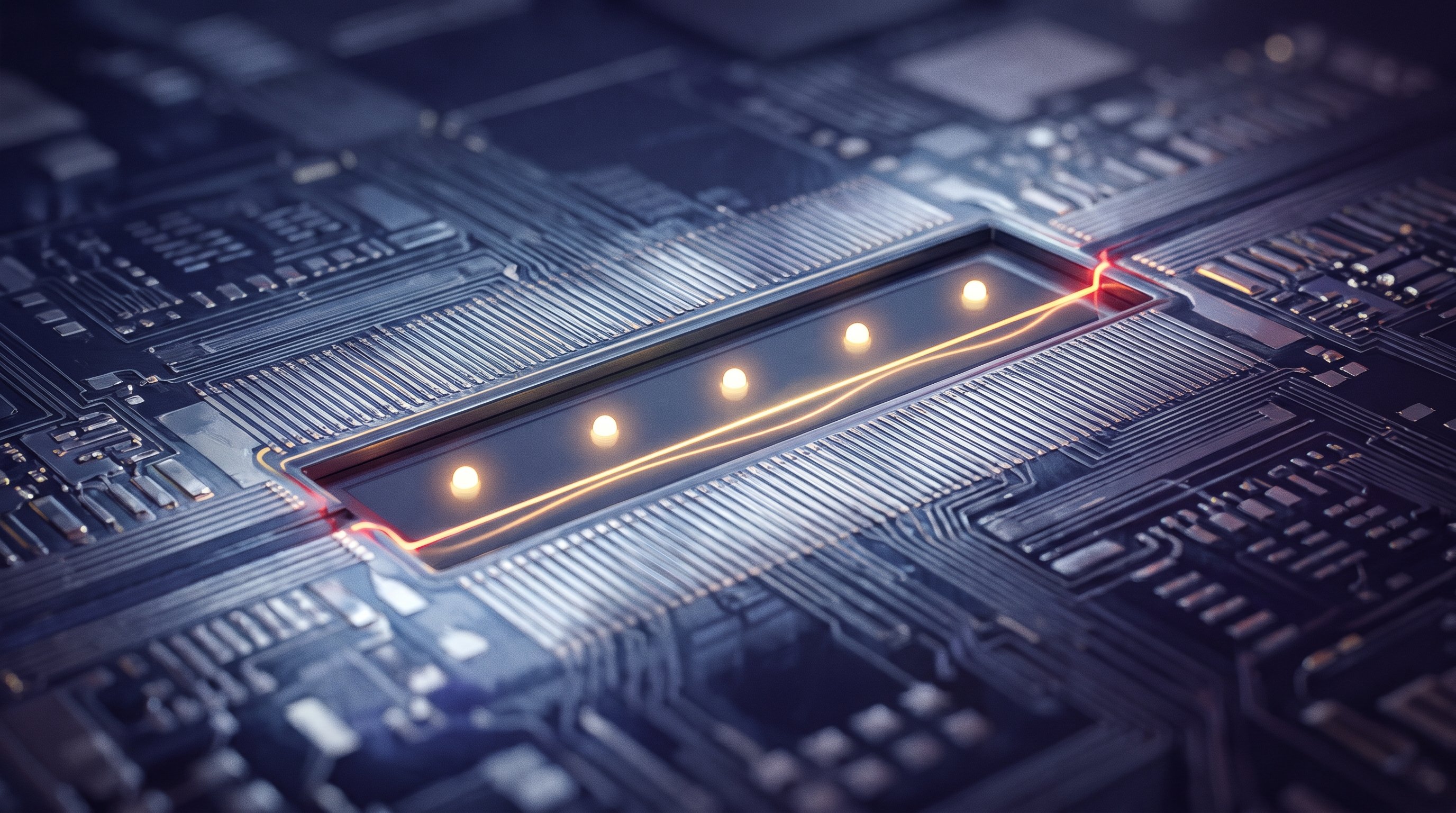
Researchers at the Japanese research institute RIKEN have controlled five quantum bits at the same time with an accuracy of about 99.9 per cent. They did this through one shared control line. The team discovered what causes most errors when you operate several quantum bits at once, and found a clever way to correct it. The research was published in the scientific journal Nature Physics.
Why silicon?
A quantum computer calculates with quantum bits, or qubits for short. There are several ways to make such a qubit. One promising way uses silicon, the same material as in ordinary computer chips. A single electron is held in place inside it, and the direction in which that electron spins (its 'spin') stores the information. Such spin qubits can be made with the factories and techniques the chip industry already has. That makes them attractive for building chips with very many qubits later on.
You control a qubit with short pulses of microwaves, the same kind of radiation as in a microwave oven, but very weak. If you want a quantum computer with thousands or millions of qubits, you cannot give every qubit its own wire and its own control box: there would be far too many. So several qubits have to share one control line and also be operated at the same time, otherwise the computing becomes far too slow.
The problem: qubits disturb each other
Until now, it was exactly this simultaneous operation that went wrong. As soon as you control several qubits at once, they make many more errors. The RIKEN team investigated why. The main cause is called the AC Stark effect: the microwaves meant for one qubit slightly change the properties of the other qubits. You can compare it to a clock that starts running a little faster as soon as the neighbour switches on their radio. The qubit gets slightly out of step, and the operation turns out differently than intended.
The solution: adjusting pair by pair
You could correct this disturbance by measuring and adjusting every possible combination of qubits separately. But the number of combinations grows extremely fast with every qubit you add, so on a large chip that is an impossible task. The researchers came up with a method in which they only ever need to adjust two qubits together. According to first author Yi-Hsien Wu, who carried out the experiments as a PhD student, this keeps the adjustment manageable even with larger numbers of qubits. Co-author Leon Camenzind, who supervised the work, calls it an important step towards making silicon quantum chips larger.
The results
On their own, each qubit reached an accuracy of well over 99.99 per cent: out of ten thousand operations, on average fewer than one went wrong. The best one even came close to 99.999 per cent. With three qubits at once, accuracy stayed above 99.99 per cent. With all five at once, it was around 99.9 per cent. According to the researchers, that is close to the level needed for a quantum computer that can correct its own errors.
The errors have not disappeared completely yet. Controlling five qubits at once needs more microwave power, and that also disturbs the qubits a little. The team expects that a better chip design can reduce this. That is the next step. The work is part of a large Japanese research programme (Moonshot) led by Seigo Tarucha, which aims to build an error-tolerant quantum computer made of silicon.
What does this mean for the road to the singularity?
Quantum computers will be able to do calculations that are out of reach for ordinary computers, for example when designing new materials and medicines. That requires very many qubits that work together accurately. This research shows that qubits in silicon can share a control line and work at the same time without accuracy collapsing. For now it is about five qubits in a lab. But because silicon fits in with the existing chip industry, the road to chips with many more qubits has come a step closer.
What is the technological singularity? Read the explanation →