Nederlands
Tiny holes that slow down light make a small Japanese chip for optical fibre far more efficient
Japanese researchers built a component that turns electrical signals into light, using tiny holes that slow the light down. It is 0.3 millimetres long, runs on low voltage and sends up to 200 gigabits per second. The next step: losing less light along the way.
In an AI data centre, thousands of chips work together and constantly send each other data. Over very short distances this can be done through copper wire. But from about one metre, optical fibre is needed, Yokohama National University reports: fast electrical signals quickly get weaker in copper and produce a lot of heat. Light in optical fibre suffers much less from this.
To send data as light, a small component is needed: a modulator. It works like an extremely fast light switch. Bright light is a 1, dark is a 0, and this changes billions of times per second.
Researchers from Yokohama National University, the Institute of Science Tokyo, the Japanese research institute AIST and the research partnership PETRA have now built such a light switch that is much smaller and more energy-efficient than the usual ones. The work was led by Keisuke Kawahara, supervised by Professor Toshihiko Baba. It appeared on 22 October 2026 in the journal Nature Communications.
Smaller and more efficient
The light switches used in chips today are 2 to 4 millimetres long. That sounds small, but on a chip it is enormous: the components a modern chip uses to calculate are tens of thousands of times smaller. And for the fast connections of the future, dozens of these switches have to fit side by side on one chip. Usual switches also need a high voltage, plus extra helper chips that amplify and clean up the signal. Those helper chips use a lot of power.
The new light switch is about a third of a millimetre long, six to twelve times shorter. It sends up to 200 gigabits per second, enough to send about five high-quality films every second. According to the university, this costs the switch itself about a hundred times less energy than the usual switches. The laser and the electronics around it come on top of that. The switch works on the low voltage that ordinary chips can supply themselves, so fewer helper chips are needed.
How to make light and dark
The laser shines all the time. The switch splits its light into two halves, which each follow their own path and come together again at the end. Light is a wave, with peaks and troughs. If both halves arrive exactly in step, peak on peak, they strengthen each other: bright light comes out, a 1. If one half runs exactly half a wave behind, every peak falls on a trough and they cancel each other out: no light comes out, a 0. Noise-cancelling headphones do the same with sound.
To switch, one half must therefore be able to fall half a wave behind on command. A voltage on one of the two paths takes care of this: it makes the silicon there a tiny bit slower for light. This effect is very weak. In ordinary switches, the path therefore has to be those 2 to 4 millimetres long, so that the lag can build up over the whole length to that half wave.
The secret: holes that slow down the light
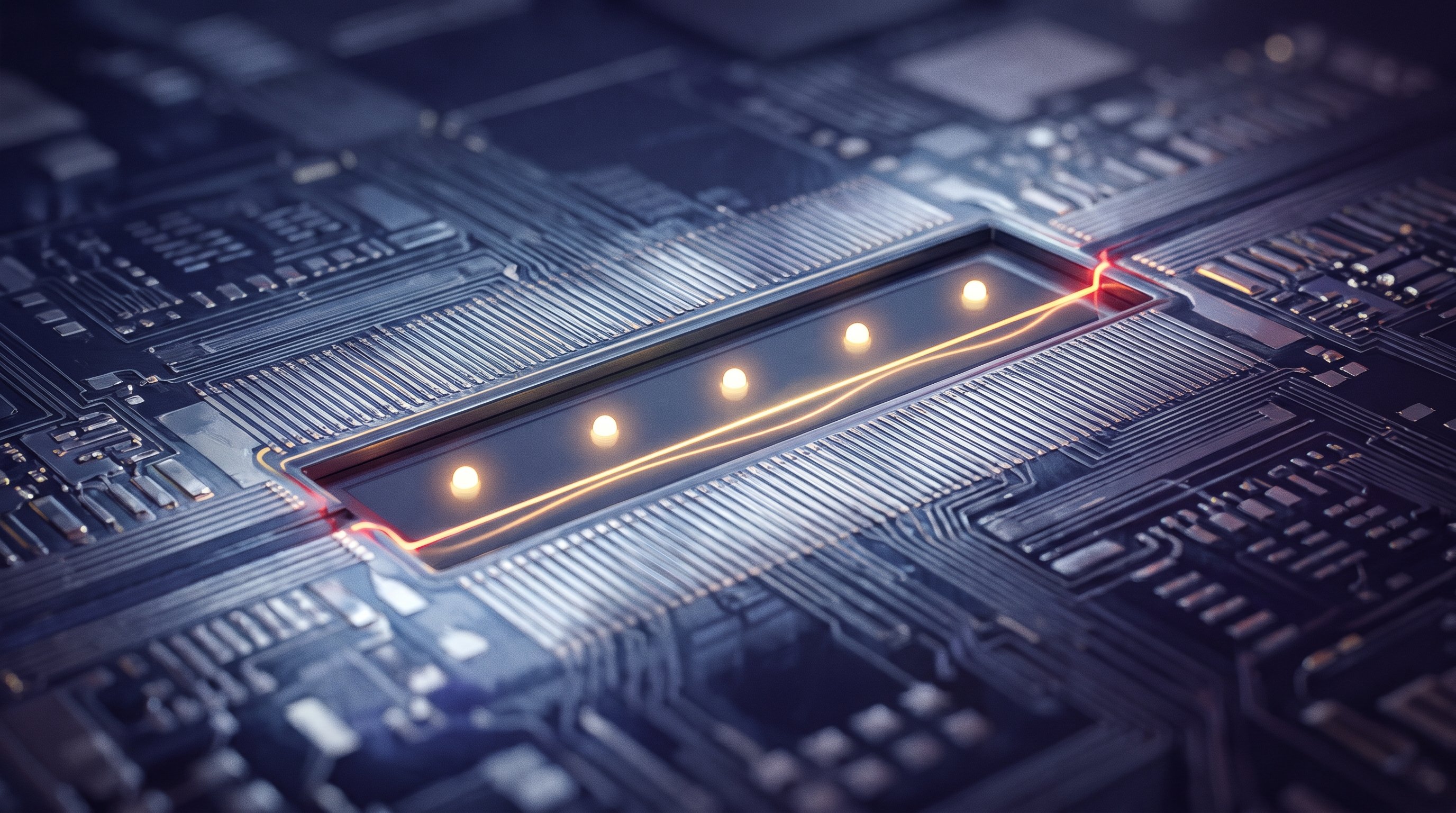
The Japanese team built up that lag over a much shorter stretch. They made a regular pattern of tiny holes in the silicon. At each hole, a little bit of light bounces back. As a result, the light keeps going back and forth a little, and moves forward five to fifteen times more slowly than normal.
This way the light stays much longer in the stretch where the voltage is applied, and the voltage has much more time to make the light fall behind. Compare it with walking through a rain shower: if you walk slowly, you get much wetter over the same distance than if you run. That is why a third of a millimetre is enough to reach the half-wave lag, where 2 to 4 millimetres were needed before. And less voltage is needed.
Switches with such holes already existed, but they were too slow for very fast signals. Earlier versions reached 64 gigabits per second. The researchers built in a clever correction that gives every fast change an extra push. This way the new version reaches 200.
What still needs to happen
A lot of light is still lost in the switch: of the light that goes in, 3 to 7 per cent comes out again. In the experiments, the researchers made up for this with a light amplifier. With a better design, they expect to bring that loss down. The switch also still has to be tested in a complete connection.
After that, the researchers want to send several colours of light through one switch at the same time, each with its own data stream. With 16 to 32 colours, this would deliver 3.2 to 6.4 terabits per second, according to their calculations.
The switch is made with the techniques the chip industry already uses. According to Baba, this means it can be made on a large scale, without new factories. He sees the component as a building block for light components built in right next to the computing chip. This idea is already being tested in practice: this month, three companies showed a working server rack in which AI chips talk to each other via light, with the light components directly next to the chip. The closer light components sit to the chip, the more important it becomes that they are small and energy-efficient. That is exactly what the Japanese switch is made for.
What does this mean for the road to the singularity?
AI systems grow by having more and more chips work together. The more chips, the more data has to travel back and forth between them, and the more power and space the connections cost. A light switch of a third of a millimetre that needs little power and few helper chips makes it possible to put many more light connections on one chip.
There is still work to do: less light loss, and more colours of light at the same time. But the principle works, and it fits into the factories that already exist. That clears the way for more efficient and faster connections in the data centres on which the next generations of AI will run.
What is the technological singularity? Read the explanation →