Nederlands
IBM links two quantum chips with 80-centimetre cables
IBM researchers connected two quantum chips of 120 qubits each with four superconducting links of 80 centimetres. Quantum information came across correctly 99 times out of 100 on average. It is a step towards quantum computers built from separate modules.
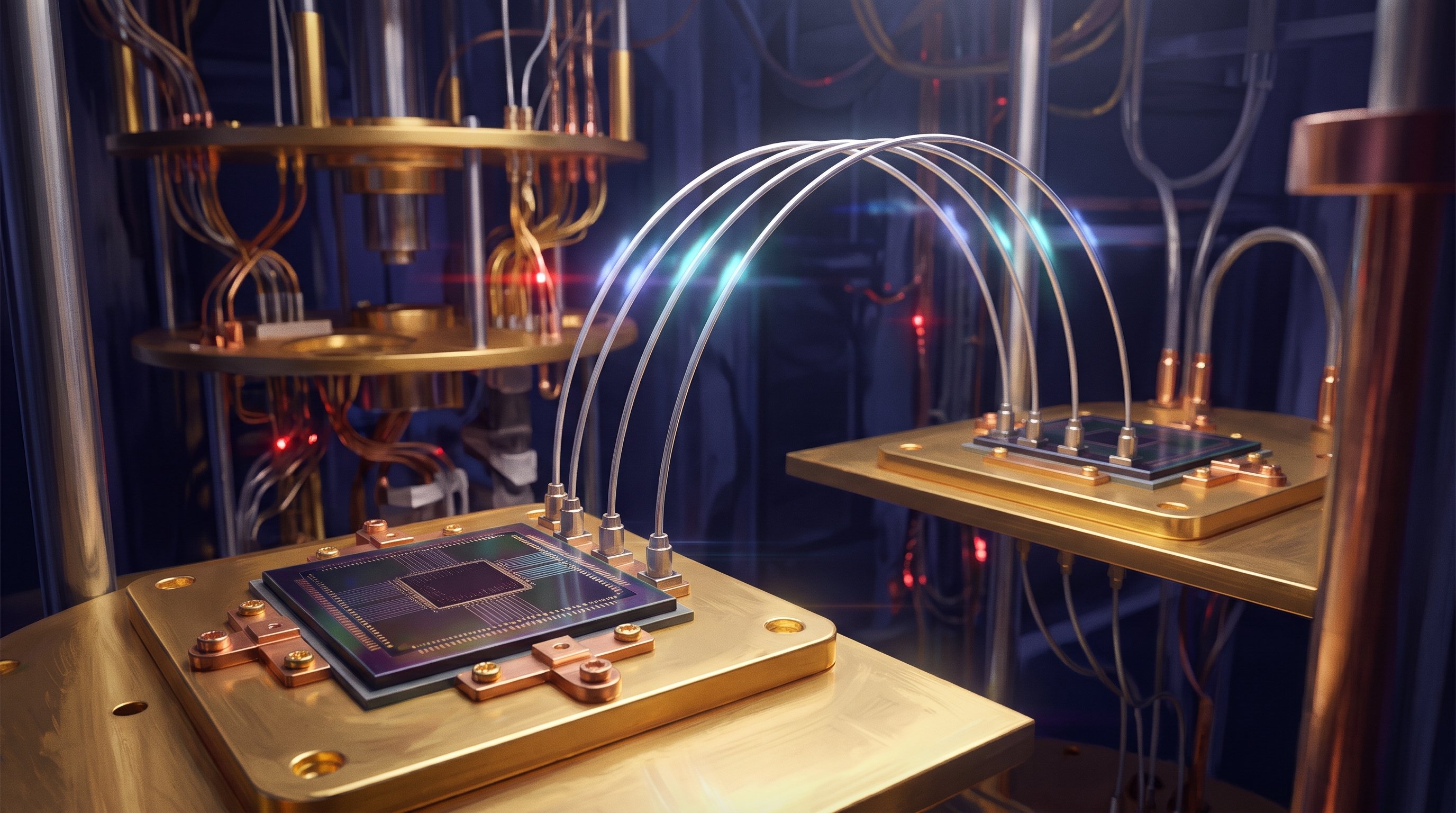
IBM researchers have connected two quantum chips through four links with cables of about 80 centimetres. Each chip has 120 qubits, the computing units of a quantum computer. Quantum information travelled over those links from one chip to the other. That worked in 99 per cent of cases on average. The best link reached 99.29 per cent.
The work comes from IBM's T.J. Watson research centre. It is online as a preprint and is still being reviewed by other scientists. According to the researchers, it is, as far as they know, the first time that such large superconducting quantum chips have been connected to each other through several links at once.
Why link chips together?
An ordinary computer calculates with bits: a 1 or a 0, like heads or tails. A qubit can also be something in between, like a coin that is still spinning. Only when it is measured does it land on heads or tails. This allows a quantum computer to solve some problems much faster than an ordinary computer.
To reach their full power, quantum computers will probably need millions of qubits. Those do not fit on one chip. According to quantum scientist Winfried Hensinger of the University of Sussex, sooner or later you run up against the size of the chip. That determines how many qubits fit on it. This is why many companies want to link smaller chips together as building blocks, like pieces of a puzzle.
That linking is difficult. Quantum information is very fragile: a little heat or interference is enough to disturb the spinning coin. A distance of 80 centimetres is therefore very long for such information.
How the link works
Each link consists of a cable of superconducting aluminium. Superconducting means that, at extreme cold, the metal conducts electricity without resistance. At each end of the cable sits a small, adjustable coupling element that serves as a relay station. The information is passed on like a relay baton from a qubit on the first chip, through those relay stations and the cable, to a qubit on the second chip.
The cables stand upright on the chip. That way more connections fit side by side. They are only pressed into place once both chips are already inside the cooling system. According to the researchers, this makes the approach practical for large machines with many connections.
The researchers also carried out computing steps between qubits on the two different chips. These succeeded in 94.75 per cent of cases on average, and in 96.42 per cent with the best link. With those computing steps they created entanglement across the two chips. Entangled qubits are so closely linked that they act as one whole, even though they sit on different chips. In addition, the cables lost little energy. They kept working after the system had been warmed up and cooled down again three times.
What still needs to improve
The researchers saw that magnetic interference affected the quality of the signal. They want to make the links even more efficient before they are ready for use. In this experiment two chips were linked. The next step is linking many more chips. According to the researchers, it will then become harder to make every connection work equally well.
IBM wants to build the chips and links into the cooling systems the company showed in August 2026. These keep the qubits at the extremely low temperature they need. The company eventually wants to link hundreds of chips together in such systems. According to IBM, this should lead in 2029 to the first fault-tolerant quantum computer: a machine that catches its own calculation errors and can therefore carry out long calculations reliably. Jay Gambetta, director of IBM Research, calls linking these cooled modules and making them work a big step in that direction.
A different approach from Sussex
IBM is not the only one working on links between quantum chips. In February 2023, researchers at the University of Sussex described a very different approach in the journal Nature Communications. They use electrically charged atoms, ions, floating above a chip as qubits. With an electric field they moved those ions from one chip to another, the way you slide a puzzle piece over to the next piece. Their technique is called UQConnect.
That worked 2,424 times per second. More than 99.999993 per cent of the ions arrived correctly. According to the researchers, the quantum information in the ion was preserved. These figures cannot be compared with IBM's. In Sussex the question was whether the ion itself arrived. At IBM it was about how well the quantum information came across. The company Universal Quantum, a spin-off from the university, is developing the technique further. According to quantum scientist Mariam Akhtar, who led the research on the prototype, the experiment confirms the design that Universal Quantum is developing.
What does this mean for the road to the singularity?
Quantum computers will be able to do calculations that ordinary computers cannot handle. Researchers mention, among other things, designing new materials, research into medicines, better security and climate models. For that, the machines need to become much larger than they are now.
This work by IBM shows that large superconducting quantum chips can talk to each other reliably, even when they are already inside their cooling system and tens of centimetres apart. That is an important building block for computers made of many modules instead of one ever larger chip.
The next steps are clear: less interference, more links at once and eventually hundreds of linked chips. If that succeeds, a quantum computer that is large and reliable enough for truly useful calculations will come a good deal closer.
What is the technological singularity? Read the explanation →