Nederlands
Liquid with manganese particles gives a flow battery more than five times the capacity in the lab
Chinese researchers added solid manganese dioxide to the liquid of a flow battery. In lab tests, a litre held more than five times as much charge as earlier manganese liquids, even at a much higher current. Larger trials are the next step.
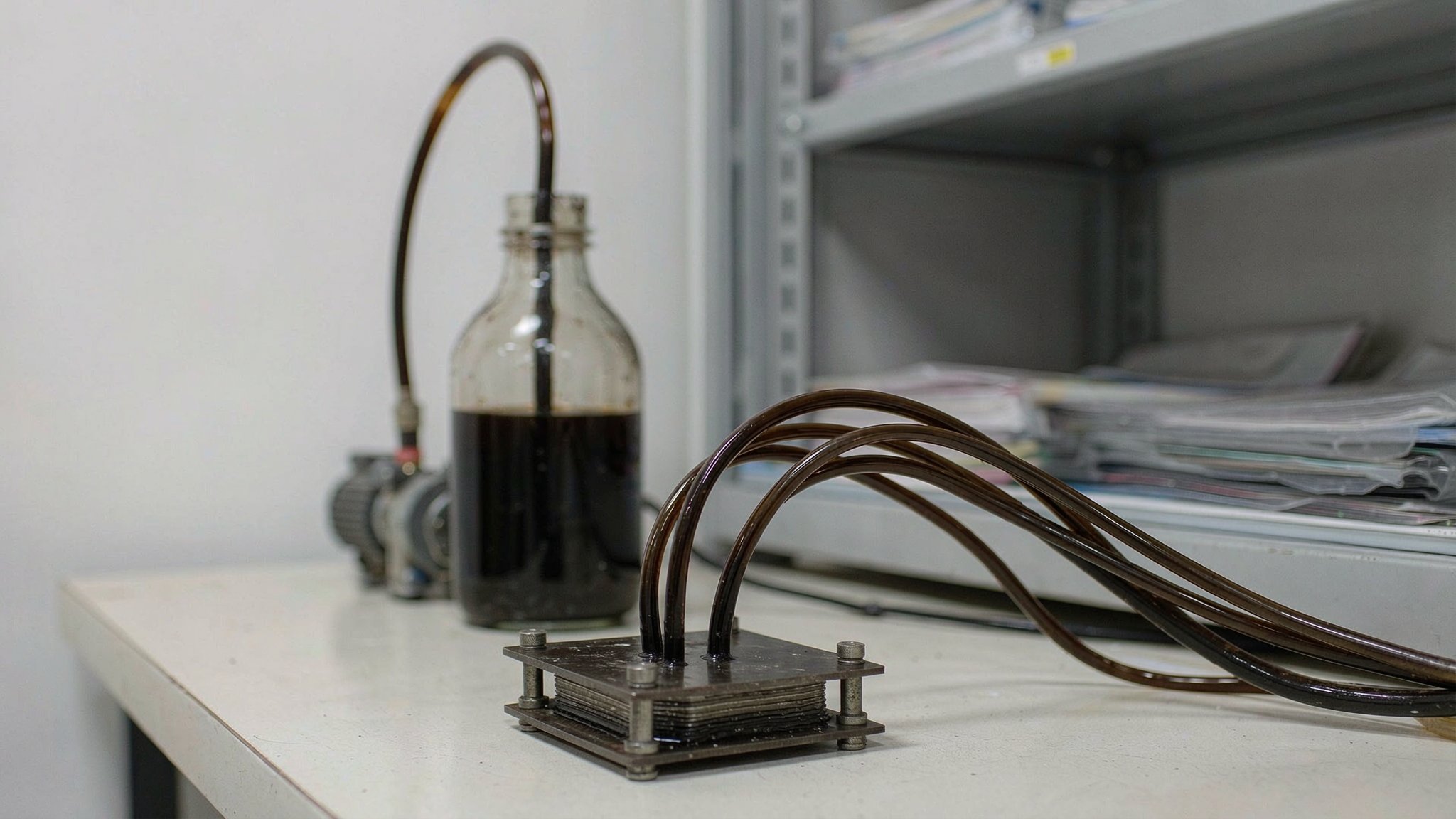
Chinese researchers have tested a manganese-based flow battery in the lab that stores more than five times as much charge per litre of liquid as previously reported manganese liquids. The capacity reached 156.2 ampere-hours per litre, 409 per cent more. An ampere-hour is a measure of the amount of electric charge. The work, by a team from Shanghai University and the Qinghai Institute of Salt Lakes, part of the Chinese Academy of Sciences, appeared in the journal Nano-Micro Letters.
Why manganese, and where it got stuck
A flow battery stores energy not in solid plates but in liquid in tanks. The liquid is pumped past a cell, where it takes up or gives off charge. Anyone who wants to store more simply uses bigger tanks. That is why such batteries are interesting for storing solar and wind power.
Manganese is cheap, environmentally friendly and widely available. The problem is how much of it fits in the liquid. In an ordinary liquid of manganese sulfate in sulfuric acid, at most about 1 mole per litre dissolves. A mole is a fixed measure for a number of particles. The sulfuric acid already contains a lot of sulfate itself, and that stops more manganese sulfate from dissolving. Less manganese in a litre means less charge in a litre.
Solid particles as an extra supply
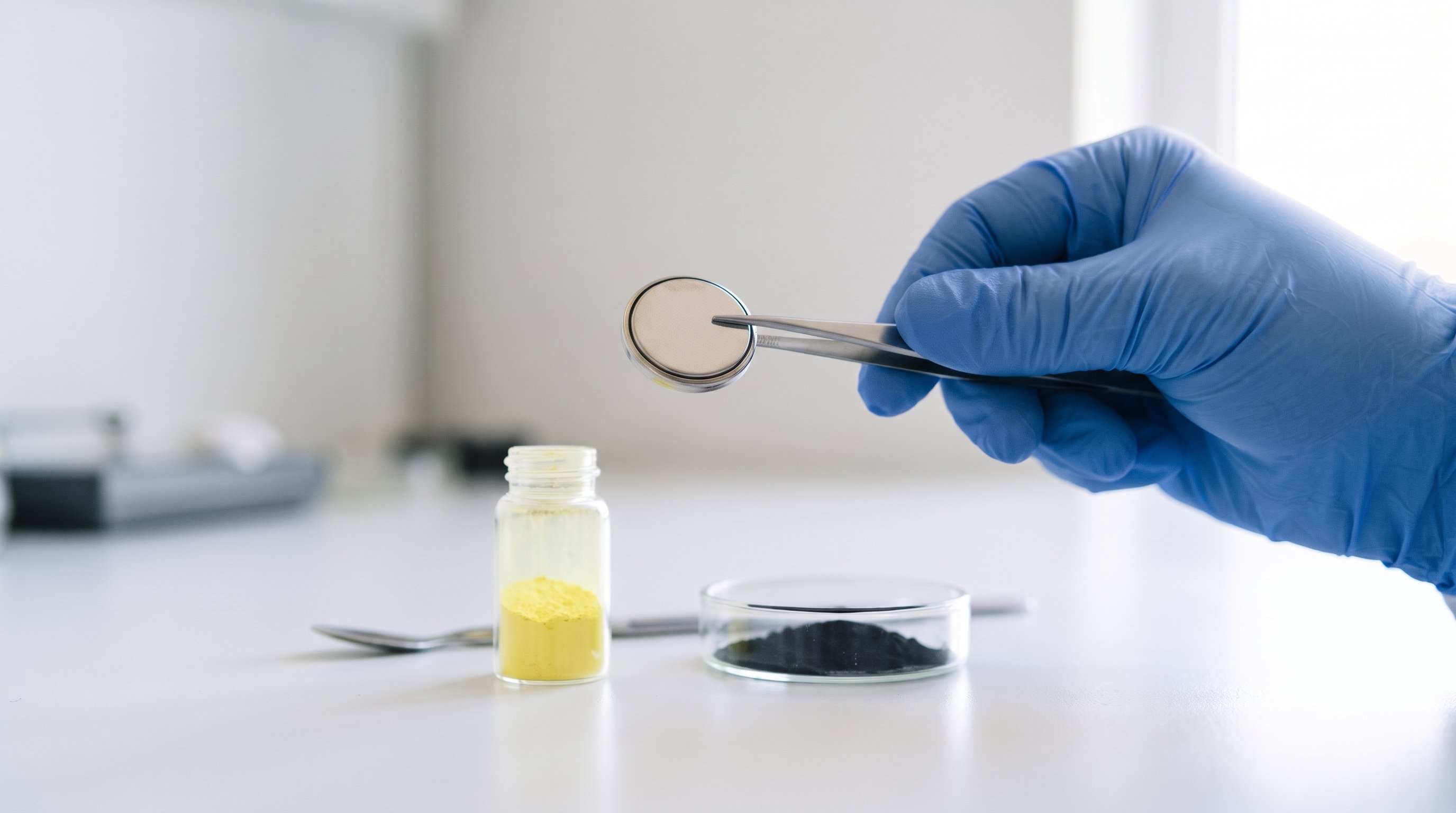
The team therefore added solid manganese dioxide to the liquid. This creates a thick mixture with floating particles, known as a slurry. During discharge, this solid manganese dioxide turns into dissolved manganese. The extra manganese thus comes from the solid supply, and not from manganese sulfate that first has to dissolve. With a mixture of 4 moles of manganese dioxide per litre, the dissolved manganese rose to 3.76 moles per litre, almost four times the usual limit.
Solid particles do have a drawback: they react slowly. Earlier batteries of this type therefore worked at no more than 1 milliampere per square centimetre of electrode, a low current. In the new battery, this changes at the second charge. The solid manganese dioxide that forms then goes back into solution. After that, the battery runs on a reaction between two forms of dissolved manganese, and no longer on the solid particles.
This gives a higher voltage during discharge and makes stable operation at 30 milliamperes possible, thirty times as much as reported before. At that current, the capacity of the mixture with 4 moles stayed above 151 ampere-hours per litre, and more than 71 per cent of the energy came back.
The next steps
The researchers ran a test of one hundred charge and discharge cycles with a thinner mixture of 1 mole per litre. About 99 per cent of the charge came back, and 76 per cent of the energy.
There are still two points to work on: manganese that leaks to the other side of the battery, and particles that build up. Both cost capacity, and the researchers want to reduce them further. The figures are comparisons with previously reported liquids and batteries of this type. For use on a large scale, trials are now needed with many more charge cycles and with complete systems.
What does this mean for the road to the singularity?
A world that increasingly runs on sun and wind needs cheap ways to store power for moments without sun or wind. Manganese is an attractive material for this, because it is plentiful. This research tackles two bottlenecks at once: more charge fits in a litre, and the battery can handle a higher current. It is a lab result, and for that very reason a good first step. If this can be kept up in large installations, storing renewable power on the scale of the whole electricity grid comes a good deal closer.
What is the technological singularity? Read the explanation →