Nederlands
Magnetic microbots help dissolve blood clots faster in tests
Researchers at ETH Zurich have built tiny magnetic robots that help a medicine flow towards a blood clot. In a lab model the clot dissolved six times as fast as with the medicine alone, and it also worked better in living pigs.
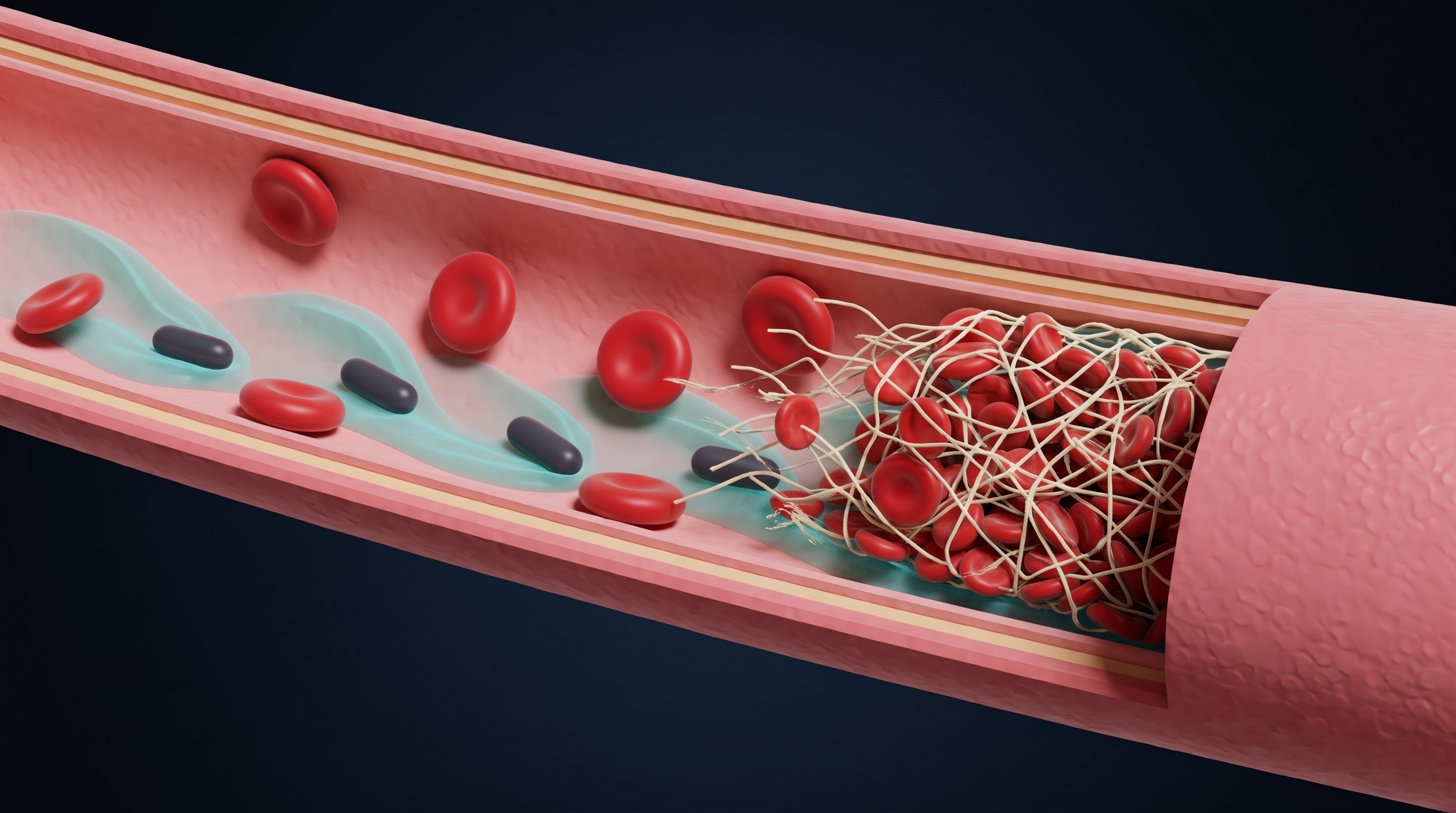
A blood clot can block a blood vessel so completely that almost no blood flows past it. There are medicines that dissolve a clot, but they first have to reach it. Doctors therefore often deliver such a medicine with a catheter, a thin tube that is pushed forward through a blood vessel, to just before the blockage. The medicine has to cover the last stretch on its own. Because the blood there is standing still, that goes slowly.
A team led by Simone Schürle, professor of medical microsystems at the Swiss technical university ETH Zurich, came up with microrobots for this: robots so small that they can only be seen under a microscope. They do not carry the medicine themselves. They set the blood around the clot in motion, and that flow carries the medicine to the clot.
Robots that do somersaults
The robots are elongated and about the size of a red blood cell: some eight thousandths of a millimetre long. They are made of a sugar-based gel that the body tolerates, with tiny grains of iron oxide inside. During production these grains are lined up along the length of the robot, so that it behaves like a compass needle.
A rotating magnetic field outside the body then makes the robots turn over and over. As a result, they roll along the wall of the blood vessel towards the clot, like a gymnast doing one somersault after another. With every turn they push and pull at the blood around them. This creates small currents that carry the medicine to the clot. The robots and the medicine are delivered together through the catheter.
From the lab to pigs
First the team tested the robots in a silicon model with small channels shaped like blood vessels, blocked by clots of pig blood. With the rolling robots added, the medicine dissolved a clot six times as fast as without them.
This was followed by a study with Charité university hospital in Berlin, in living pigs with a clot in an artery. After half an hour, the part of the blood vessel where blood was flowing again was twice as large as in pigs that only received the medicine. According to Schürle, her team is, to her knowledge, the first to show this in a large animal that is relevant for treating humans.
The research is now being reviewed by other scientists, and the robots have not yet been used in patients. The next step is research into their safety in animals over a longer period, followed by tests in, for example, a model of a heart attack. ETH Zurich has applied for a patent on the robots.
What does this mean for the road to the singularity?
Microrobots are often presented as minuscule couriers that deliver a medicine inside the body or drill open a clot. This team chooses a simpler role: the robot only has to make the blood flow. That makes it useful for medicines that already exist and are approved. If this approach proves safe in humans, a hard-to-reach blockage does not need a new medicine, only a better way to get the existing one to the right place.
If that trend continues, the question will no longer be only which medicine a doctor gives, but also how the doctor steers it from outside the body. In a stroke or heart attack every minute counts, so a treatment that dissolves a clot faster can limit damage to the brain or heart muscle. Robots that a doctor steers through the body with a magnet could in this way become a normal part of the treatment room, next to the catheter that is already standard today. First, researchers have to show that the robots remain safe and are properly cleared from the body.
What is the technological singularity? Read the explanation →