Nederlands
Mars rover Perseverance drives a record distance and mostly steers itself
The Mars rover Perseverance has driven 45.22 kilometres: further than any other vehicle on another planet or moon. It steered itself for more than 90 per cent of that distance. NASA has extended the mission until about the end of 2028.
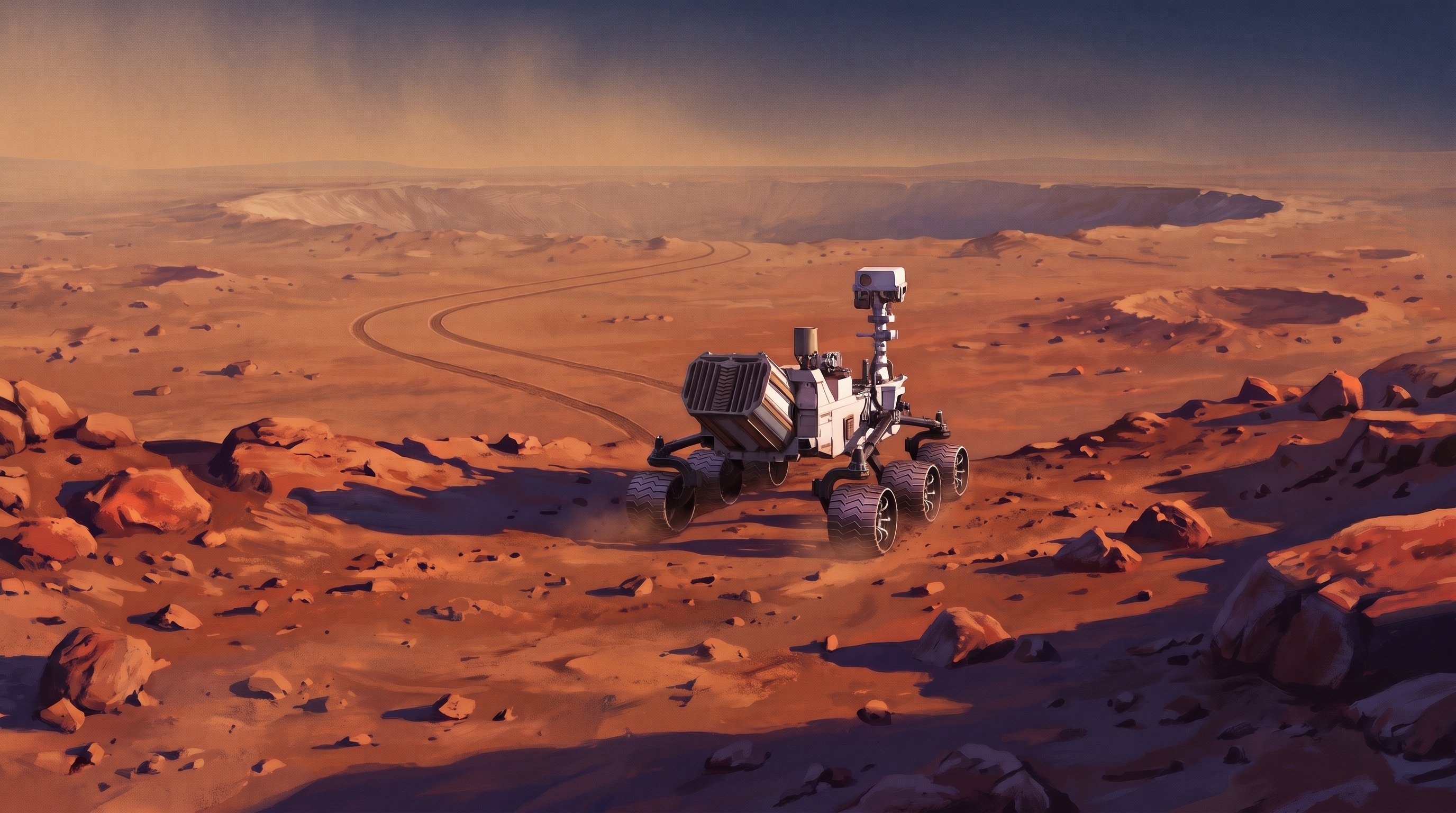
NASA's Mars rover Perseverance set a record on 11 October 2026. That day its counter stood at 45.22 kilometres: never before has a vehicle driven so far on another planet or moon. The previous record belonged to its predecessor Opportunity, with 45.16 kilometres. Opportunity took almost fifteen years to do that, from 2004 to 2018. Perseverance needed about five and a half years. Its twin on Earth, which the team uses to try out drives, received a certificate from Guinness World Records for it.
The records on the Moon are also well behind it. The Soviet lunar rover Lunokhod 2 drove 39 kilometres in 1973, and the Apollo 17 astronauts covered almost 36 kilometres with their lunar car in 1972.
Driving without a driver
You cannot steer a Mars rover live with a joystick: a signal from Earth takes minutes to arrive. That is why people on Earth choose points on the map where the rover has to go. Perseverance does most of the driving between those points itself, with its navigation system AutoNav.
It works like this: while driving, the rover takes pictures of the terrain in front of it. From these it builds a three-dimensional map on which it recognises rocks, holes and steep slopes. It then chooses a safe route itself. According to NASA's Jet Propulsion Laboratory (JPL), which built and operates the rover, it processes 600,000 measurement points with every look. The first Mars rover, Sojourner, did this in 1997 with 20 points and drove about 100 metres in total.
Perseverance drove more than 90 per cent of the distance on its own in this way. For the rovers Spirit and Opportunity, the first with AutoNav, it was about 5 per cent. On a single Martian day, Perseverance can cover up to 412 metres. That it has come this far is much more than was originally intended: the mission was designed for at most about 20 kilometres of driving.
More and more on its own
The team keeps improving the rover. After thousands of test drives on the computer, Perseverance may now drive on slopes of up to 24 degrees, and 20 centimetres of space under its belly is enough. It also received better software to brake for rocks, may send almost twice as much power to its steering motors, and estimates in advance how much its wheels will slip.
A clever idea: the rover now works out by itself where it is. It compares its own pictures of the ground with maps that satellites made from above, a kind of GPS for a planet without GPS. For this it uses the fast computer from the base station of the small helicopter Ingenuity, which travelled with the rover. That computer was not built to withstand the radiation on Mars. The team therefore wrote software that catches memory errors caused by radiation. The team is also studying how generative AI can help plan the route of long journeys for the rover.
In search of very old rocks
Perseverance is now driving through the area Lac de Charmes, just outside the western rim of Jezero crater. Rocks about 4 billion years old lie there. The rover is on its way to a place called Idubi, where the researchers hope to find traces of ancient hot springs. Later it will drive to Rainbow Falls, a block of old crust 100 metres wide that was pushed up when the crater was formed by an impact.
So far, the rover has collected 29 samples of rock and soil. Among them is the rock Cheyava Falls, with possible traces of past life. How these samples will ever reach Earth is still open: in early 2026 the US Congress stopped funding the mission that was to collect them. Japan, meanwhile, is working on bringing back soil from a moon of Mars.
NASA has extended Perseverance's mission until about the end of 2028. Project manager Steven Lee expects the rover to extend its record considerably in the coming years. The team is also working to make sure that bright sunlight in its navigation cameras no longer hinders the rover. At the moment it has to stop in the middle of the afternoon when it is driving towards the sun.
What does this mean for the road to the singularity?
Robots that make their own decisions in the real world are an important step towards smart machines that take work off our hands. Perseverance shows that this can work reliably for years, in a place where nobody can step in if something goes wrong. The share of the distance that a Mars rover drives by itself rose from 5 per cent for its predecessors to more than 90 per cent now. Every step in this makes future robots on Mars, the Moon and on Earth more independent and faster. The next step is already lined up: a rover that checks for itself where it is along the way and can keep driving even towards the sun.
What is the technological singularity? Read the explanation →