Nederlands
New membrane breaks down more than 90 per cent of six types of PFAS in water
Researchers at Arizona State University do not just remove PFAS from water, they also break the substances down. Their palladium membrane kept this up for almost two months. The next step is to make the system cheaper and larger.
PFAS are also known as 'forever chemicals'. They are found in firefighting foam, non-stick coatings and water-repellent clothing, and they hardly break down in nature. They are a well-known problem in soil and water, also across Europe.
Water companies can already remove PFAS from water, for example with activated carbon or very fine filters. But then the substances end up in the filter or in a concentrated waste stream. They have been moved, not removed.
A team led by Bruce Rittmann of Arizona State University (ASU) has now found a way to really break down PFAS in water. The research was published in the journal PNAS on 19 October 2026. Researchers from Rice University, the National University of Singapore and the Chinese universities Tongji and Nanjing also took part.
Why PFAS are so tough
The strength of PFAS lies in the bond between carbon and fluorine. That is one of the strongest bonds in chemistry. It is why PFAS repel water and grease so well, but also why they last so long. According to Rittmann, the usual methods for breaking down pollution do not work on them.
A straw full of hydrogen
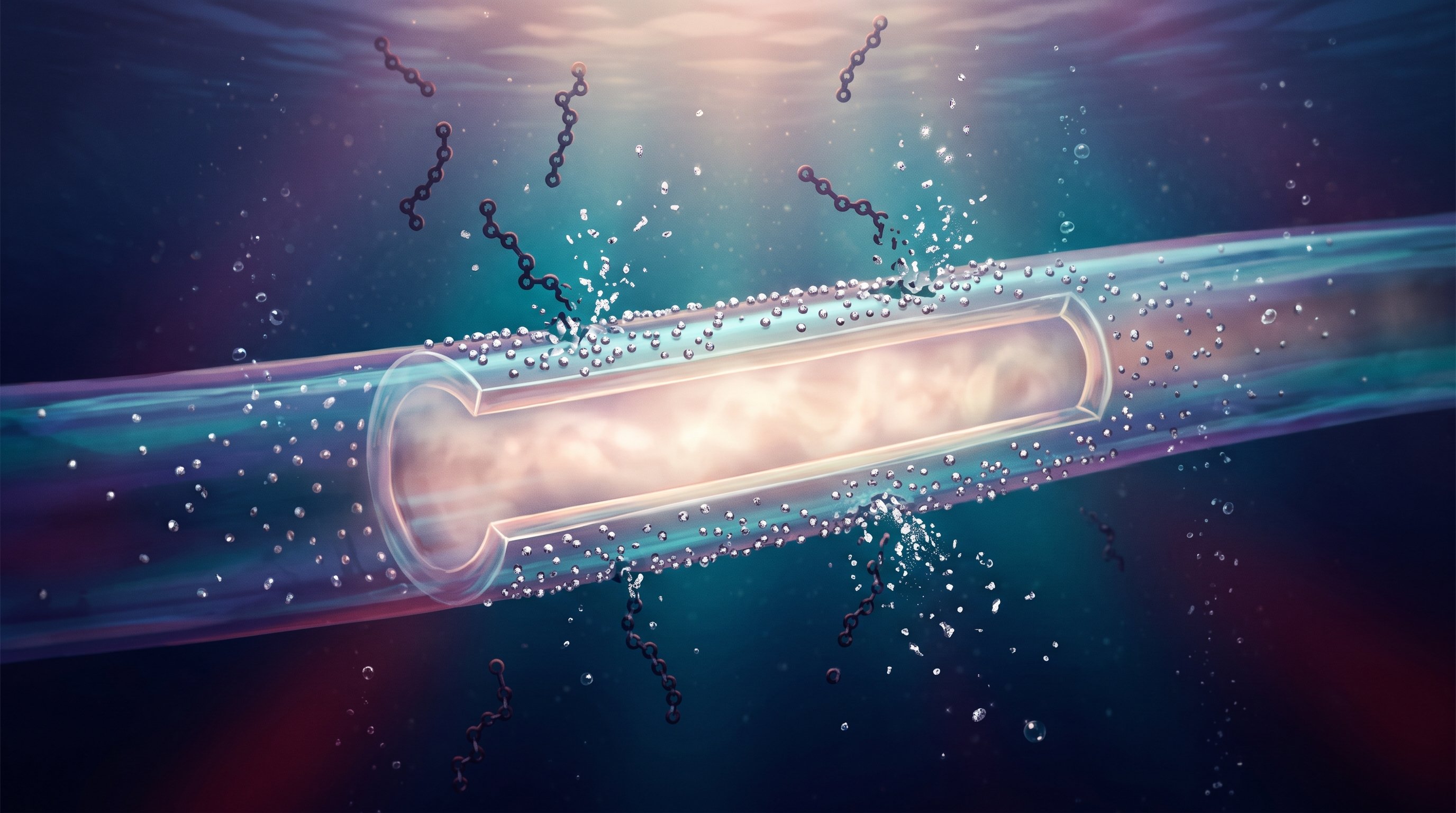
The new system consists of thin, hollow fibres, a kind of very small straw. Hydrogen gas flows under pressure through the inside of the fibres. The gas passes through the wall to the outside.
On the outside is a layer of tiny grains of the precious metal palladium. This metal acts as a catalyst, a substance that helps a reaction along: it splits the hydrogen gas into separate, highly reactive hydrogen atoms. PFAS in the water around the fibres stick to the palladium. There, the reactive hydrogen atoms cut the fluorine loose from the carbon. What remains are simpler substances.
Almost two months in a row
The researchers ran the system non-stop for 58 days on water containing six PFAS that regulators are concerned about. More than 90 per cent of each of those six substances disappeared. Of all the fluorine in those substances, about 83 per cent was released.
The idea builds on earlier work by the same group. In that work, the membranes supplied hydrogen to bacteria that break down pollution. In this research, the palladium does that work.
The next steps
Palladium is expensive: according to Rittmann, about 50,000 dollars per kilo (about 44,600 euros). Using less palladium is therefore the first aim of the follow-up research. Technical work is also still needed to make the system large enough for a water treatment plant.
The researchers see a clever combination. Existing filters first remove PFAS from large amounts of water and collect them in a small waste stream. The new membrane then breaks down that waste stream. The group is also working on membranes that combine palladium with bacteria that break down PFAS. According to Rittmann, that too works in early tests.
What does this mean for the road to the singularity?
Cleaning up what previous generations left behind is also part of a better future. This research shows that 'forever' chemicals do not have to stay forever: with the right catalyst they can be broken down, and for almost two months in a row.
The biggest challenge now is a cheaper catalyst than palladium. That is exactly where AI can help. AI models are increasingly searching huge numbers of possible materials for candidates with the right properties, and can draw on knowledge from chemistry, biology and water technology at the same time. In this way, the step from a lab experiment to an affordable installation at a water company could become a good deal shorter.
What is the technological singularity? Read the explanation →