Nederlands
Old CDs, Lego bricks and packaging become a sponge that pulls water from the air
Chemists at the University of Vienna turn plastic waste into a sponge that captures water vapour from the air, even when the air is dry. With a little heat, for example from the sun, the water comes out again. The next step is to test how long the material lasts.
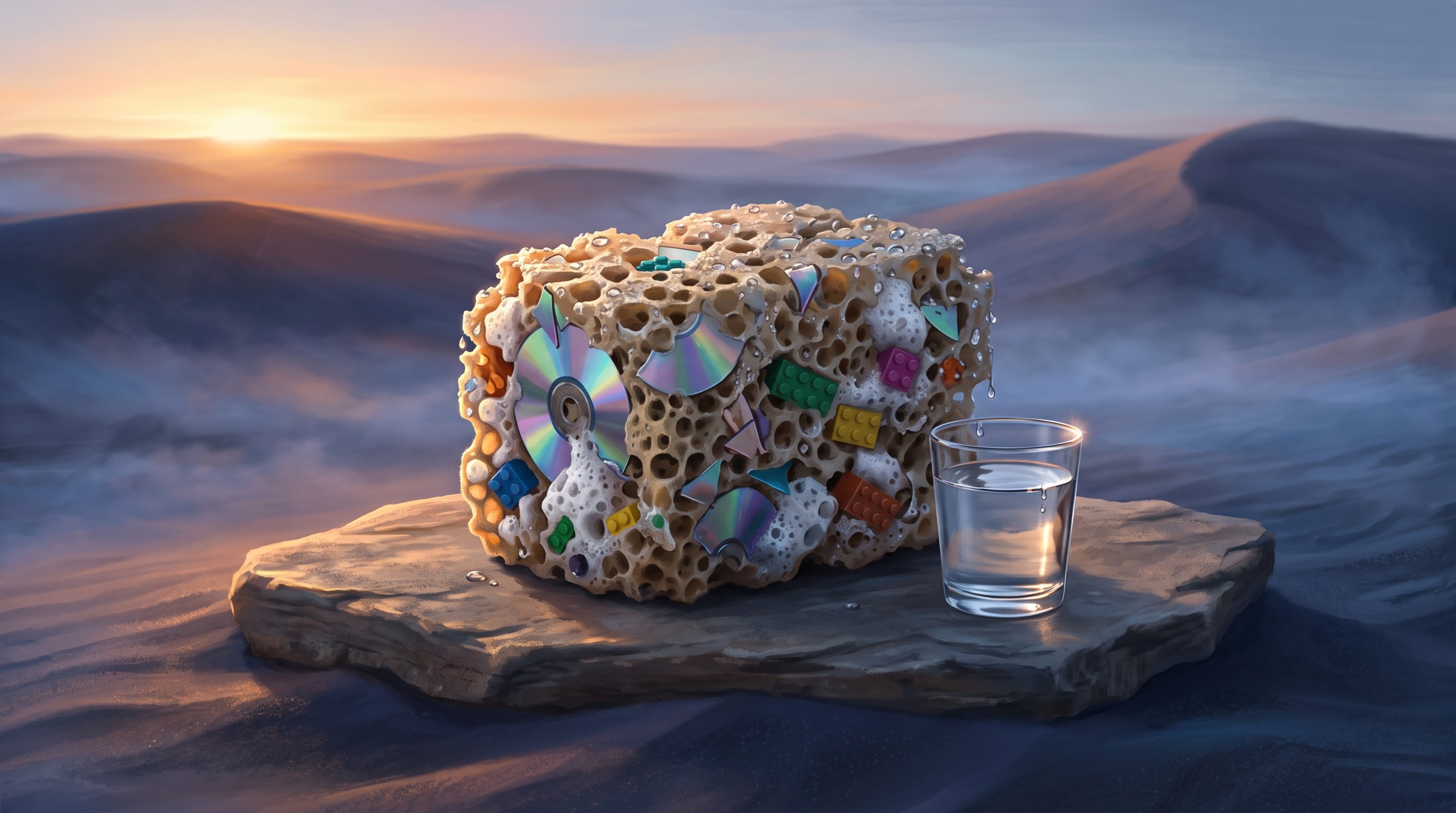
In many places on Earth, clean drinking water is scarce. Yet there is always water in the air, even above a desert: as invisible water vapour. Researchers all over the world are working on materials that can capture that vapour. Such a material works like a sponge: it soaks up moisture at night and releases it again during the day, when the sun warms it.
Chemists at the University of Vienna have now made such a sponge from plastic waste. They used packaging made of polystyrene (the plastic of yoghurt pots and foam packaging), old CDs and Lego bricks. A mixture of different kinds of plastic waste also worked. The team of materials chemist Robert Woodward, with Anastasiia Naryshkina and Paul Schweng, described the method on 14 October in the journal Chem Circularity.
From waste to sponge
The plastics the researchers used are built from long chains with ring-shaped building blocks. Those rings can be tied to each other, so that the plastic becomes a firm network full of tiny cavities. The result looks like a kitchen sponge, but with holes that are many thousands of times smaller: as a result, there is a huge amount of surface inside.
The researchers then treat the network with sulphuric acid. This attaches small groups to the surface that strongly attract water. This way the plastic, which normally repels water, becomes a material that actually pulls moisture out of the air.
A big advantage is that the plastic does not first have to be broken down completely into its building blocks. The waste is converted in one go. And because mixed waste also works, it does not have to be carefully sorted first.
How much water does it deliver?
The polystyrene sponge worked best. In humid air, it absorbed almost 60 per cent of its own weight in water. So one kilo of sponge then holds more than half a litre of water. In dry air, such as in a desert, it was about 20 per cent of its weight. Most of the water went in, and came out again, within an hour.
Only a little heat is needed to get the water out. Above 60 degrees Celsius it goes quickly, but with a stream of dry air it already works at 30 to 45 degrees. In dry, sunny regions, the sun could do that work. The sponges could take up and release water several times in a row without working any worse.
Two problems at once
Other materials that pull water from the air already exist, such as the metal-organic frameworks for which the Nobel Prize in Chemistry was awarded in 2025. According to the researchers, many of those materials are expensive or take a lot of energy to make. Their sponge made from waste could be cheaper, and cleans up plastic at the same time. Woodward sees it as a way to tackle two big environmental problems at once: plastic waste and water shortage.
So far the work has been done in the lab. The researchers are now looking at how long the sponges last and how much raw material and energy it takes to make them. For use in practice, it also needs to become clear how well it works with constantly changing waste, whether the liquids used can be reused and how to build the sponge into a device. According to the team, the material could also be useful for energy storage and cleaning gases.
What does this mean for the road to the singularity?
Pulling water out of the air with waste: it shows how clever chemistry can turn a problem around. What used to be rubbish becomes a raw material. Discoveries like this often come from combining fields, here recycling and water harvesting.
AI can come to play a big role in that. A large language model knows the literature on plastics, on desert climates and on water purification at the same time. It can suggest connections that stay out of sight for a single specialist, for example which other waste streams would suit such a sponge. AI is also already helping in the search for new materials, for example by predicting how crystals are built. If that kind of help comes together with the work of teams like the one in Vienna, the path could become faster from a promising experiment to devices that actually deliver water where it is needed most.
What is the technological singularity? Read the explanation →