Nederlands
Laser flash turns plastic into trillions of tiny diamonds
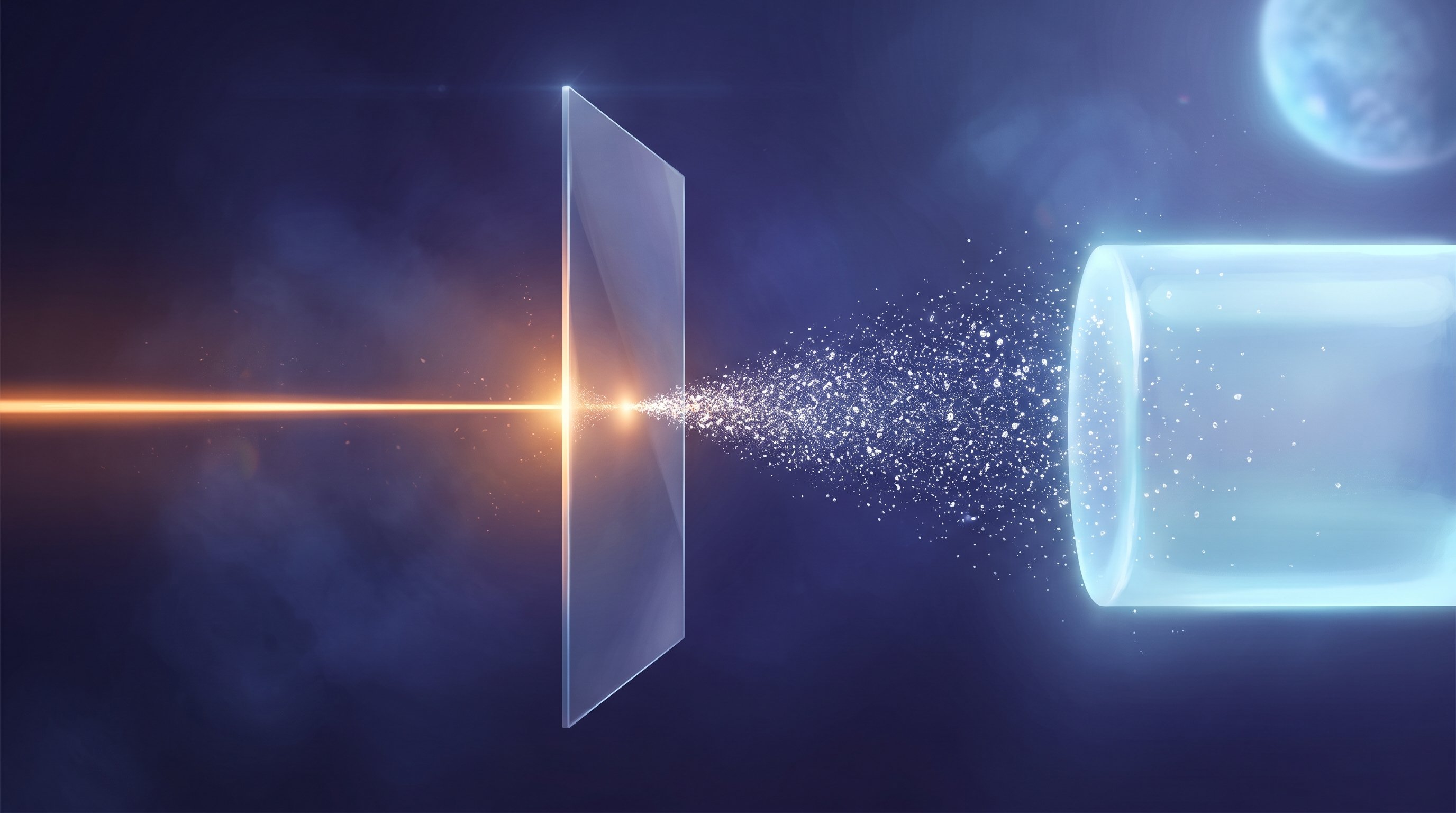
German physicists fire a powerful laser at a thin sheet of the plastic that soft-drink bottles are made of. Each flash produces about 10 trillion tiny diamonds averaging 3 millionths of a millimetre, almost all the same size. The next step is making enough of them to work with.
Diamond makes you think of jewellery, but most diamond is used for grinding and polishing. The smaller the grains, the more you can do with them. Nanodiamonds are the smallest grains there are: more than 20,000 of them fit side by side across the thickness of a hair.
Researchers from the German research centre Helmholtz-Zentrum Dresden-Rossendorf (HZDR) and the University of Rostock have found a new way to make them: with a laser flash on a sheet of plastic. Their diamonds are 3 nanometres in size on average (a nanometre is a millionth of a millimetre) and each consists of about 3,000 carbon atoms. What is special is that they are almost all the same size. The research appeared at the end of August in the journal Diamond and Related Materials; the institutes announced it in mid-September.
Why tiny diamonds are useful
Nanodiamonds are hard, strong and highly resistant to heat. Today they are mainly used in grinding and polishing products. Researchers see many more possibilities. They can serve as very sensitive sensors, as a contrast agent that makes MRI scans in hospital clearer, or as a helper substance that speeds up chemical reactions. One example of the latter is breaking down CO2 with sunlight. Because the grains are so small, together they have an enormous surface on which such a reaction can take place.
At the moment, nanodiamonds are usually made by setting off explosives in a sealed vessel. This produces grains of around 5 nanometres, which clump together. Afterwards they have to be boiled in hot acid for one or two days to remove soot and metal residues. Controlling precisely how big the grains become does not work well this way. According to the German researchers, their laser method can do that, and it also produces cleaner diamonds.
From plastic to diamond in a flash
The team worked with PET, the plastic that soft-drink bottles are made of. PET consists largely of carbon, and diamond is nothing but carbon with its atoms in a very tight pattern. If you squeeze the plastic hard enough, the carbon atoms can arrange themselves into diamond.
The experiments took place at ELI Beamlines, a large laser institute just south of Prague. There, a powerful laser fired three times a minute at a foil 0.1 millimetres thick, each time at a new spot. Each flash drives a shock wave through the foil. For a moment the pressure is about a million times as high as the air pressure around us. In that fraction of a second, the diamonds form.
When the shock wave reaches the back of the foil, the diamonds are flung into the empty space at more than 10 kilometres per second. That is more than 36,000 kilometres per hour, as fast as a meteorite. To catch them intact, the team used a cylinder with a soft gel that dissolves in water. The diamonds land in it softly enough not to break. The researchers then dissolved the gel, purified the diamonds and examined them with an electron microscope at the University of Rostock that can make individual atoms visible. That way they saw the diamonds with their own eyes for the first time. Lead author Ben Heuser, who did the experiments for his PhD research, calls it a milestone the team had worked towards for a long time.
It started with Neptune and Uranus
The idea comes from astronomy. Deep inside the ice giants Neptune and Uranus, it is thousands of degrees hot and the pressure is millions of times higher than on Earth. Diamonds may form there and sink inwards like rain. The group of physicist Dominik Kraus, who now heads HZDR's institute for high-energy physics and is a professor in Rostock, has been recreating those conditions with lasers and plastic for years. In 2022 the researchers, together with colleagues in the United States, showed that nanodiamonds form in PET within a few billionths of a second.
According to Kraus, the team did expect diamond to form, but it happened so fast that they started thinking about a practical use. One question then remained open: do the diamonds stay intact once the pressure and heat disappear again? With this experiment, the answer is yes.
The next steps
One flash produces about 10 trillion diamonds, but because they are so small, together they weigh very little. A hundred flashes produced a few hundred micrograms, a few tenths of a milligram. That is enough to study them properly. The goal is to make milligrams at a time, just like the current method. It helps that lasers are being developed for nuclear fusion research that can fire much more often per second and use energy more efficiently. The more often the laser flashes, the more diamonds are produced. Further experiments in Rostock and at large laser institutes have to show this.
An extra advantage: during production, other kinds of atoms can be built into the diamonds. That way you can make them suitable for a specific task, for example as a sensor or as a contrast agent.
The team is also looking beyond diamond. In November a first experiment is planned to make BC8, a form of carbon that so far exists only in calculations. BC8 would be more compact than diamond, about as hard, but less likely to break. On Earth it cannot form naturally.
What does this mean for the road to the singularity?
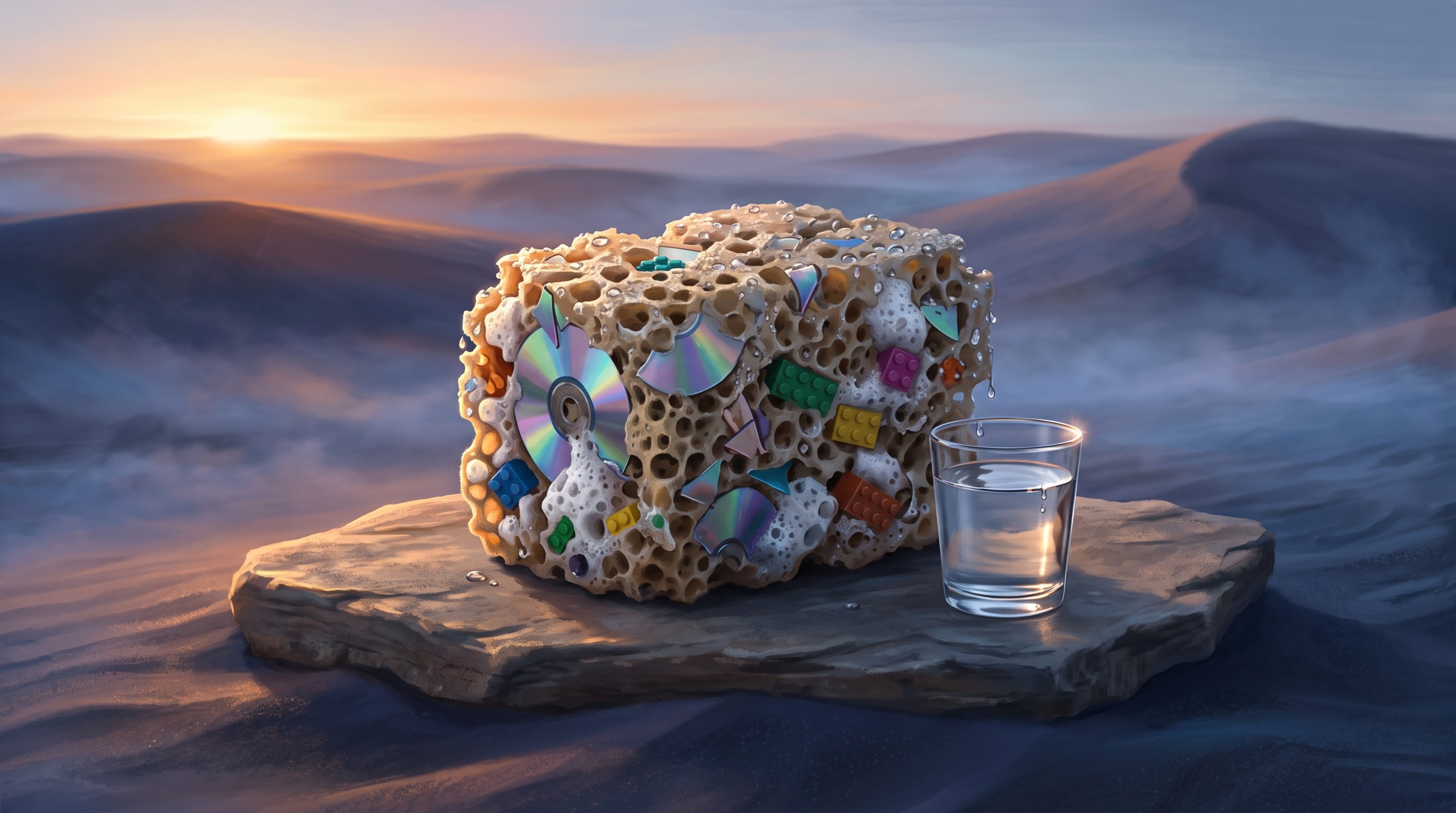
This research nicely shows how progress sometimes comes from an unexpected direction. What began as a question about the interior of distant planets is now becoming a way to make a useful material more cleanly and more precisely. Plastic is a raw material for something new here, just as with chemists who turn plastic waste into a sponge that pulls water from the air.
Exactly such links between fields are something AI is getting better and better at. A planetary scientist does not readily think of contrast agents for MRI, and a doctor does not think of the inside of Neptune. Large AI models have knowledge of all those fields at once and can spot such bridges sooner. AI can also help with the next step: calculating which laser settings and which built-in atoms give the best diamonds for a particular task, so that fewer experiments are needed. If production can be scaled up, tiny made-to-measure diamonds come within reach, from super-sensitive sensors to cleaner ways of breaking down CO2.
What is the technological singularity? Read the explanation →