Nederlands
One-gram wireless microscope follows thousands of brain cells in freely moving mice
Chinese researchers built a one-gram microscope that a mouse wears on its head. Without cables, it films the activity of more than 8,500 brain cells at once while the mouse walks around, swims and interacts with other mice.
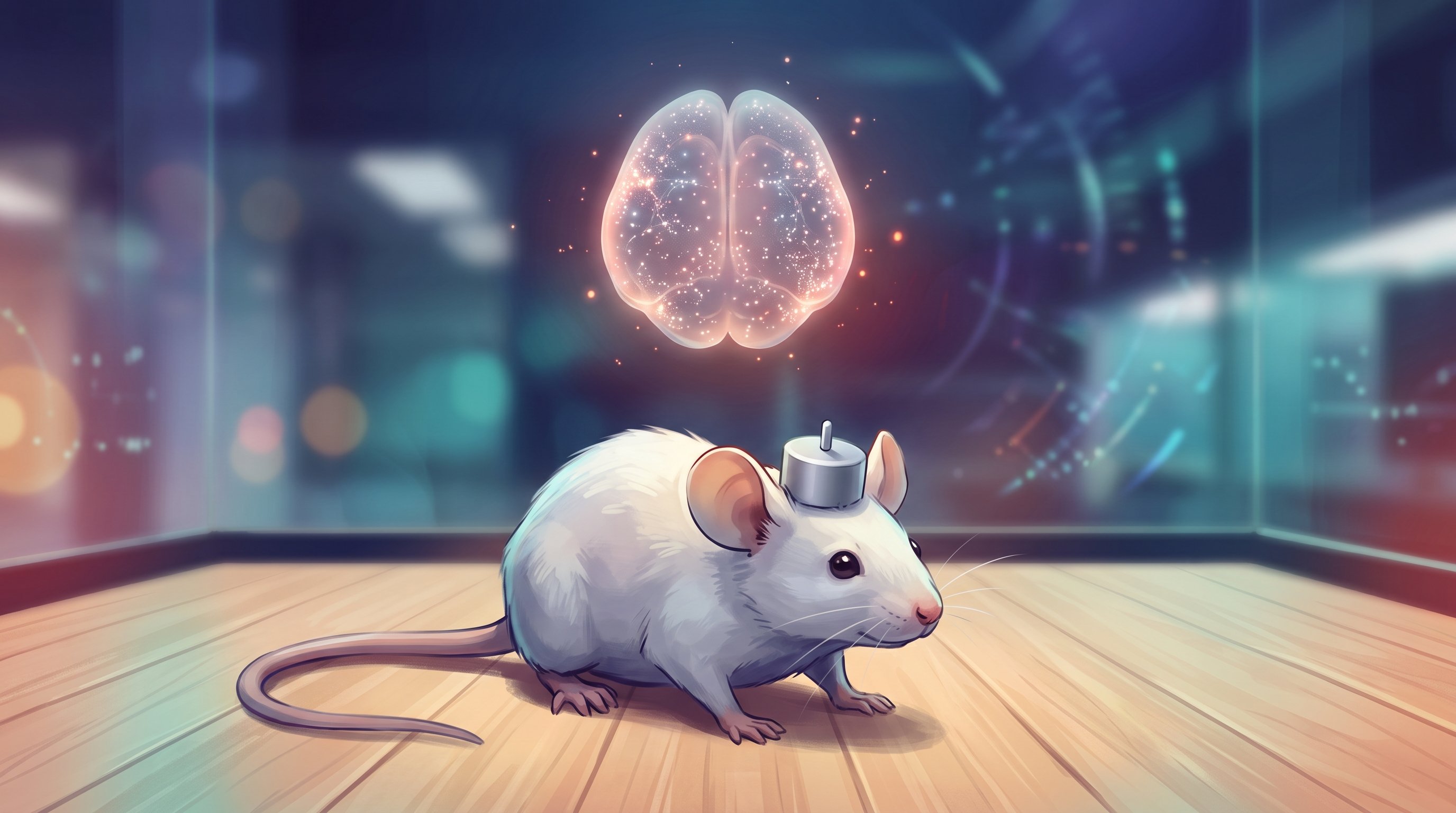
Anyone who wants to understand how the brain works would ideally like to see what brain cells do while an animal behaves normally. That is difficult. The best microscopes are large and heavy, so the animal has to lie still with its head fixed. Small microscopes that a mouse can wear on its head already exist, but they are usually attached to a cable or see only a small part of the brain.
Researchers at Tsinghua University in Beijing have now built a microscope that solves both problems. It is called Airscope, weighs about one gram, as much as a paperclip, and works without wires. They describe it on 19 October in the scientific journal Nature, together with Fudan University and Princeton University, among others.
A large part of the cerebral cortex in one image
The microscope looks through a small window in the skull at the top of the cerebral cortex. That is the outer layer of the brain, where things such as seeing, feeling and moving are processed. The image is 6 millimetres wide. In a mouse, that is a large part of the top of the brain. Even so, it is sharp enough to tell individual brain cells apart.
The mice's brain cells have been modified so that they light up when they are active. The microscope takes 12.5 images per second and sends them wirelessly. This way, the researchers saw the activity of more than 8,500 brain cells at once in each mouse. Thanks to a clever lens design, the device is almost three times shorter than earlier small microscopes, while according to the team it sees as many cells as large microscopes on a lab bench.
Mice that can simply be mice
Because there is no cable, the mice could walk around freely in a spacious enclosure of 2.3 by 2.3 metres, swim and interact with each other. The researchers even followed five mice at once, together accounting for more than 21,000 brain cells. An AI system recognised in the video footage what each mouse was doing, without first having to be trained specially for it.
That produced valuable insights. In the cerebral cortex, the researchers saw activity patterns linked to the social ranking among the mice. From the brain activity of two mice, they could even predict which of the two would win a contest. They also saw patterns related to where a reward lay in a maze. And because the small microscope also fits on the spinal cord, they could follow the brain and spinal cord at the same time. While a mouse learned to be afraid of something, the spinal cord seemed to steer the cerebral cortex, and not only the other way round.
Next steps
The research was done in mice whose brain cells had been specially modified to light up. The microscope sees the top of the cerebral cortex, not the deeper parts of the brain. According to the researchers, Airscope now makes this kind of measurement in freely moving animals practical and within reach of many laboratories. Other teams can use it to study social behaviour, learning and memory.
What does this mean for the road to the singularity?
Brain research and AI have been helping each other forward for decades. The first neural networks were loosely based on brain cells, and now AI helps to understand what animals do while their brains are being filmed. With thousands of cells at once in freely moving animals, huge amounts of data are produced. AI in particular can find patterns in it that people overlook.
Anyone who better understands how real brains learn, work together and make decisions can also draw new ideas for AI from that. In the longer term, this knowledge helps with brain implants and with treatments for brain diseases. A one-gram microscope brings all of that a little closer.
What is the technological singularity? Read the explanation →