Nederlands
OpenAI data centre will cut its power use by up to 1,000 megawatts when the grid is in trouble
OpenAI promises that its new data centres will use less electricity when the power grid is under strain. The first one, in the US state of Georgia, can cut up to 1,000 megawatts. A British trial showed that AI computers can do this quickly.
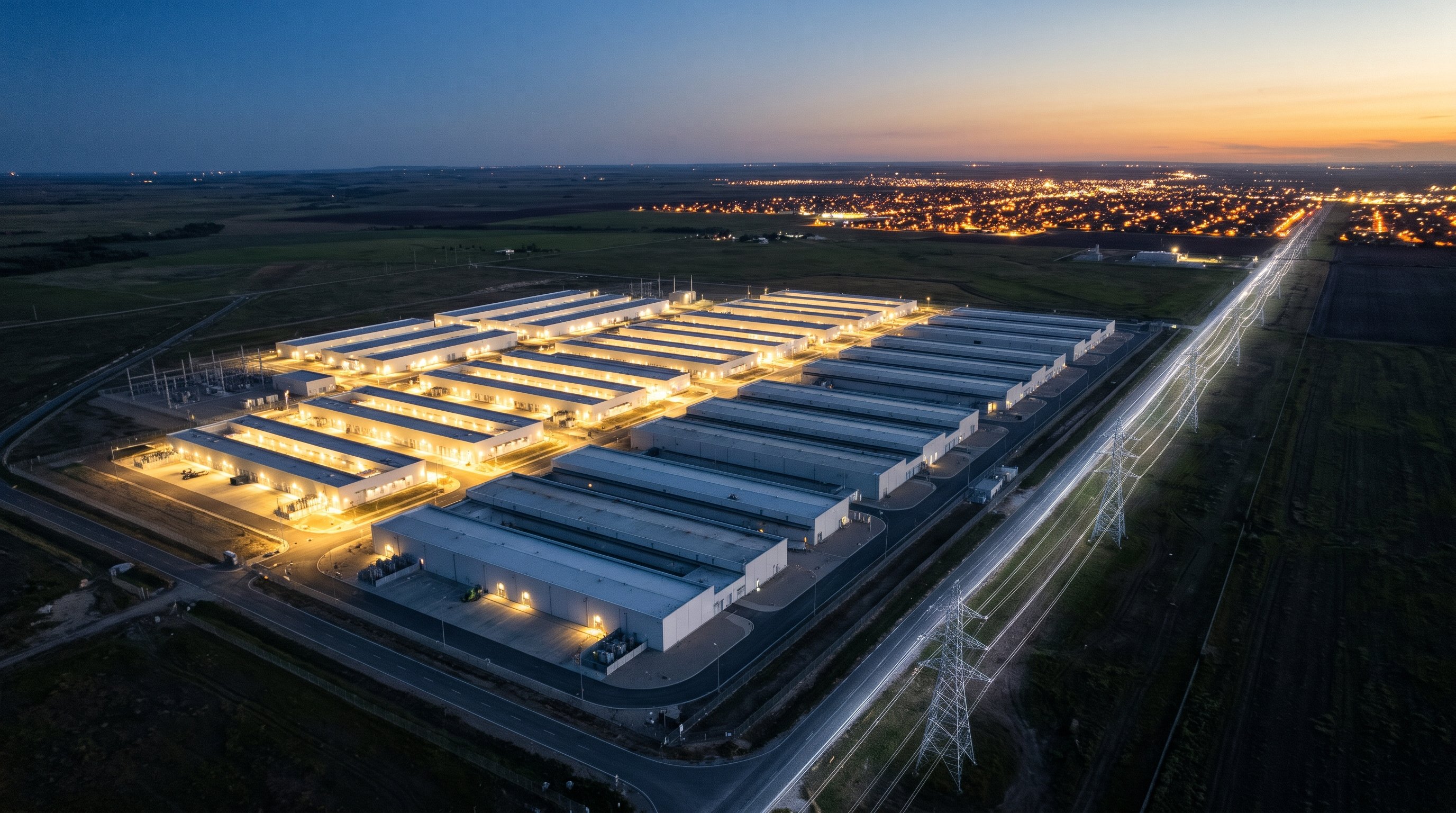
AI data centres use enormous amounts of electricity. In the United States, demand is growing so fast that power companies have to build new power stations and high-voltage lines. The hardest moment for the grid is a peak: a heatwave in which everyone switches on the air conditioning, or a large power station that suddenly fails. At such a moment, consumption has to go down somewhere, or a blackout threatens.
OpenAI, the maker of ChatGPT, wants to help with this. On 2 November 2026, the company started the Grid Protectors Program. The commitment: every large data centre that OpenAI builds itself will use less electricity when the grid is in difficulty. OpenAI agrees the exact terms with each power company separately.
First data centre in Georgia
The first project is a planned data centre in Effingham County, about 45 minutes by car from the city of Savannah in the state of Georgia. According to the power company Georgia Power, it needs about 3,200 megawatts. In a 25-year contract, OpenAI has agreed that Georgia Power may reduce the supply by up to 1,000 megawatts in busy periods. That is almost a third of what the data centre uses. According to OpenAI, this equals the average electricity use of about 700,000 American households.
Georgia Power announced the contract in July and called it one of the largest agreements of this kind for a single building in the United States. OpenAI pays all the costs of the connection and the electricity supply itself, so that other customers do not have to pay for it. According to Georgia Power, such agreements mean the company has to build fewer new power stations, which saves customers money in the long run. In future, OpenAI also wants to use its own generation and batteries at some data centres when the grid needs help.
British trial: AI computers can scale back quickly
An earlier trial in London showed that such a data centre can really scale back quickly. In December 2025, the grid operator National Grid ran a five-day test together with the American company Emerald AI, the research institute EPRI, the cloud company Nebius and the chipmaker NVIDIA. They used 96 powerful NVIDIA AI chips in a new Nebius data centre.
The researchers sent more than 200 simulated emergency signals to the data centre. According to National Grid, the system responded to every signal and consumption fell by up to 40 per cent, while the important work carried on. In a test that imitated the failure of a large power station, consumption dropped by 30 per cent within about half a minute. A reduction could also be kept up for as long as ten hours.
It works because not all the work of an AI computer is equally urgent. Answers that a user is waiting for carry on as normal. Work that can wait, such as training a new AI model or testing it, is done more slowly for a while or paused. When the grid is calm again, that work picks up by itself. Emerald AI wants to use the same approach in a data centre of almost 100 megawatts that NVIDIA is building in the state of Virginia.
Caveats
OpenAI itself says that flexible consumption is not a replacement for new power stations and high-voltage lines. It is an addition. According to the technology site Tech Times, critics point out that separate agreements between one company and one power company are checked less strictly than the official schemes monitored by the American energy regulator. How much the promise is worth therefore depends on how well it can be enforced later.
The subject is sensitive. According to a Gallup poll from March 2026, 71 per cent of Americans are against an AI data centre in their own neighbourhood. In July 2026, the state of New York became the first state to introduce a pause of up to one year on permits for large new data centres.
What does this mean for the road to the singularity?
For the growth of AI, chips are no longer the only problem: more and more often, there is simply not enough electricity. This agreement shows that an AI data centre can also help the grid, by quickly taking a step back at busy moments. If that works on a large scale, new data centres can be connected faster without overloading the grid. The next step is for OpenAI to make such agreements at its other data centres too, and for them to work in practice, not only in a trial.
What is the technological singularity? Read the explanation →