Nederlands
Physicists use entangled light to check where someone is
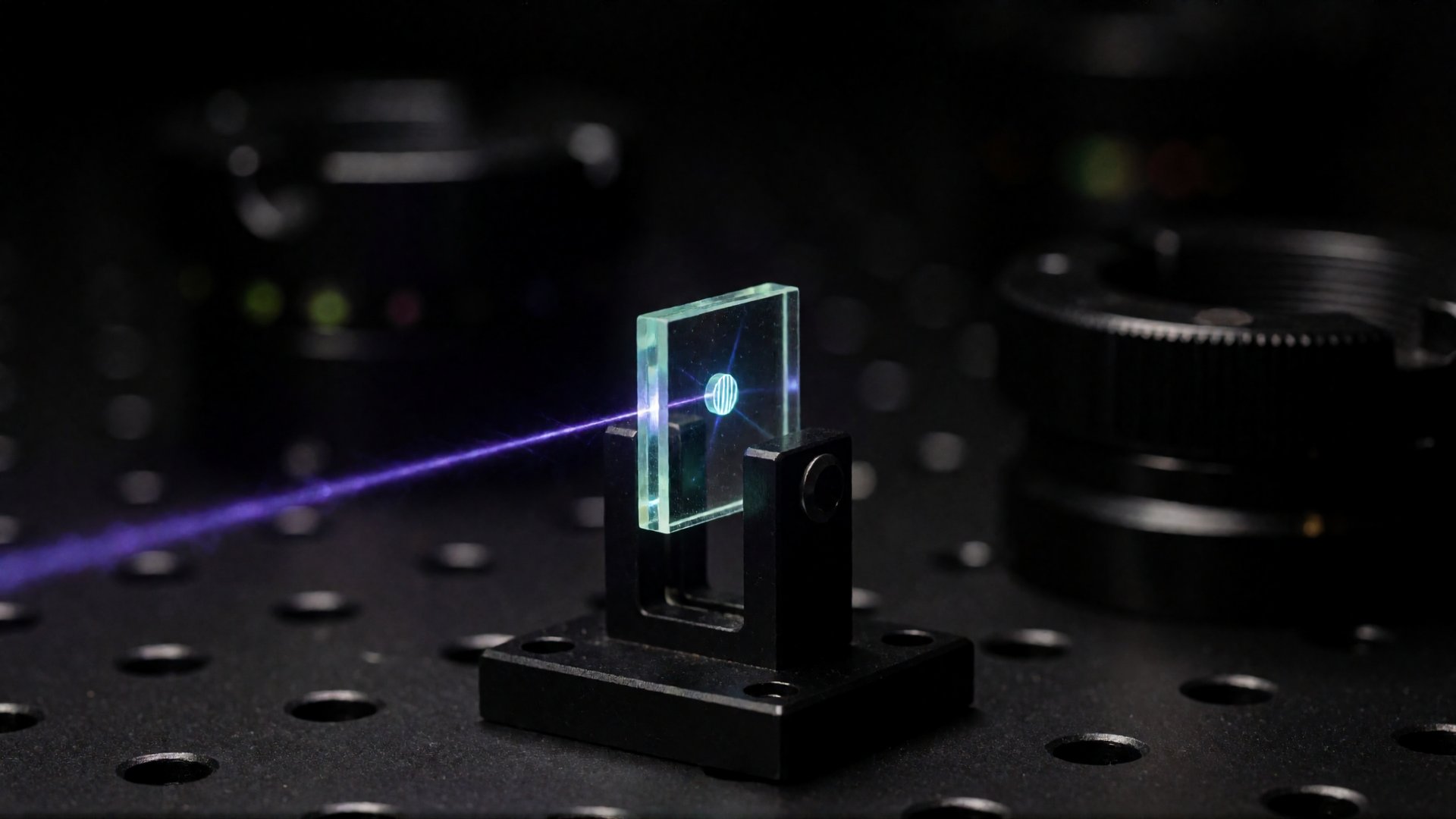
Physicists at the US institute NIST and partners in Spain and elsewhere have shown in full for the first time that entangled particles of light can verify where someone is, without having to trust the equipment. Practical use is still about ten years or more away.

Anyone who logs in to a bank or controls a power grid from a distance usually proves who they are: with a password, a code or a fingerprint. It is much harder to prove where someone is. A location signal can be faked, and earlier quantum methods only worked if you trusted the equipment or assumed that an attacker had little computing power.
Physicists at NIST, the US National Institute of Standards and Technology, have now carried out the first complete experiment with a method that works without those assumptions. The team, led by NIST physicist Krister Shalm, worked with partners including the University of Colorado Boulder, the Spanish company Quside and the research institute ICFO in Barcelona. The research was published in Nature ; a first version appeared online in January 2026.
How the experiment worked
On the NIST campus in Boulder, Colorado, the team built two checking stations, 195 metres apart and connected by cables and thin optical fibres. Between them sat the party that had to prove it was at a stated location.
Each time, one of the stations created a pair of entangled particles of light: particles whose measurement results are more closely linked than ordinary physics allows. The station kept one and sent the other to the party being checked. At the same time, both stations sent random numbers, timed so that they arrived at the stated location at exactly the same moment. Those numbers decided how the party had to measure the particle of light. The result went straight back.
Two things make cheating impossible. The first is time: information cannot travel faster than light. Anyone sitting somewhere else receives the numbers later and so answers too late. The second is the link between the measurements. The stations checked it with a Bell test: a statistical test that shows whether measurement results are so closely linked that only real entanglement can explain them. Any fault in the equipment, or any tampering with it, weakens that link, and then the test fails. So the stations do not need to trust the quantum devices: the measurement results themselves are the proof. The team repeated this step millions of times in a few minutes.
This worked because the NIST detectors caught almost every photon, or particle of light. If too many particles of light are missed, the Bell test cannot be passed. The team also used a fast, efficient source of entangled particles of light that NIST developed earlier.
More precise than without quantum physics
According to the researchers, they pinned down the location along one direction about 2.5 times more precisely than the best method without quantum physics, and that method does not even work at a distance. Compared with non-quantum methods that answer just as fast, the area within which the party had to be was more than 4.5 times smaller.
There is one caveat. According to the authors, the general protocol can cope with lost signals and with attackers who have substantial quantum resources. In the experiment itself, they tested a version that is secure against attackers who share only very little entanglement with each other in advance. NIST physicist Scott Glancy expects that practical use may take more than ten years. That requires quantum networks that reliably share entangled particles of light on a large scale, for example between a customer and their bank.
What does this mean for the road to the singularity?
Today we prove online who we are, but never where we are. That is exactly the gap used by fraudsters who pose as a colleague on a video or phone call, and by attackers who try to take over a water treatment plant or power grid from far away. If a system can demand proof that an instruction really comes from the control room itself, a stolen password or a faked voice matters much less. That becomes more important as AI gets better at imitating people: a voice or a face is getting easier and easier to fake, but the speed of light is not.
The method also changes who you have to trust. Today a bank trusts the chip in your phone, and therefore its maker. Here nobody has to trust the equipment, because physics itself provides the proof. If quantum networks grow in the coming years, such a location check could become an ordinary building block of secure connections, for banks and hospitals just as much as for the local grid operator.
What is the technological singularity? Read the explanation →